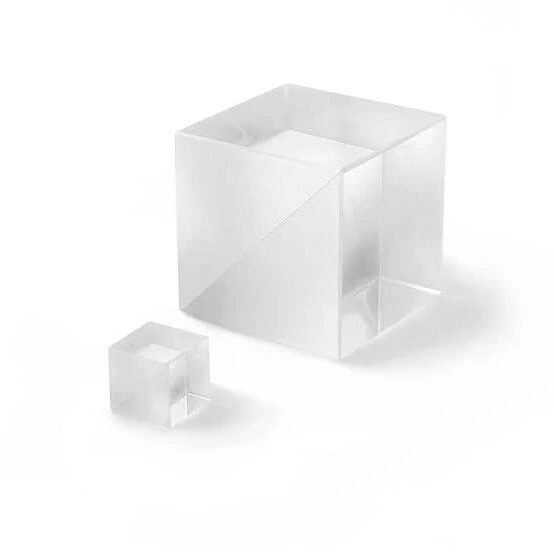
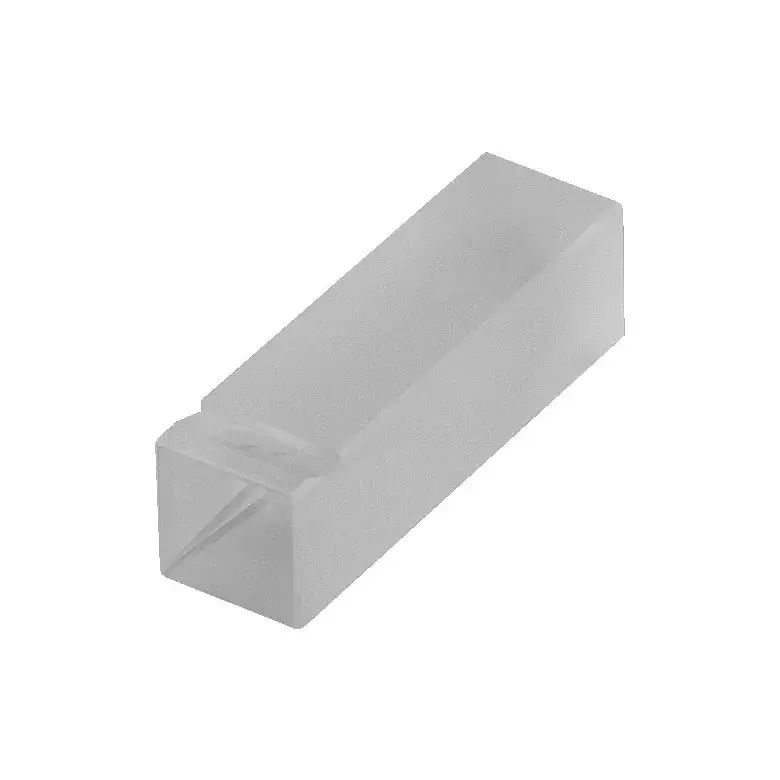
Beamsplitter Cube
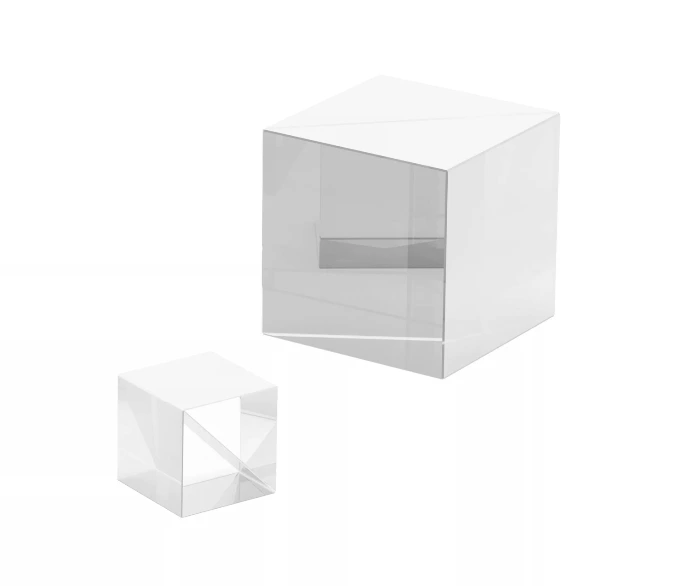
Two right angle prisms cemented together with a precision thin-film coating on the hypotenuse interface — splitting an incident beam into two output beams at 90° to each other. Available in non-polarizing (50:50 intensity split) and polarizing (orthogonal polarization states separated) configurations for use across virtually every optical wavelength range.
Construction
Two cemented right-angle prisms
Output geometry
Transmitted + 90° reflected
Split ratio
50:50 or polarizing
Wavefront distortion
Lower than plate BS
Overview
- Two identical right angle prisms cemented hypotenuse-to-hypotenuse with a thin-film beamsplitter coating at the interface
- Non-polarizing BSC: partially reflective multilayer coating transmits ~50% and reflects ~50% of the incident beam regardless of polarization state
- Polarizing BSC: multilayer coating transmits p-polarization and reflects s-polarization — separating the two orthogonal linear polarization states into two output beams
- The cube form eliminates the secondary displaced beam produced by plate beamsplitters — the two output beams emerge from adjacent cube faces at exactly 90° with no parallel displacement artifacts
- Available in sizes from 2 mm to 100+ mm cubes in a wide range of glass types, split ratios, and wavelength ranges
- The standard beamsplitter element in laser interferometers, optical coherence tomography systems, polarization analysis instruments, and laser power monitors
Key Features
Dual-output beam splitting
Produces two output beams — a transmitted beam continuing along the input axis and a reflected beam at exactly 90° — from a single compact element. Both outputs emerge from flat polished faces with equal path length through glass, minimizing differential wavefront error between the two channels compared to plate beamsplitter geometries.
Polarization beam splitting (PBS)
A polarizing beamsplitter cube transmits p-polarization with >99% efficiency and reflects s-polarization with >99% efficiency — achieving extinction ratios of 500:1 to 2000:1 in precision grades. This is the standard element for polarization-based optical isolation, ellipsometry, quantum optics experiments, and laser power splitting by polarization.
Minimal wavefront distortion
The cube geometry produces equal glass path lengths for transmitted and reflected beams — unlike plate beamsplitters where the reflected beam travels less glass than the transmitted beam, producing differential optical path difference. This symmetric geometry is critical in interferometers where wavefront balance between reference and measurement arms must be maintained.
Custom split ratios
Non-polarizing beamsplitter cubes are available in standard 50:50 and custom split ratios such as 90:10, 70:30, and others — using partially reflective thin-film coating designs tailored to the required T:R ratio. Custom split ratio cubes are used in laser power monitors, optical feedback loops, and sampling beam splitters where asymmetric splitting is needed.
Design and Construction
Interface coating types
Non-polarizing (NPBS)
- Metallic coating (aluminum or chrome) — broadband; polarization-independent; lower damage threshold
- Dielectric multilayer — designed for specific waveband; higher LIDT; slight polarization dependence
- Achromatic dielectric — minimized polarization dependence over a broad spectral range
Polarizing (PBS)
- MacNeille-type multilayer dielectric — standard PBS coating; works at 45° incidence; optimized for one waveband
- Extinction ratio: standard 100:1; precision 1000:1; high-extinction 2000:1+
- Available for visible, NIR, SWIR, and UV wavebands
Specifications & tolerances
Optical performance
- Split ratio uniformity: ±5% standard; ±2% precision for 50:50 NPBS
- Surface flatness: λ/4 standard; λ/8 for interferometry
- Surface quality: 60-40 standard; 20-10 laser grade
- Transmitted wavefront distortion: <λ/4 standard; <λ/8 precision
AR face coatings
- BBAR on all four outer faces — reduces entry/exit reflection losses
- V-coat — specific laser wavelength; <0.2% reflectance per face
Optical Materials
Standard glass
Visible & NIR
- N-BK7 — most common substrate for visible BSC; excellent homogeneity; moderate laser damage threshold
- N-SF1 — used in some PBS designs for optimized MacNeille layer performance in the visible
- N-K5, N-BAK4 — used in specific PBS designs for improved birefringence-free performance
UV-grade
- UV Fused Silica — UV NPBS for 248–400 nm; low autofluorescence
- CaF₂ — deep UV PBS and NPBS below 248 nm; birefringent in some orientations
Specialty materials
NIR & SWIR
- Sapphire — UV through 5.5 µm; rugged BSC for harsh environments
- YVO₄ (yttrium orthovanadate) — highly birefringent crystal; used for polarization-based BSC in telecom
IR beamsplitters
- ZnSe — 0.5–20 µm; metallic or dielectric coating NPBS for CO₂ laser beam sampling
- Germanium — 2–12 µm; LWIR beamsplitter cubes for thermal imaging system power splitting
Wavelength Options
UV
- 248–400 nm
- UVFS / CaF₂
- UV NPBS coating
Visible
- 400–700 nm
- N-BK7
- NPBS or PBS
NIR
- 700–1600 nm
- BK7 / UVFS
- NIR PBS / NPBS
SWIR
- 1400–2500 nm
- UVFS / Specialty glass
- SWIR coatings
LWIR
- 8–12 µm
- ZnSe / Ge
- Metallic BS coat
Applications
Interferometry
Michelson & Mach-Zehnder
The standard beamsplitter in Michelson and Mach-Zehnder laser interferometers — splitting the source beam into reference and measurement arms with equal glass path lengths in both arms, minimizing chromatic and wavefront imbalance errors that degrade fringe contrast and measurement accuracy.
Imaging
Camera & sensor splitting
Non-polarizing cubes split the image-bearing beam between two cameras simultaneously — enabling simultaneous imaging of the same scene in different wavelength bands, with different neutral density levels, or onto different sensor formats for high-speed stereo or spectral imaging systems.
Laser
Beam sampling & monitoring
Low-splitting-ratio cubes (e.g. 90:10 T:R) sample a small fraction of a laser beam for power monitoring, pulse energy measurement, or wavelength monitoring — maintaining 90% throughput to the main application while providing a continuous real-time power reference signal.
Polarimetry
Polarization analysis
Polarizing beamsplitter cubes split unpolarized or partially polarized light into pure p and s polarization channels simultaneously — enabling simultaneous detection of both polarization components for ellipsometry, polarimetric imaging, and Stokes parameter measurement.
OCT
Optical coherence tomography
Polarization-maintaining and non-polarizing beamsplitter cubes form the core of OCT sample arm/reference arm splitters — the symmetric cube geometry minimizes group delay dispersion mismatch between arms that would otherwise degrade the OCT axial resolution.
Quantum Optics
Entanglement & photon splitting
50:50 non-polarizing beamsplitter cubes are the foundational element of quantum optical experiments — Hong-Ou-Mandel interference, Bell state measurements, and quantum key distribution systems all require precisely balanced 50:50 beam splitting of single photon states.
Why choose Beamsplitter Cubes
No secondary beam displacement
Unlike plate beamsplitters that produce a laterally displaced secondary reflection, cube BSs produce clean 0° and 90° beams with no ghost — critical for interferometry and polarization analysis.
Equal optical path lengths
Both transmitted and reflected outputs travel equal glass path lengths — minimizing differential dispersion and wavefront imbalance between interferometer arms.
Polarizing or non-polarizing
Available in both PBS and NPBS configurations — one compact element serves both power splitting and polarization separation functions with the same mounting geometry.
Wide spectral range coverage
Available from deep UV (248 nm) through LWIR (12 µm) in appropriate substrates and coatings — the same cube geometry covers the entire optical spectrum used in modern photonics.
Frequently asked questions
Here are some common questions about Beam Splitter.
Use a polarizing beamsplitter cube (PBS) when: the source is linearly polarized and you need maximum efficiency in one polarization channel; you need to separate or analyze polarization states; or you need high extinction ratio between the two output beams. Use a non-polarizing cube (NPBS) when: the source is unpolarized or circularly polarized; you need equal splitting regardless of polarization state; or polarization-dependent splitting would introduce measurement errors (as in OCT or white-light interferometry).
A glass plate beamsplitter produces a second reflection from its back surface — creating a secondary beam laterally displaced from and slightly angled relative to the main reflected beam. This secondary "ghost" beam interferes with the primary in interferometers and imaging systems. A cube beamsplitter's interface is internal — the cement layer on the hypotenuse has nearly the same refractive index as the glass, eliminating the back-surface reflection. The result is clean single-beam outputs with no ghost reflections.
The LIDT of a BSC is primarily determined by the interface coating. Metallic (aluminum) coating NPBS: LIDT typically 0.5–1 J/cm² at 1064 nm ns pulses — lowest. Dielectric multilayer NPBS/PBS: 5–20 J/cm² at 1064 nm — suitable for most pulsed laser applications. Cemented cubes are generally not recommended for ultrafast (fs) pulse laser systems at high fluences — air-spaced plate beamsplitters with appropriate LIDT-rated coatings are preferred for high-power applications.
Cemented beamsplitter cubes introduce group delay dispersion (GDD) from the glass and cement — typically hundreds of fs² at 800 nm — that broadens ultrashort pulses. For femtosecond laser applications, broadband chirped-mirror dispersion compensation or pre-compensation is needed, or alternatively, an air-spaced plate beamsplitter or pellicle beamsplitter should be used to minimize material dispersion. Fused silica BSC have lower GDD than BK7 versions and are preferred when a cube geometry is required.