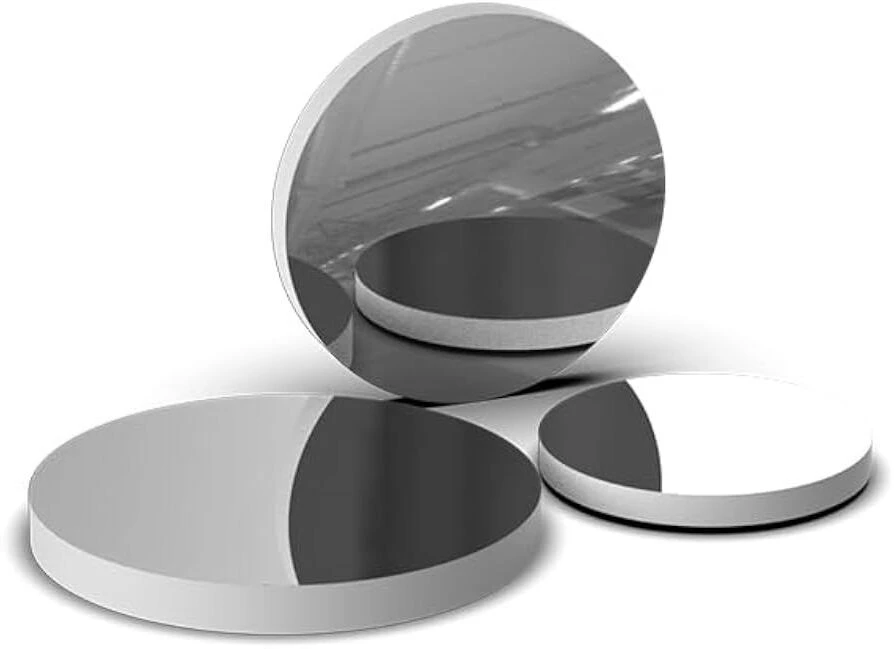
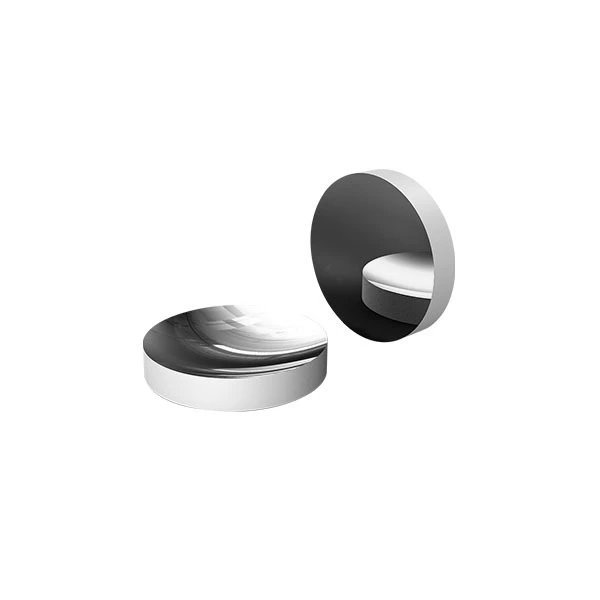
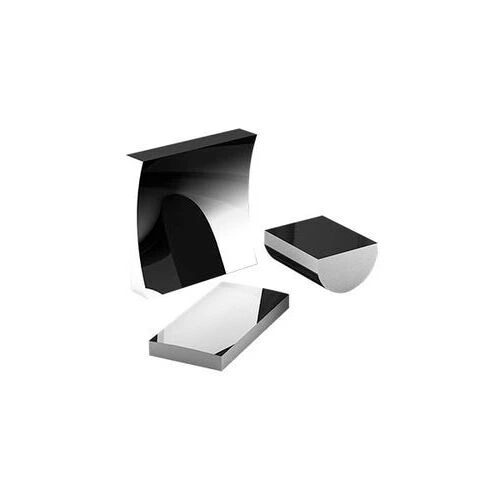
D-Shaped Mirror
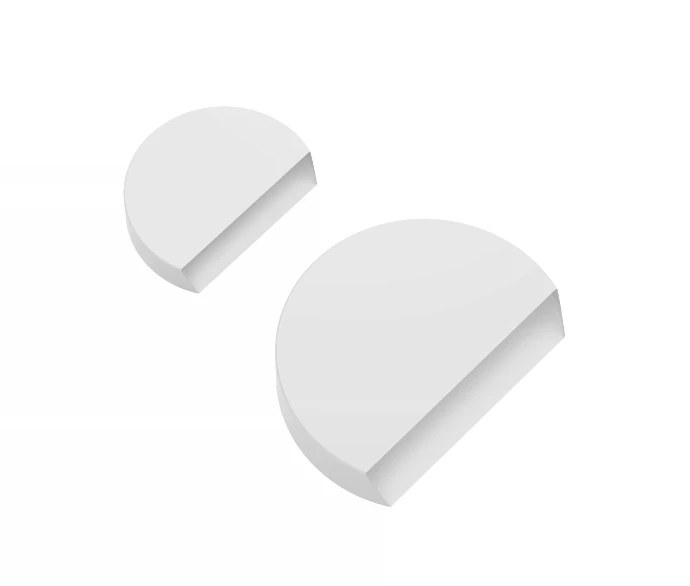
A flat mirror with one straight edge formed by cutting a circular mirror in half (or off-center) along a diameter — enabling two beams to be positioned edge-to-edge with minimal gap. The essential element for beam combining, beam picking-off, and compact multi-beam optical layouts where standard circular mirrors would require excessive spacing.
Shape
Half-circle (D profile)
Flat edge tolerance
<0.1 mm to diameter line
Function
Beam combining / pick-off
Optical power
None (flat surface)
Overview
- A flat mirror cut along a diameter (or near-diameter chord) to produce a semicircular or D-shaped profile with one straight edge
- The straight edge allows the mirror to be positioned immediately adjacent to another beam path without the dead space a full circular mirror would require
- Used in pairs or combined with another optic to pick off part of a beam while allowing the remainder to pass directly by the straight edge
- Available in half-circle (cut exactly on the diameter) and off-center D-shapes (cut at other chord positions) depending on the beam geometry required
- Edge quality (chamfer, bevel, and straightness) at the cut line is critical — a poorly finished edge introduces scatter and diffraction at the beam boundary
- Manufactured from standard circular mirror blanks — same substrate and coating options as full circular flat mirrors
Key Features
Edge-to-edge beam positioning
The straight edge allows a D-shaped mirror to sit immediately next to a second beam path with minimal gap — enabling compact multi-beam combining geometries that a full circular mirror's curved edge would prevent from achieving the same close spacing.
Beam pick-off
Used to intercept and redirect one portion of a diverging or expanding beam while leaving the rest of the beam undisturbed — common in laser systems where a small sample of the main beam must be picked off for power monitoring or alignment diagnostics without blocking the primary beam path.
Compact beam combining
Two D-shaped mirrors arranged with their flat edges adjacent can combine two separate beams into a single co-propagating output with minimal physical separation — a technique used in multi-laser combining systems and dual-channel optical instruments.
Precision edge geometry
The straight edge is manufactured to tight positional tolerance relative to the mirror's geometric center — critical for applications where the edge must align precisely with a beam boundary or with the edge of an adjacent optical component in a tightly packed beam path.
Design and Construction
Geometry & specifications
Edge specifications
- Edge straightness: <0.1 mm deviation from true diameter line standard; tighter for precision applications
- Edge position tolerance: distance from mirror center to flat edge controlled to ±0.05 mm
- Edge chamfer: small bevel applied to prevent chipping; minimized to preserve usable clear aperture near the edge
Surface specifications
- Surface flatness: λ/4 to λ/10 — same range as full circular flat mirrors
- Surface quality: 60-40 standard; 20-10 to 10-5 for laser applications
Coating options
Standard coatings
- Protected aluminum, silver, or gold — same options as standard flat mirrors
- Dielectric laser line coatings — for high-power laser beam combining applications
Substrate
- N-BK7, fused silica, or Zerodur — selected based on application thermal and precision requirements
Optical Materials
Standard materials
Visible & NIR
- N-BK7 — standard substrate for general beam combining applications
- Fused Silica — laser-grade applications requiring low thermal expansion and high damage threshold
Coatings
Reflectance options
- Protected silver — high-efficiency visible/NIR beam combining
- Protected gold — IR beam combining and CO₂ laser systems
- Dielectric laser mirrors — maximum reflectance at specific combining wavelengths
Wavelength Options
Visible
- 400–700 nm
- Protected Ag
- >97% reflectance
NIR
- 700–2000 nm
- Protected Ag
- >97% reflectance
LWIR
- 8–12 µm
- Protected Au
- >96% reflectance
Applications
Laser Systems
Multi-laser beam combining
Combines output from multiple laser sources into a single co-propagating beam — used in RGB laser projector systems and multi-wavelength laser processing heads where beams must be combined with minimal spatial offset.
Diagnostics
Beam sampling & monitoring
Picks off a small fraction of a main laser beam for power monitoring, wavelength measurement, or beam profiling without interrupting the primary beam — a common technique in laser system diagnostics and feedback control loops.
Spectroscopy
Compact monochromator layouts
Used in compact monochromator and spectrometer designs to route input and output beams in close proximity — minimizing the overall instrument footprint by allowing beam paths to pass closely alongside one another.
Interferometry
Compact interferometer layouts
Used in space-constrained interferometer designs where standard circular mirrors would require excessive beam separation — the flat edge allows tighter beam path packing within compact instrument housings.
Why choose D-Shaped Mirrors
Compact beam packing
The straight edge enables beam paths to be packed closer together than any circular mirror geometry would allow — critical for space-constrained optical system designs.
Clean beam pick-off
Provides a sharp, well-defined edge for intercepting a portion of a beam — minimizing diffraction and scatter compared to using a partial circular mirror aperture.
Same coating ecosystem as flats
Available in all the same substrate and coating combinations as standard flat mirrors — no compromise in reflectance or spectral range from the modified shape.
Frequently asked questions
Here are some common questions about achromatic lens.
Edge quality is specified by edge straightness (deviation from a true straight line, typically <0.1 mm) and edge chamfer size (the small bevel applied to prevent chipping, typically 0.1–0.3 mm). For beam pick-off applications where the edge must cleanly separate two beam paths, tighter edge straightness specifications minimize scatter and diffraction artifacts at the beam boundary.
Yes. While the standard D-shaped mirror is cut exactly on the diameter (producing a true half-circle), custom off-center cuts are available for applications requiring a specific clear aperture shape or a particular edge-to-center distance to match a specific beam geometry or housing constraint.