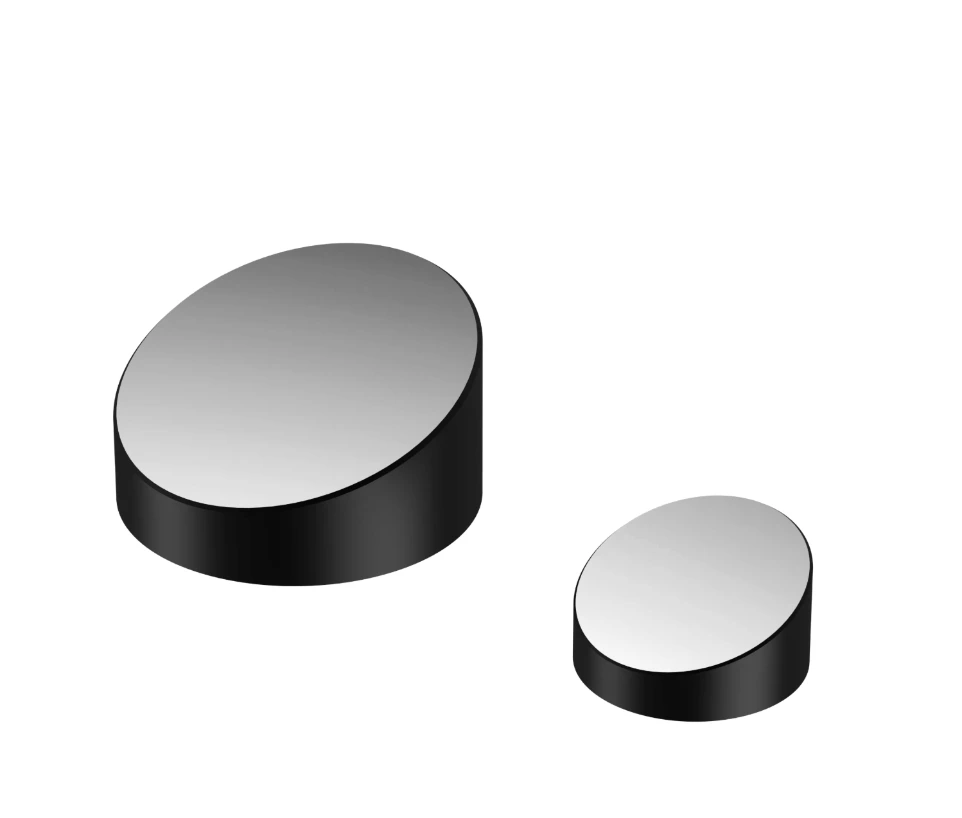
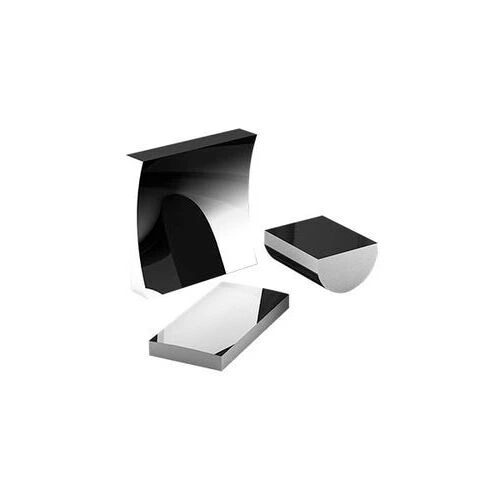
Elliptical Mirror
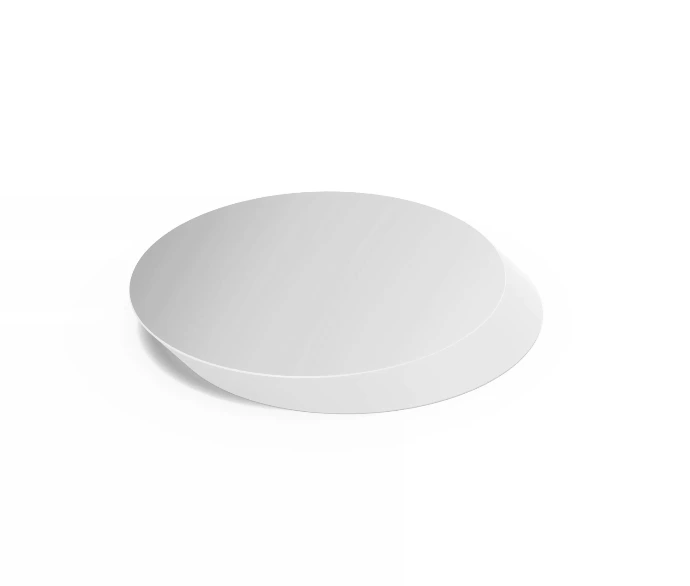
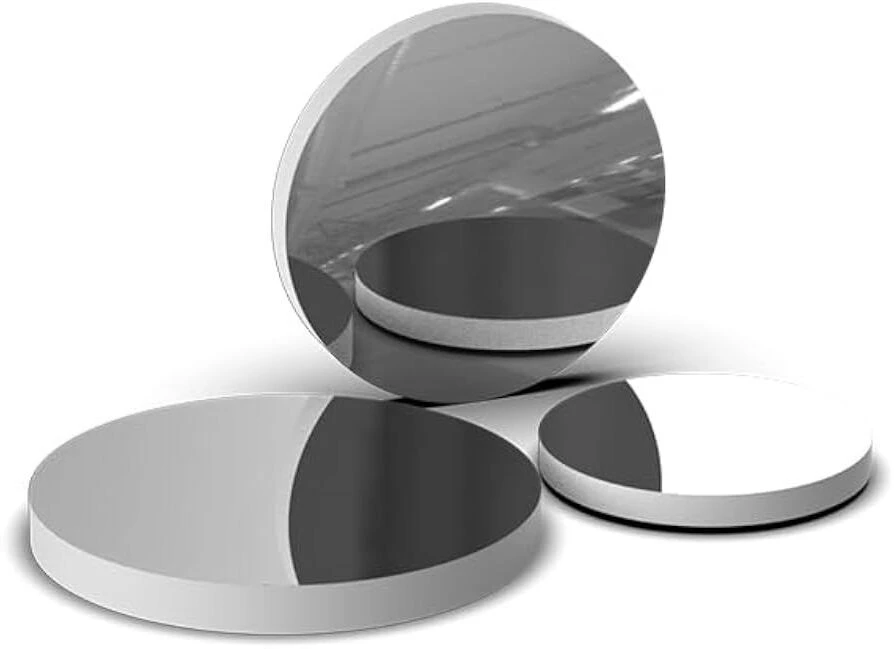
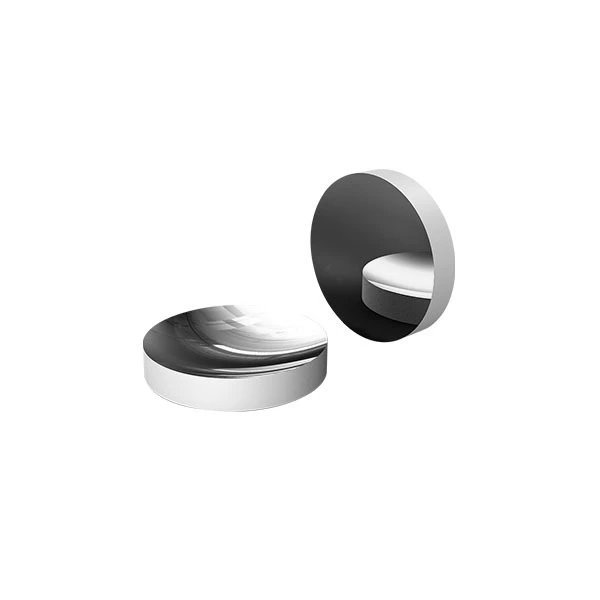
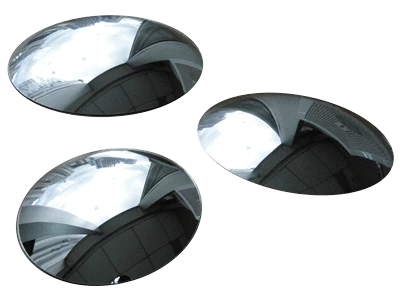
A mirror with an elliptical (or ellipsoidal) reflective surface that perfectly images one focal point of the ellipse onto the other — providing aberration-free finite-conjugate imaging for off-axis applications such as 45° beam folding with a circular projected aperture. The standard choice wherever a point-to-point relay at a fixed conjugate ratio is needed without spherical aberration.
Surface form
Ellipsoid of revolution
Function
Point-to-point relay (both foci)
Standard use angle
45° (circular clear aperture)
Aberration
Zero for conjugate foci
Overview
- A mirror whose reflective surface follows an ellipsoid of revolution — a three-dimensional surface generated by rotating an ellipse about its major axis
- An ellipse has two distinct focal points (foci) — any ray originating at one focus and reflecting off the elliptical surface passes exactly through the second focus, with zero aberration for that specific conjugate pair
- Unlike a parabolic mirror (which images one focus to infinity), an elliptical mirror images one finite focal point to another finite focal point — making it the natural choice for finite-conjugate relay applications
- Mounted at a 45° angle, an elliptical mirror's projected clear aperture appears circular when viewed along the beam axis — unlike a spherical or flat mirror at 45° which projects as an ellipse, requiring an oversized substrate
- Commonly used in pairs to relay an image or focus point through an intermediate optical path with zero on-axis aberration at each conjugate pair
- The eccentricity of the ellipse (ratio of focal separation to major axis length) determines the specific conjugate ratio and off-axis geometry of the mirror
Key Features
Aberration-free finite conjugate
For light originating at exactly one focus of the ellipse, the elliptical surface reflects every ray to converge exactly at the second focus — with zero spherical aberration, zero coma, and zero astigmatism for that specific conjugate pair, a unique property among standard mirror geometries.
Circular projected aperture at 45°
When mounted at 45° to the beam, an elliptical mirror's clear aperture, as projected along the optical axis, appears perfectly circular — eliminating the need for an oversized elliptical substrate that a flat or spherical mirror would require at the same mounting angle to capture the full beam without vignetting.
Image relay applications
Pairs of elliptical mirrors are used to relay an image or focused beam through an intermediate space (such as around an obstruction or through a vacuum chamber wall) while maintaining aberration-free imaging at each conjugate stage — a technique used in beamline relay optics and synchrotron radiation transport systems.
Design and Construction
Geometry & specifications
Key parameters
- Semi-major axis (a) and semi-minor axis (b) define the ellipse shape; eccentricity e = √(1−b²/a²)
- Focal distance from center: c = ae; the two foci are located at ±c along the major axis
- Conjugate distances (source-to-mirror and mirror-to-target) are fixed by the specific ellipse geometry chosen for the application
Tolerances
- Surface figure: λ/4 to λ/10 depending on application precision requirements
- Focal point positioning accuracy: critical — errors directly reduce coupling efficiency to the second focus
- Surface quality: 60-40 standard; 20-10 for laser and precision imaging applications
Manufacturing & variants
Manufacturing methods
- Diamond turning of metal substrates — common for IR and laser applications
- Precision glass molding or CNC polishing — for high-precision visible and UV applications
Off-axis elliptical segments
- Similar to off-axis parabolic mirrors, off-axis ellipsoid segments separate the focal points from beam obstruction
- Used in synchrotron beamline optics and X-ray grazing-incidence focusing systems
Optical Materials
Substrate materials
Standard substrates
- Aluminum — diamond-turned; common for lamp reflectors and IR collection optics
- BK7 / fused silica glass — precision polished elliptical mirrors for laser and scientific instrument applications
- Copper — high thermal conductivity; used in high-power laser pump cavity elliptical reflectors requiring active cooling
Coating types
Reflective coatings
- Protected aluminum — broadband lamp reflector and general-purpose applications
- Protected gold — IR collection optics and high-power laser pump cavities
- Dielectric high-reflectance coatings — laser pump chamber applications requiring maximum pump light coupling efficiency
Wavelength Options
Visible
- 400–700 nm
- Protected Al
- Lamp reflector grade
NIR
- 700–2000 nm
- Protected Ag/Au
- >96% reflectance
MWIR/LWIR
- 2–20 µm
- Protected Au
- >96% reflectance
Applications
Illumination
Lamp reflector housings
Elliptical reflectors behind arc lamps and filament sources collect light emitted at the first focus and concentrate it at the second focus — the standard geometry for projector lamp housings, fiber illuminator couplers, and microscope condenser light sources requiring maximum collection efficiency.
Laser Systems
Laser pump cavities
Used in flashlamp-pumped and arc-lamp-pumped solid-state laser designs — the elliptical cavity places the pump lamp at one focus and the laser gain medium (rod or slab) at the other, maximizing the fraction of pump light absorbed by the gain medium for efficient laser operation.
Spectroscopy
Sample illumination optics
Used in spectroscopic sample chambers and fluorescence excitation optics to efficiently collect and focus excitation light onto a small sample volume — maximizing signal while minimizing stray light from inefficient collection geometries.
Synchrotron
Beamline relay optics
Off-axis elliptical mirrors at grazing incidence are used in synchrotron and X-ray free-electron laser beamlines to relay and focus X-ray and EUV radiation — the aberration-free finite-conjugate imaging property of the ellipse is essential at these wavelengths where refractive optics are impractical.
Medical
Therapeutic light delivery
Elliptical reflector geometry is used in phototherapy and laser therapy delivery systems to efficiently couple light from an extended source into a treatment fiber or aperture positioned at the second focus, maximizing therapeutic light delivery efficiency.
Solar
Solar collector optics
Used in some solar concentrator and solar simulator designs where finite-conjugate (rather than collimated) collection geometry is required to relay concentrated sunlight to a fixed receiver position.
Why choose Elliptical Mirrors
Zero aberration at both foci
The only mirror geometry providing perfectly aberration-free imaging between two finite conjugate points — unmatched for point-to-point relay applications.
Circular aperture at 45°
Eliminates the oversized substrate requirement of flat or spherical mirrors used at 45° — a more compact, material-efficient solution for off-axis beam folding with circular apertures.
Maximum light collection efficiency
The standard geometric solution for collecting light from an extended source and concentrating it efficiently at a target — used universally in lamp housings and laser pump cavities.
Achromatic, scalable design
Like all mirrors, free of chromatic aberration and scalable to any size — from millimeter-scale synchrotron optics to meter-scale solar collector geometries.
Frequently asked questions
Here are some common questions about achromatic lens.
A flat or spherical mirror used at 45° to a beam must have an elliptically shaped substrate to fully capture a circular beam without vignetting — because the beam strikes the surface at an angle, the projected footprint along the beam axis is foreshortened. An elliptical mirror's surface is specifically shaped (by the ellipse's geometric properties) so that when mounted at the matching 45° angle for its eccentricity, the apparent (projected) clear aperture as seen along the beam direction appears perfectly circular — eliminating the foreshortening effect and requiring a smaller, less expensive substrate for a given beam diameter.
Use a parabolic mirror when one conjugate is at infinity — collimating a point source or focusing a collimated beam, the most common case in telescopes and laser collimation. Use an elliptical mirror when both conjugates are at finite distances — relaying an image or focus point from one specific location to another specific location, as in lamp reflector housings, laser pump cavities, and beamline relay optics. The elliptical mirror is the finite-conjugate analog of the parabolic mirror's infinite-conjugate aberration-free imaging.