Equilateral Dispersing Prism
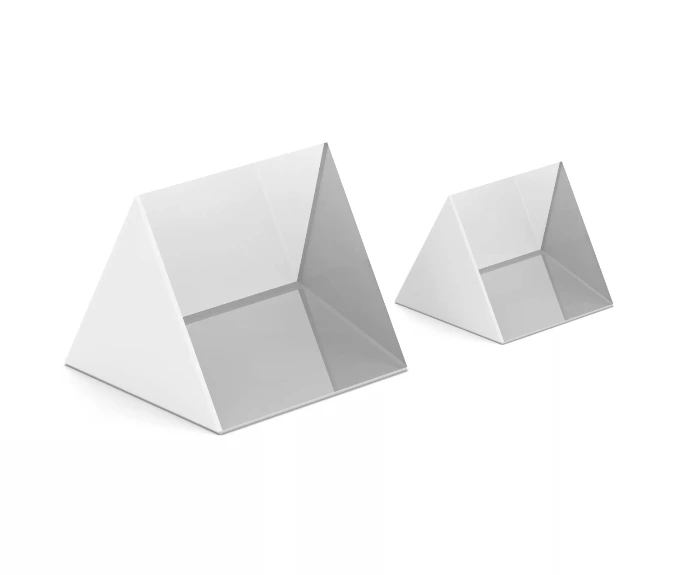
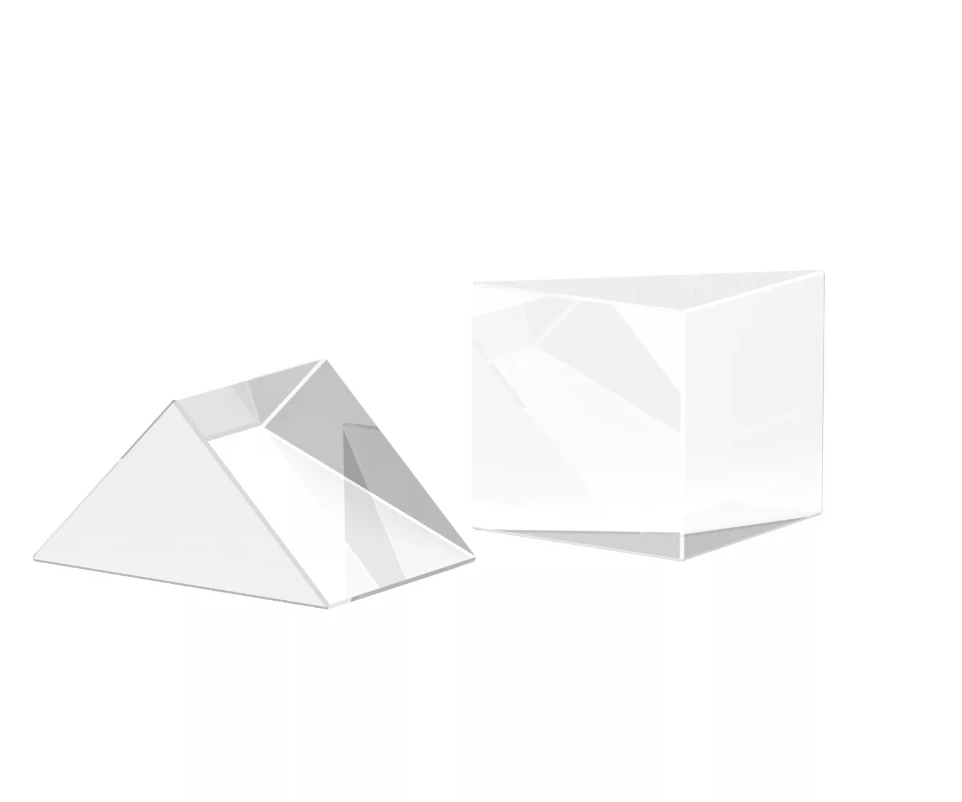
A triangular glass prism with three equal 60° angles — the classic dispersing prism used to separate broadband light into its constituent wavelengths. The workhorse of spectroscopy, laser tuning, and wavelength measurement, delivering maximum angular dispersion per unit prism size for any given glass material.
Angles
60° – 60° – 60°
Function
Wavelength dispersion
Min. deviation angle
30–50° (glass dependent)
Image effect
Disperses (no inversion)
Overview
- Equilateral triangle cross-section with all three angles equal to 60° — the simplest and most common dispersing prism geometry
- Light entering one face is refracted twice — at entry and exit — with the two refractions adding their angular dispersions for maximum wavelength separation
- At the angle of minimum deviation, the beam passes symmetrically through the prism — at this angle, dispersion is maximized and distortion minimized
- Angular dispersion is determined by the glass material's Abbe number — high-index, low-Abbe-number glass (e.g. flint glass) produces greater dispersion than low-index crown glass
- The minimum deviation condition satisfies Snell's law symmetrically — also the condition for the most accurate refractive index measurement of the glass material
- Can be used in pairs (double-pass or back-to-back) to compensate angular deviation while preserving dispersion
Key Features
Maximum angular dispersion
The 60° apex angle provides the highest angular dispersion achievable with a single-element prism for a given glass material. At minimum deviation, the two refracting surfaces both contribute equal and additive chromatic deflection — producing a wider spectral spread than any smaller apex angle prism of the same glass type.
Refractive index measurement
The minimum deviation angle of an equilateral prism uniquely determines the refractive index of the glass: n = sin[(A + δₘ)/2] / sin(A/2), where A = 60° and δₘ is the measured minimum deviation angle. This is the standard method used in glass manufacturers' quality control and in optical laboratory exercises worldwide.
Spectral line separation
Provides sufficient angular separation between spectral lines to resolve individual emission or absorption features in spectrometer instruments. The resolving power depends on the prism base width and the glass dispersion — wider prisms with higher-dispersion glass resolve finer spectral features.
Tunable laser wavelength selector
Used in tunable dye lasers and broadly tunable solid-state laser cavities as the wavelength-selective element. Rotating the prism changes which wavelength is returned to the gain medium for oscillation — providing continuous wavelength tuning across the gain bandwidth with no moving gratings or etalons.
Design and Construction
Geometry & angle control
Angle tolerances
- All three angles: 60.000° ± 1 arcmin standard; ±30 arcsec precision; ±5 arcsec spectroscopy grade
- Angle errors directly affect the deviation angle calibration of spectrometer instruments
- Parallelism of opposite edges: <30 arcsec
Surface requirements
- All three faces polished flat: λ/4 standard; λ/8 precision; λ/10 for high-resolution spectroscopy
- Surface quality: 60-40 standard; 20-10 for laser tuning applications
- Clear aperture: 80% of each face
Dispersion parameters
Angular dispersion
- Angular dispersion at minimum deviation: dδ/dλ = (dn/dλ) × (2 sin(A/2)) / cos[(A+δₘ)/2]
- Higher dn/dλ (lower Abbe number) → more dispersion
- N-SF10 (Abbe V=28): ~2× more dispersion than N-BK7 (V=64) at 550 nm
Coatings
- Uncoated — for broadband spectroscopy where AR reflection loss is acceptable
- BBAR AR — on entry/exit faces for minimum insertion loss in laser tuning use
- V-coat — single-wavelength laser prisms
Optical Materials
Low-dispersion glass (broadband)
Crown glass substrates
- N-BK7 (V=64) — standard broadband spectroscopy; moderate dispersion; excellent visible transmission
- N-BAK1 — low-dispersion crown for precise angular deviation measurements
UV-grade
- UV Fused Silica — UV spectroscopy 185–2500 nm; anomalous dispersion below 200 nm; used for excimer laser tuning
- CaF₂ — 130 nm–10 µm; for deep UV and broadband UV-IR spectral dispersion
High-dispersion glass (fine resolution)
Flint glass substrates
- N-SF10 (V=28, n=1.728) — high dispersion; standard for maximum spectral resolution applications
- N-SF11 (V=25.8, n=1.784) — highest standard dispersion; premium tunable laser prisms
- N-F2 (V=36) — intermediate dispersion; balance of dispersion and transmission
Wavelength Options
Deep UV
- 130–350 nm
- CaF₂ / UVFS
- UV-AR faces
UV-VIS
- 250–700 nm
- UVFS / N-BK7
- BBAR or uncoated
Visible
- 400–700 nm
- N-SF10 / N-BK7
- VIS BBAR
NIR
- 700–2500 nm
- UVFS / N-BK7
- NIR BBAR
Applications
Spectroscopy
Prism spectrometers
The standard dispersing element in prism spectrometers and monochromators — separating broadband light into a continuous spectrum for wavelength-resolved measurement of emission lines, absorption features, and spectral power distributions of light sources.
Laser
Tunable laser cavity
Placed inside a tunable dye laser or Ti:Sapphire laser cavity, the equilateral prism selects the lasing wavelength by feedback of only the desired wavelength back to the gain medium. Rotating the prism continuously tunes the output wavelength across the full gain bandwidth.
Education
Visible spectrum demonstration
The standard optics demonstration prism — separating white light into the visible rainbow spectrum. The equilateral form provides symmetrical, textbook-quality dispersion at the minimum deviation angle for clear, high-contrast spectrum projection.
Research
Refractive index measurement
Used in precision goniometer setups to measure the refractive index of the glass material itself — the minimum deviation angle measurement is the most accurate single-pass method for determining n to 5–6 decimal places for glass characterization.
Solar
Solar spectrum analysis
Historical solar spectrographs used high-dispersion equilateral prisms to spread the solar spectrum across a wide photographic plate — revealing the Fraunhofer absorption lines used to identify chemical elements in the solar atmosphere and establish the foundations of astrophysical spectroscopy.
Industrial
Colorimetry & quality control
Used in color measurement instruments and quality control spectrophotometers to disperse light from samples for wavelength-resolved transmittance or reflectance measurements — ensuring color accuracy in dye, paint, and materials manufacturing.
Why choose Equilateral Dispersing Prisms
Maximum dispersion
The 60° apex angle maximizes angular dispersion for any given glass — more wavelength separation per unit prism size than any smaller apex angle configuration.
Precise and measurement
The only standard prism geometry used to directly measure glass refractive index via minimum deviation — the most accurate single-element optical measurement of n available.
Tunable laser control
Simple rotation of the equilateral prism continuously tunes output wavelength of dye and broadband solid-state lasers — no grating, etalon, or servo required.
Wide material range
Available in glass spanning Abbe numbers from 25 to 64 — material selection directly controls the dispersion power to match spectrometer resolution requirements.
Frequently asked questions
Here are some common questions about Equilateral Dispersing Prisms.
The minimum deviation angle δₘ is the specific incidence angle at which the beam passes symmetrically through the prism — entering and exiting at equal angles. At this orientation: (1) the angular dispersion is maximized; (2) the wavefront distortion is minimized; (3) the refractive index can be calculated from δₘ using n = sin[(A + δₘ)/2] / sin(A/2). For spectrometer and laser tuning applications, operating at or near minimum deviation gives the cleanest spectral separation and lowest aberrations.
Prisms offer: higher throughput efficiency (no diffraction order loss — all light goes into a single transmitted beam), no higher-order overlapping (which complicates grating-based spectrometers), and better performance at UV wavelengths where grating efficiency drops. Gratings offer: higher spectral resolution for a given instrument size, linear dispersion (constant wavelength per mm), and ability to be blazed for maximum efficiency at a specific wavelength. Prisms are preferred for broadband, high-throughput spectroscopy and laser tuning; gratings for high-resolution narrow-band applications.
Angular dispersion depends on dn/dλ — the rate of change of refractive index with wavelength. A low Abbe number (high dispersion) glass like N-SF11 (V=25.8) produces significantly more angular separation between wavelengths than N-BK7 (V=64.2) for the same prism apex angle and size. For maximum spectral resolution in a spectrometer, the highest-dispersion glass compatible with the required transmission range should be used.