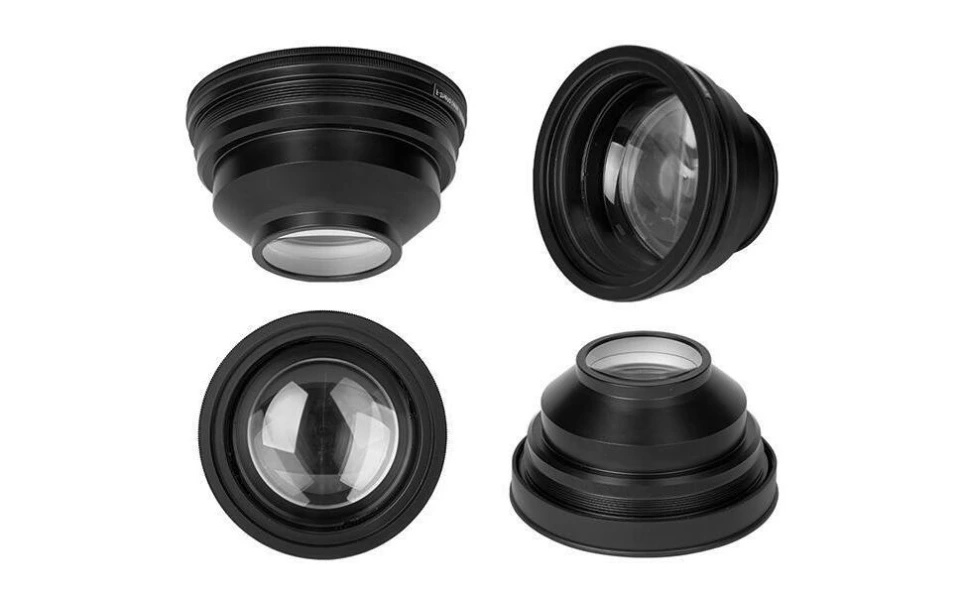
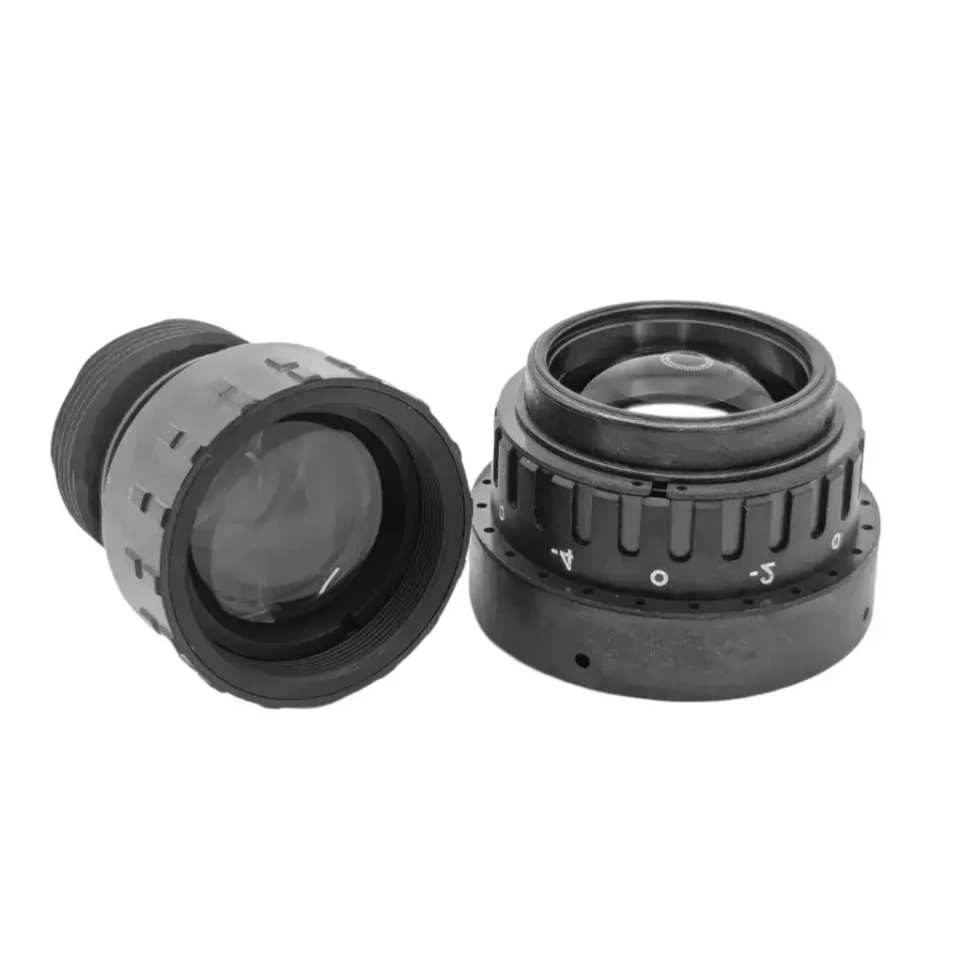
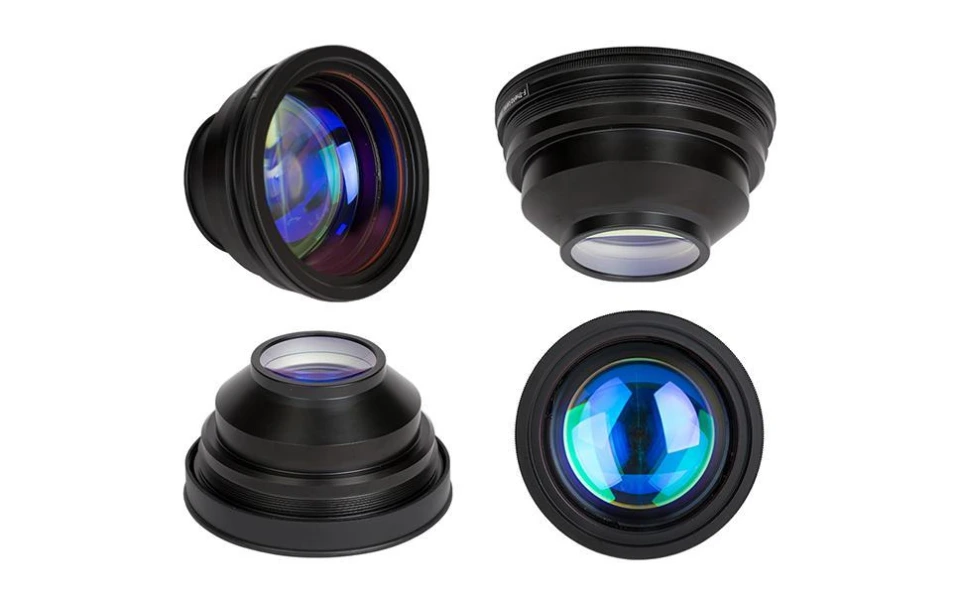
F-Theta Lens
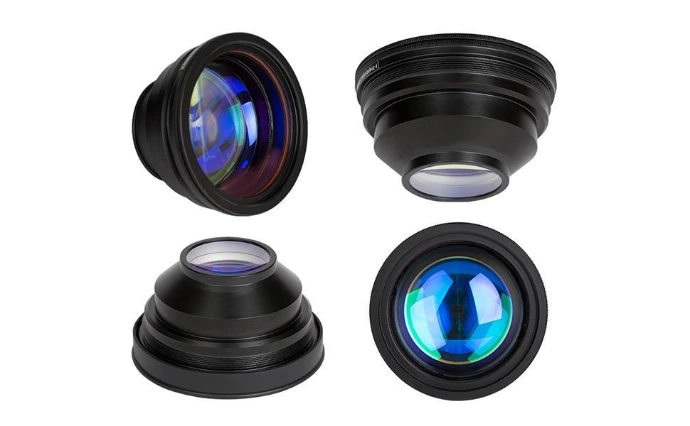
A multi-element scan lens that converts the angular motion of a galvanometer mirror into linear spot displacement across a flat field — the defining optical assembly of every laser marking, engraving, and material processing system. Engineered so spot position equals focal length times scan angle, F-theta lenses deliver flat-field, distortion-controlled focusing across the full scan area.
Function
Linear angle-to-position scanning
Relationship
Spot position = f × θ
Field type
Flat field (not curved)
Elements
Typically 3–7
Overview
- A multi-element lens assembly placed after a galvanometer scan-mirror pair to focus a moving laser beam onto a flat target plane with the focused spot position directly proportional to the scan angle: x = f·θ
- Corrects the field curvature that a simple lens would introduce when focusing a beam scanned across a range of angles — without F-theta correction, the focal plane would be a curved (spherical-like) surface rather than the flat plane required for marking or processing a flat workpiece
- Simultaneously corrects the nonlinear relationship between scan angle and image height that occurs in standard optics (which follow f·tanθ, not f·θ) — this geometric correction is what gives the lens its name and its defining "f-theta" linearity property
- Standard optical engine behind laser marking, engraving, cutting, welding, and additive manufacturing systems — wherever a galvanometer-steered beam must be focused with consistent spot size and linear positioning across a flat work surface
- Available in standard (non-telecentric) and telecentric configurations — telecentric versions additionally ensure the beam strikes the target at normal incidence everywhere in the field, at the cost of a larger lens aperture and shorter working distance relative to scan field size
- Specified by scan field size, focal length, working wavelength, and spot size — design wavelength and material selection are matched closely to the specific laser source (fiber, CO₂, UV, or ultrafast) used in the system
Key Features
Linear scan geometry
The defining property of an F-theta lens — focused spot displacement on the target plane is directly proportional to the scan mirror angle, rather than the f·tanθ relationship of a conventional lens. This linearity is essential for accurate, predictable positioning in marking, engraving, and drilling applications where the controller commands angle but the system must deliver precise linear position.
Flat-field focusing
Corrects the field curvature inherent to simple focusing lenses, bringing the focal plane into a flat surface that matches the planar workpiece — without this correction, only the center of the scan field would be in sharp focus while the edges would defocus as the beam scans outward.
Consistent spot size across the field
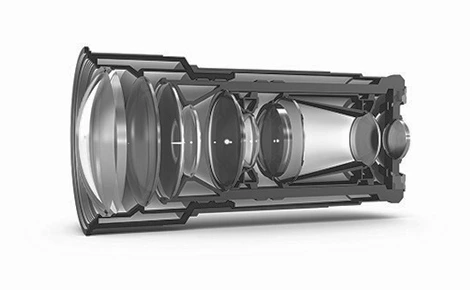
Multi-element design (typically 3 to 7 lens elements) controls spherical aberration, coma, and astigmatism across the full scan angle range — maintaining a uniform, diffraction-limited or near-diffraction-limited focused spot size from the center to the edge of the scan field, critical for uniform mark quality and process consistency.
Wavelength-matched design
F-theta lenses are optimized for a specific laser wavelength or narrow wavelength band — fiber laser (1064 nm), CO₂ laser (10.6 µm), UV laser (355 nm), and green laser (532 nm) F-theta lenses each use different glass or crystal substrates and AR coatings matched to that specific source, since a single broadband design cannot achieve optimal performance and high damage threshold across all these wavelengths simultaneously.
Design and Construction
Optical configuration
Standard (non-telecentric) F-theta
- Compact design with fewer elements (3–5 typical); smaller aperture and lower cost
- Beam strikes the target plane at varying angles of incidence away from center — acceptable for most marking and engraving
- Shorter overall lens length relative to scan field size
Telecentric F-theta
- Additional elements (5–7 typical) constrain chief rays to be parallel to the optical axis at the image plane
- Beam strikes the target at normal (90°) incidence across the entire scan field — critical for precision hole drilling and via formation
- Larger rear element aperture (must equal or exceed the scan field size) and longer working distance requirements
Performance parameters
Key specifications
- Scan field size: from tens of millimeters (micro-machining) to 600+ mm (large-format marking)
- F-theta linearity (distortion): typically <0.1% to <1% across the field depending on grade
- Spot size uniformity: controlled to within a defined percentage variation center-to-edge
- Telecentricity error (telecentric versions): typically <1–2° across the full field
Specialty variants
- Achromatic telecentric F-theta — color-corrected between the processing wavelength and a separate vision/alignment wavelength for combined processing and imaging systems
- Q-series / low-dispersion designs — minimize thermal lensing and focal shift for high-average-power and ultrafast laser sources
Optical Materials
Visible & NIR substrates
Fiber & green laser F-theta
- N-BK7 — standard substrate for 1064 nm fiber laser F-theta lenses; cost-effective, widely available
- Fused Silica — higher damage threshold and lower thermal lensing for high-power fiber laser and 532 nm green laser systems
UV & ultrafast F-theta
- UV-grade Fused Silica — standard for 355 nm UV laser F-theta lenses; low absorption, high LIDT
- CaF₂ — used in specific high-power or deep-UV F-theta designs requiring minimal dispersion
Infrared substrates
CO₂ laser F-theta
- Zinc Selenide — standard substrate for 10.6 µm CO₂ laser F-theta lenses; low absorption at this wavelength
- Germanium — used in some CO₂ F-theta element designs for specific optical power requirements
Coatings
- V-coat AR — single-wavelength, matched to the laser source; minimizes reflection loss and back-reflection-induced ghosting
- LIDT-rated coatings — for high-average-power and high-peak-power ultrafast laser F-theta systems
Wavelength Options
UV
- 355 nm
- UV Fused Silica
- V-coat 355 nm
Green
- 532 nm
- Fused Silica / BK7
- V-coat 532 nm
Fiber/NIR
- 1064 nm
- N-BK7 / Fused Silica
- V-coat 1064 nm
CO₂ LWIR
- 10.6 µm
- ZnSe
- V-coat 10.6 µm
Applications
Industrial
Laser marking & engraving
The core focusing optic in every galvanometer-based laser marking and engraving system — delivering consistent, flat-field, linearly positioned marks across the full work area for product identification, serialization, and decorative engraving.
Electronics
PCB via drilling & micro-machining
Telecentric F-theta lenses provide the normal-incidence focusing required for precise, straight-walled microvia drilling in PCB and semiconductor package manufacturing, where off-normal drilling would produce angled or elliptical holes.
Manufacturing
Laser welding & cutting
Used in galvanometer-scanned laser welding and remote cutting systems for automotive battery, electronics, and sheet metal applications, providing fast, accurate beam positioning across the work envelope without moving the workpiece.
Research
Scanning laser microscopy & OCT
Used in confocal scanning laser microscopy and optical coherence tomography (OCT) systems to scan a focused beam across the sample with the flat-field, linear-position characteristics needed for accurate image reconstruction.
Semiconductor
Wafer marking & laser annealing
Provides flat-field focusing for laser marking of semiconductor wafers and laser annealing processes, where uniform spot size and linear positioning across the wafer surface directly affect process consistency and yield.
Additive MFG
Selective laser sintering / melting
Used in metal and polymer additive manufacturing (SLS/SLM) systems to scan the laser beam across each powder layer with the flat-field accuracy required for dimensionally accurate, layer-by-layer part construction.
Why choose F-Theta Lenses
Linear scan accuracy
The only lens assembly that delivers the f·θ linear relationship between scan angle and spot position — essential for predictable, accurate galvanometer-based positioning.
Flat-field consistency
Corrects field curvature so the entire scan area stays in focus on a flat workpiece — eliminating the center-sharp, edge-soft defocus of uncorrected scanning optics.
Wavelength-optimized variants
Available purpose-built for UV, green, fiber/NIR, and CO₂ laser wavelengths — each variant matched in substrate, coating, and design for maximum performance at that specific wavelength.
Telecentric option for precision drilling
Telecentric F-theta variants guarantee normal-incidence focusing everywhere in the field — the only practical solution for precision via drilling and straight-wall micro-machining.
Frequently asked questions
Here are some common questions about F-Theta lens.
In a conventional lens, the image height for a given input angle θ follows h = f·tan(θ) — at large angles, this relationship becomes increasingly nonlinear, causing the image to compress toward the edges. An F-theta lens is specifically designed so that image (spot) height instead follows h = f·θ — a direct linear relationship between angle and position. This is the origin of the name: focal length times theta. The practical benefit is that a galvanometer scanning through equal angular increments produces equal linear position increments on the target, simplifying the control system and ensuring accurate, predictable positioning across the full scan field.
Use a telecentric F-theta lens when the application requires the laser beam to strike the workpiece at normal (90°) incidence across the entire field — critical for precision hole drilling (where off-normal incidence produces angled or elliptical holes), applications where the workpiece may not sit exactly at the nominal focal plane (telecentric designs maintain consistent spot size over a range of working distances), or any process where consistent perpendicular beam delivery affects quality. Use a standard (non-telecentric) F-theta lens for general marking and engraving where slight off-normal incidence at the field edges is acceptable — these lenses are more compact and cost-effective.
Generally no — standard F-theta lenses are optimized (substrate selection, element curvatures, and AR coating) for a specific laser wavelength or narrow band. Using a 1064 nm fiber laser F-theta lens with a 355 nm UV laser, for example, would result in poor focus quality due to uncorrected chromatic effects and the coating would not provide adequate AR performance or damage threshold at the different wavelength. For systems combining a processing laser with a separate alignment or vision wavelength, an achromatic telecentric F-theta lens specifically designed and color-corrected for both wavelengths should be used.