Fisheye Lens
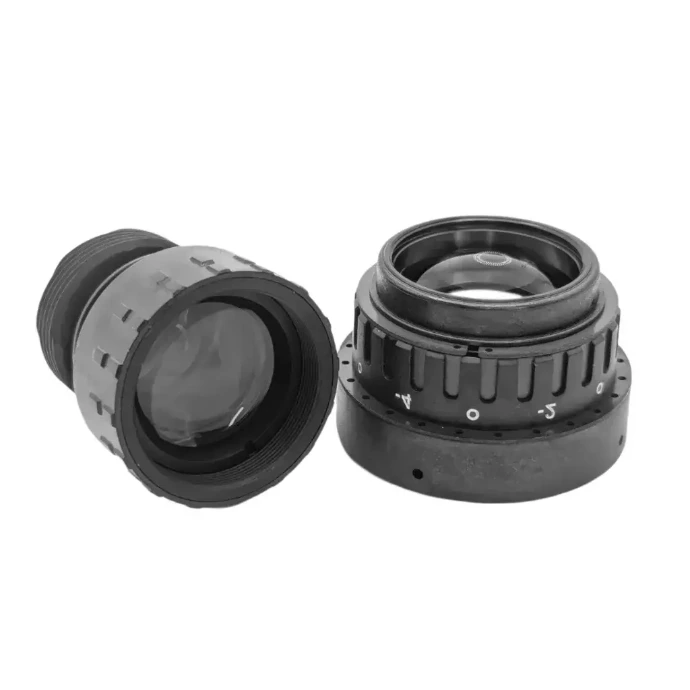
An extreme wide-angle lens assembly using a large, strongly curved front element to capture a field of view of 180° or more — deliberately accepting barrel distortion in exchange for hemispherical coverage no rectilinear lens can achieve. The defining optic for panoramic imaging, immersive content capture, and surveillance applications requiring maximum angular coverage from a single sensor.
Field of view
180° or greater
Projection types
Equidistant, stereographic, orthographic, equisolid
Distortion
Deliberate (barrel)
Front element
Large, strongly convex
Overview
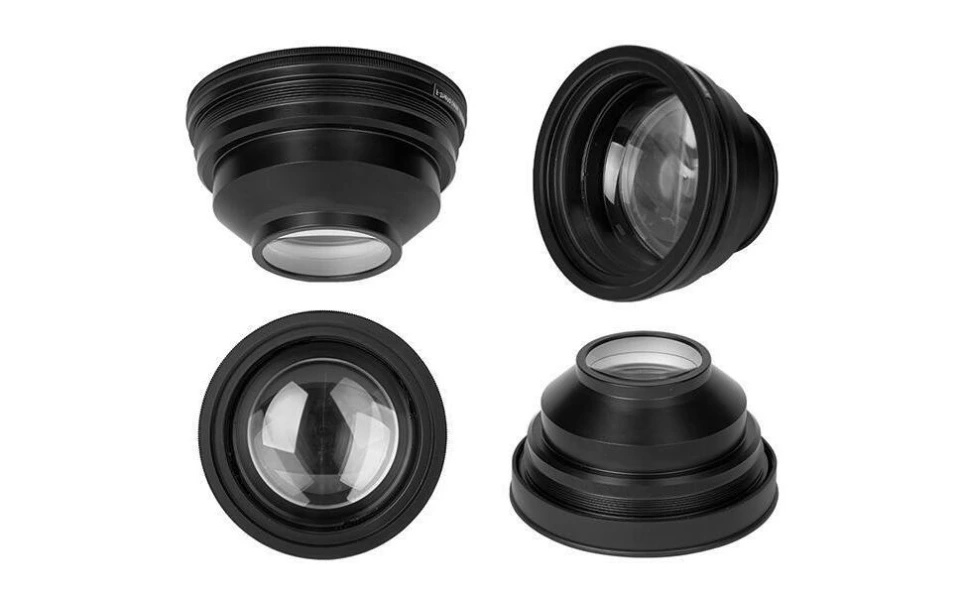
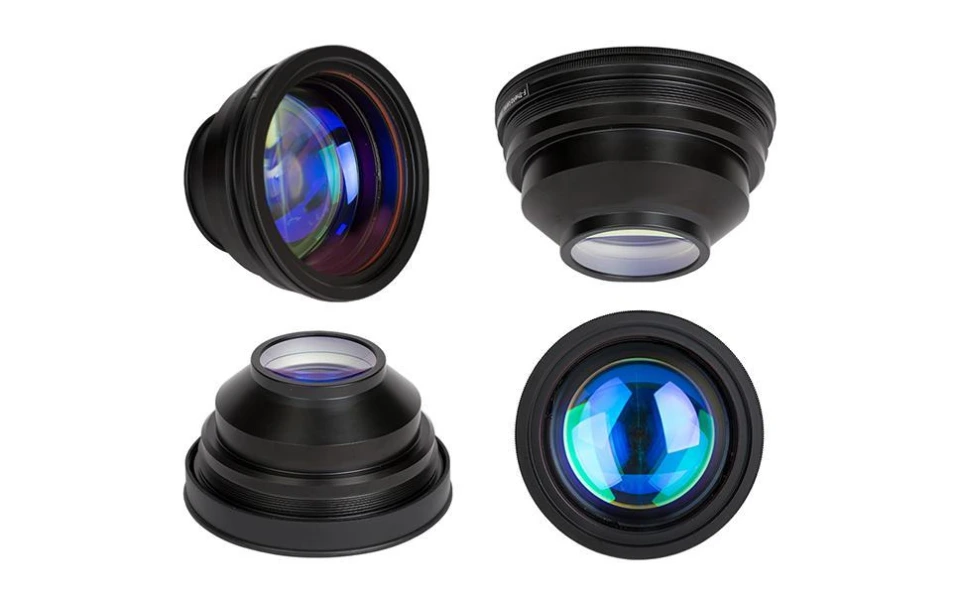
- A multi-element lens assembly built around a large, deeply curved front (often near-hemispherical) element that bends extreme off-axis rays into the lens — achieving angular fields of view of 180° or more that no rectilinear lens design can physically capture
- Deliberately abandons the rectilinear projection (straight lines remain straight) of conventional lenses in favor of one of several curvilinear mapping functions — equidistant, stereographic, orthographic, or equisolid-angle projection — each trading off angular coverage, edge magnification, and area distortion differently
- Equidistant (also called "f-theta" in this context, though distinct from laser-scanning F-theta lenses) projection is the most common mapping, where image radius from center is directly proportional to the angle from the optical axis — producing a predictable, mathematically invertible distortion useful for panoramic stitching and dewarping
- Used wherever maximum angular coverage from a single fixed camera position is the priority — security and surveillance domes, 360° panoramic and virtual-reality content capture, and scientific sky/horizon observation
- The deliberate barrel distortion can be digitally "dewarped" in post-processing or real-time software to produce a corrected rectilinear or panoramic output — a standard processing step in most modern fisheye-based imaging systems
- Front element size and curvature create unique mechanical and optical challenges — large entrance pupils for light gathering, but at the cost of front element vulnerability to damage, glare, and significant size/weight compared to standard lenses
Key Features
Hemispherical field coverage
Captures up to 180° (or slightly more) of angular field in a single exposure — physically impossible for any rectilinear lens design, since true rectilinear projection mathematically diverges to infinite image size as the field angle approaches 90°. Fisheye curvilinear projection remains finite and well-behaved at and beyond 90°, enabling the extreme coverage.
Mathematically defined distortion mapping
Unlike uncontrolled optical aberration, fisheye barrel distortion follows a well-defined, repeatable projection function (equidistant, stereographic, etc.) that can be precisely characterized and digitally reversed — enabling accurate panoramic dewarping, virtual reality content mapping, and geometric measurement from the distorted source image
Large light-gathering front element
The large, strongly curved front element captures light from an extremely wide range of incident angles simultaneously — supporting bright, fast (low f-number) designs that gather substantial light despite the extreme field of view, important for low-light surveillance and astronomical applications.
Single-camera panoramic capture
Achieves panoramic or near-spherical coverage from a single, fixed-position camera and lens — eliminating the need for multiple cameras, rotating mechanisms, or image-stitching across multiple exposures that would otherwise be required to capture an equivalent field of view.
Design and Construction
Projection types
Common mapping functions
- Equidistant projection — image radius proportional to field angle; most common, predictable, easy to dewarp
- Stereographic projection — conformal (preserves local shapes); popular for "little planet" panoramic effects
- Orthographic projection — compresses edges strongly; emphasizes center of frame
- Equisolid-angle projection — preserves solid angle (area) relationships; used in some scientific and photometric applications
Optical architecture
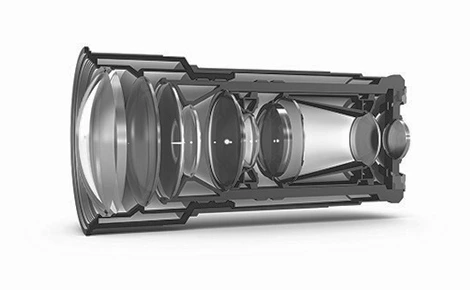
- Large strongly-curved front negative meniscus element(s) — captures extreme off-axis rays and pre-bends them toward the lens axis
- Multiple correcting groups follow — control chromatic aberration, field curvature, and other off-axis aberrations across the extreme field
Specifications
Key parameters
- Field of view: typically 180° (circular fisheye) or 180° diagonal (full-frame fisheye covering the rectangular sensor)
- F-number: often moderately fast (f/2.8–f/4) to maximize light gathering across the extreme field
- Image circle: circular fisheye designs project a circular image smaller than the sensor; full-frame designs fill the rectangular sensor format
Mounting variants
- Circular fisheye — projects a full circular image with black corners on the sensor; maximum field of view for a given format
- Full-frame fisheye — fills the rectangular sensor frame edge-to-edge, with diagonal field of view at 180° but reduced horizontal/vertical coverage
Optical Materials
Standard glass elements
Front element materials
- High-index, low-dispersion crown glass — used for the large front negative element to manage chromatic aberration at extreme angles without excessive curvature
- Special low-dispersion (ED) glass — used in premium fisheye designs to control lateral chromatic aberration at the extreme field edges
Correcting group materials
- Standard crown-flint achromatic pairs — correct chromatic aberration in the rear correcting groups
- Aspheric elements — increasingly used in modern fisheye designs to control distortion and aberration with fewer total elements
Coatings & protection
Coating considerations
- Multi-layer broadband AR coatings — essential given the large number of air-glass surfaces in a complex fisheye design
- Fluorine or hydrophobic front-element coatings — protect the large, exposed front element from fingerprints, moisture, and contamination
Wavelength Options
Visible
- 400–700 nm
- Standard glass groups
- VIS BBAR
NIR-extended
- 400–900 nm
- NIR-optimized glass
- VIS-NIR BBAR
IR security
- 700–1000 nm
- NIR-transmissive elements
- IR-pass coatings
Applications
Security
360° surveillance domes
Provides full hemispherical coverage from a single fixed-mount camera, eliminating blind spots and the need for multiple cameras or pan-tilt mechanisms in security and surveillance dome camera installations.
Media & VR
360° panoramic & VR content capture
The standard lens for capturing immersive 360° and virtual reality video and photo content — pairs of fisheye lenses (front and back facing) are commonly combined to capture a full spherical panorama for VR headset playback.
Automotive
Around-view monitoring systems
Used in automotive surround-view and parking assistance camera systems, where the extreme field of view captures the full area immediately around the vehicle from compact, body-mounted camera positions.
Robotics
Omnidirectional navigation vision
Provides wide-area situational awareness for mobile robots and autonomous platforms, capturing a broad field of view for obstacle detection and navigation from a single compact camera module.
Architecture
Interior & real estate photography
Used in real estate and architectural photography to capture entire rooms or interior spaces in a single wide-coverage image, often subsequently dewarped to a more conventional perspective for presentation.
Why choose Fisheye Lenses
Maximum field of view
Achieves 180° or greater angular coverage — a field of view physically impossible for any rectilinear lens design, regardless of focal length.
Predictable, reversible distortion
The mathematically defined projection function allows precise digital dewarping — recovering a corrected perspective or panoramic view from the raw fisheye capture.
Single-camera panoramic solution
Captures an entire hemisphere or panorama from one fixed camera position — eliminating the cost, complexity, and stitching artifacts of multi-camera panoramic systems.
Compact wide-coverage option
Despite the large front element, fisheye lenses remain more compact and lower-cost than equivalent multi-camera or rotating-mechanism solutions for achieving similar angular coverage.
Frequently asked questions
Here are some common questions about Fisheye-Lens.
In rectilinear projection, image height grows as h = f·tan(θ), where θ is the field angle from the optical axis. As θ approaches 90° (a 180° total field of view), tan(θ) mathematically approaches infinity — meaning the image of an object at the edge of a true 180° field would need to form at an infinite distance from the image center, which is physically impossible. Fisheye lenses instead use curvilinear projections (such as equidistant, where h = f·θ) that remain finite and well-behaved even as θ approaches and exceeds 90°, allowing the lens to form a complete, finite image of a hemispherical or wider field of view.
Dewarping is the digital image processing step that converts the curved, distorted fisheye image back into a corrected view — typically either a conventional rectilinear perspective view of a sub-region, or an equirectangular panoramic projection of the full field. Because the fisheye lens's projection function (e.g., equidistant: h = f·θ) is precisely known and mathematically invertible, software can calculate exactly where each pixel in the distorted source image should map to in the corrected output, remapping the image accordingly. This dewarping is a standard real-time or post-processing step in most fisheye-based surveillance, panoramic, and VR imaging systems.
A circular fisheye lens projects a complete circular image that is smaller than the sensor's rectangular frame, leaving black (unexposed) corners — this configuration captures the maximum possible field of view (typically a full 180° in every direction from the image center) since the circular image circle directly represents the lens's angular coverage. A full-frame fisheye lens is designed so its image circle is large enough to fill the entire rectangular sensor frame edge-to-edge — the diagonal field of view reaches 180°, but the horizontal and vertical field of view are somewhat less, since the rectangular frame doesn't extend as far into the corners of the projected circle. Full-frame fisheye lenses are far more common in consumer and professional photography since they make full use of the sensor's resolution.