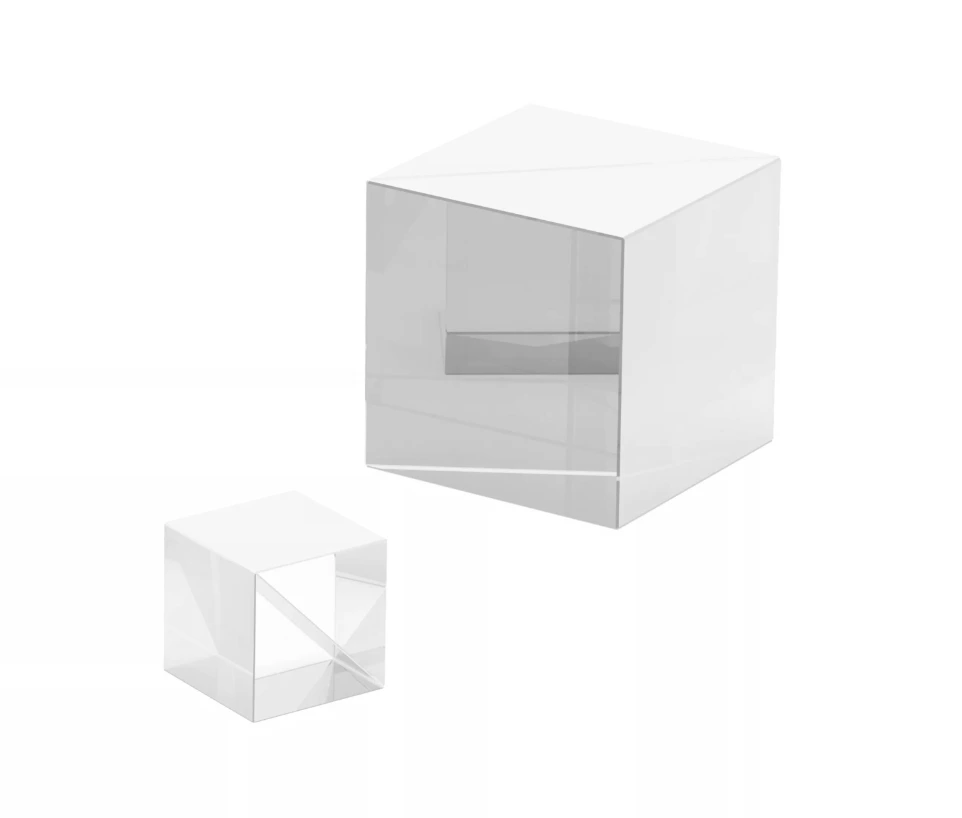
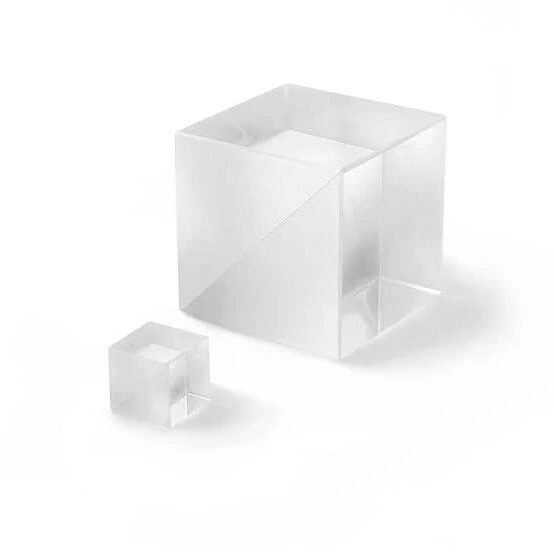
Glan-Taylor Prism
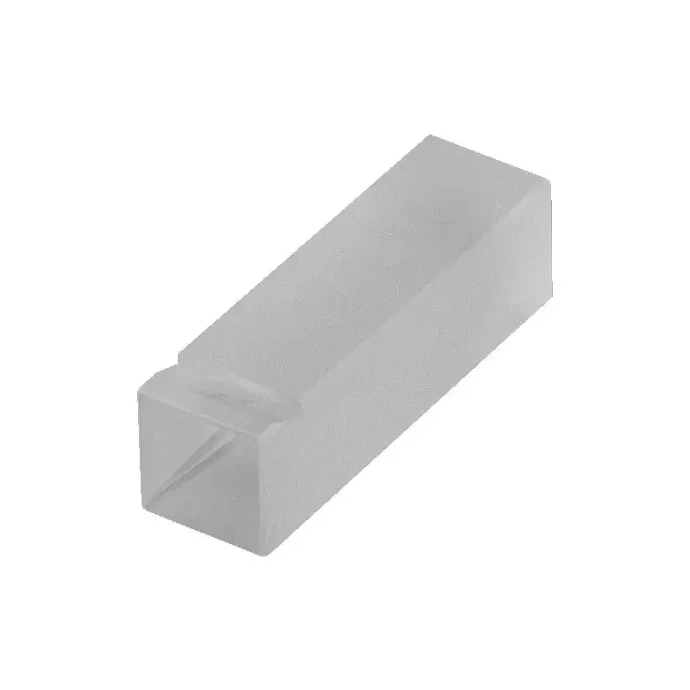
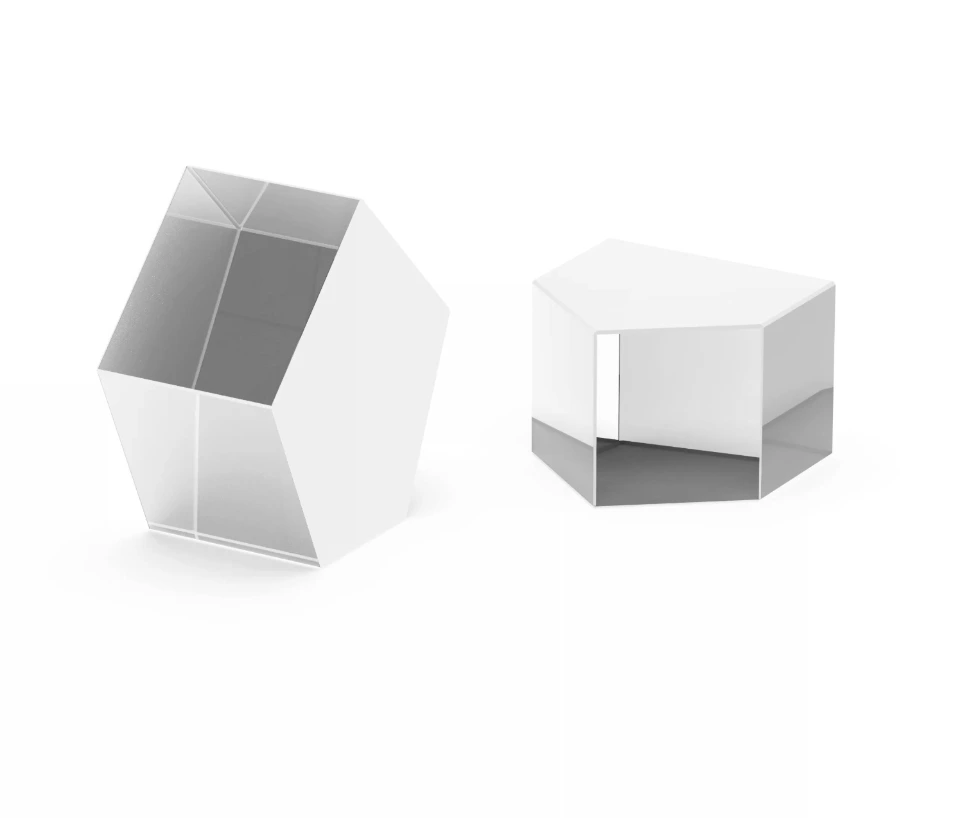
An air-spaced calcite polarizer that transmits p-polarization through TIR-based rejection of s-polarization — delivering the highest extinction ratio, highest laser damage threshold, and broadest spectral range of any standard crystal polarizer. The preferred high-power laser polarizer for UV through NIR wavelengths.
Construction
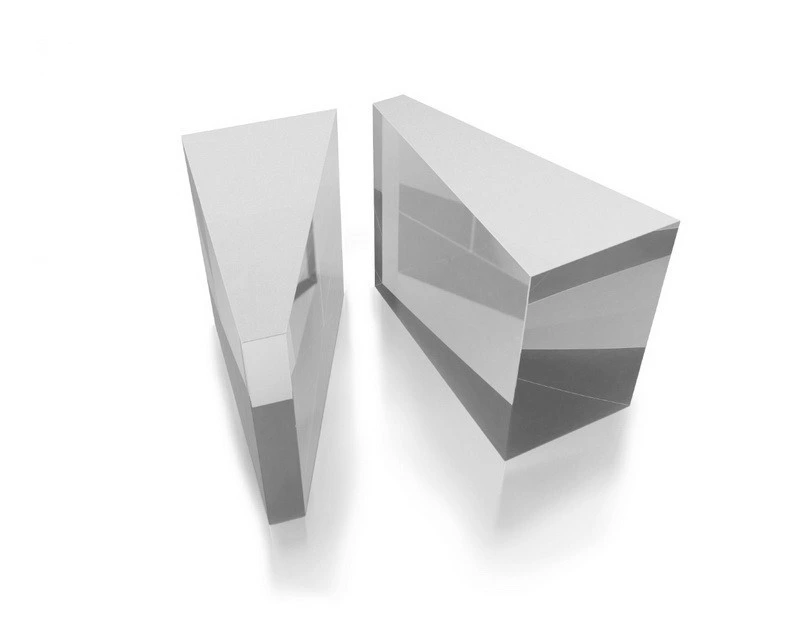
Air-spaced calcite prism pair
Transmitted output
Single p-polarized beam
Extinction ratio
>100,000:1
LIDT
High — no cement interface
Overview
- Two calcite prisms with an air gap between them — the air gap is the critical feature that eliminates the cement damage threshold limitation of Glan-Thompson designs
- The calcite optical axis is cut parallel to the entry face and perpendicular to the beam — the geometry that maximizes the birefringence difference between ordinary and extraordinary rays at the air interface
- p-polarization (extraordinary ray in this orientation) has a lower index than the air-spaced interface's effective index — it transmits through
- s-polarization (ordinary ray) has a higher index — it undergoes total internal reflection at the air gap, exiting through a side face
- The transmitted p-polarized beam exits the prism with no angular deviation — co-linear with the input — unlike Wollaston prisms that angularly separate both beams
- Air gap enables use with high-power pulsed lasers — the maximum LIDT of calcite crystal surfaces without any cement that could absorb UV or damage at high fluences
Key Features
Highest laser damage threshold
The air-spaced design eliminates the optical cement present in Glan-Thompson prisms — cement is the LIDT-limiting component in cemented polarizers. Glan-Taylor prisms achieve LIDT values of 5–20 J/cm² at 1064 nm (ns pulses) — making them the preferred polarizer for Q-switched Nd:YAG, Ti:Sapphire, and excimer laser systems where cemented polarizers would be damaged.
Ultra-high extinction ratio
The TIR rejection of s-polarization at the calcite-air interface provides essentially zero s-polarization transmission — extinction ratios of 100,000:1 to 1,000,000:1 are achievable. This is the highest polarization purity of any standard polarizing element, essential for optical pumping of atomic vapors, precision ellipsometry, and coherent optical communications.
Zero transmitted beam deviation
The transmitted p-polarized beam exits the Glan-Taylor prism exactly along the input optical axis — no angular deviation, no lateral displacement. This zero-deviation property allows the polarizer to be inserted into any optical path without requiring realignment of downstream optics.
Broad spectral range
Calcite transmits from approximately 200 nm to 2300 nm — covering deep UV through NIR in a single polarizer element. α-BBO extends coverage to 190 nm. This broad range allows one polarizer design to serve UV, visible, and NIR laser systems without changing polarizing elements when switching laser wavelengths.
Design and Construction
Air gap & geometry
Critical air gap
- Gap width: typically 50–200 µm — wide enough for TIR but narrow enough for alignment
- Gap parallelism: must be controlled to prevent beam walkoff and angular deviation
- Prism angle: chosen to place s-polarization above the TIR critical angle while keeping p-polarization below it
- L/A ratio: 0.8–1.2 typical; determines the usable angular field of view (~±4° to ±6°)
Comparison to Glan-Thompson
- Glan-Thompson: cemented — wider field of view (>14°) but lower LIDT; cannot be used at high UV power
- Glan-Taylor: air-spaced — narrower field (~±4°) but maximum LIDT; UV and high-power laser compatible
Specifications
Optical performance
- Extinction ratio: standard >100,000:1; premium >500,000:1
- Transmission (p-pol): typically 90–95% (surface reflections at entry/exit faces)
- Angular field of view: ±4° to ±6° depending on L/A ratio
- Transmitted wavefront: <λ/4 standard; <λ/8 precision grade
Coatings
- BBAR on entry/exit faces — reduces surface reflection loss from ~4% to <0.5%
- V-coat — specific laser wavelength maximizes transmission efficiency
- Brewster angle cut entry/exit faces — for UV laser systems with p-polarization
Optical Materials
Crystal materials
Standard polarizer crystals
- Calcite (Iceland spar, CaCO₃) — standard material; Δn=0.172 at 589 nm; 350–2300 nm range; highest birefringence of common polarizer materials
- α-BBO (alpha barium borate, α-BaB₂O₄) — 190–2500 nm; UV-extended; harder and more humidity-resistant than calcite; slightly lower birefringence
Specialty & UV materials
Extended UV range
- α-BBO — preferred for deep UV below 350 nm; laser-grade purity available
- MgF₂ — extends coverage to 120 nm for VUV polarization applications; lower birefringence requires larger prism angle for same extinction
- Crystalline quartz — lower birefringence (Δn=0.009); used as Glan-type for UV when calcite/BBO are unavailable
Wavelength Options
Deep UV
- 190–350 nm
- α-BBO
- UV-AR faces
UV-VIS
- 350–700 nm
- Calcite / α-BBO
- BBAR or V-coat
Visible-NIR
- 500–1100 nm
- Calcite
- BBAR or Brewster
NIR
- 1064 – 2300 nm
- Calcite
- NIR V-coat
Applications
High-power Lasers
Q-switched laser polarizers
The standard intra-cavity and extra-cavity polarizer for Q-switched Nd:YAG, Nd:YLF, and other pulsed solid-state lasers — the air-spaced design's high LIDT withstands peak power densities that would damage cemented polarizers, while providing the extinction ratio needed for efficient polarization-based cavity switching.
UV Lasers
Excimer & harmonic polarizers
α-BBO Glan-Taylor prisms polarize excimer laser (ArF 193 nm, KrF 248 nm) beams and UV harmonic outputs (266, 355 nm) where no cement can survive the UV power density and ozone exposure. Essential for UV laser material processing, photolithography, and UV Raman spectroscopy systems.
Spectroscopy
High-power spectroscopy
Used in high-power CW laser spectroscopy, cavity ring-down spectroscopy, and optical frequency standard experiments where the polarizer must handle both high average power and the extreme cleanliness of optical resonators where scattering from a cement interface would add unacceptable background noise.
Ellipsometry
Precision ellipsometers
Provides the polarization purity required for precision ellipsometric measurement of thin film optical constants — extinction ratios >100,000:1 ensure that residual cross-polarization from the polarizer does not limit the measurement sensitivity to changes in sample polarization state.
Atomic Physics
Optical pumping
Used to polarize the light beams that optically pump atomic samples (alkali metal vapors, rare earth ions) into specific magnetic sub-levels for magnetometry, atomic clocks, and quantum memory experiments — requiring the highest polarization purity achievable to prevent optical pumping into unwanted states.
Interferometry
Laser interferometer polarizers
Used as the beam-splitting and polarization-control elements in heterodyne laser displacement interferometers — providing the pure polarization states needed for clean frequency-domain signal separation in dual-frequency HeNe and fiber interferometers for precision positioning.
Why choose Glan-Taylor Prisms
Maximum laser damage threshold
Air-spaced design eliminates cement — the LIDT-limiting element in cemented polarizers — enabling use with Q-switched, excimer, and high-power CW lasers that would destroy Glan-Thompson designs.
Ultra-high extinction
TIR rejection of s-polarization provides >100,000:1 extinction — the highest standard polarization purity for demanding spectroscopy, ellipsometry, and atomic physics applications.
Zero beam deviation
The transmitted beam exits co-linear with the input — no angular or lateral deviation. The polarizer can be inserted into any optical path without any realignment of downstream components.
Broad UV-NIR range
Calcite covers 350–2300 nm; α-BBO extends to 190 nm — one polarizer platform covers UV through NIR across the full range of modern laser sources and spectroscopic instruments.
Frequently asked questions
Here are some common questions about Glan Taylor.
Both use calcite prisms and TIR rejection of ordinary polarization. Glan-Thompson: cemented with Canada balsam or optical cement — wider angular field of view (>14° half-angle) but cement limits LIDT (typically 0.5–2 J/cm² at 1064 nm) and UV transmission below ~350 nm. Cannot be used with high-power UV lasers. Glan-Taylor: air-spaced — narrower angular field (~±4°) but maximum LIDT (5–20 J/cm²), UV compatible to 200 nm, and no cement-absorption or damage issues. For any application involving high-power or UV lasers, always choose Glan-Taylor.
The s-polarization (ordinary ray) undergoes TIR at the air gap interface and exits through a polished side face of the prism — typically directed toward an absorbing black-anodized housing or a beam dump. In some applications, the rejected beam is used as a second output for monitoring or power balancing. Unlike the Wollaston prism where both beams are equally useful, in the Glan-Taylor only the transmitted p-polarization is the primary output.
The TIR rejection only works when the ordinary ray strikes the calcite-air interface above the critical angle. If the input beam is tilted too far from the prism axis, the ordinary ray's angle at the interface may fall below the critical angle — allowing s-polarization to partially transmit and degrading the extinction ratio. The angular acceptance (typically ±4–6° depending on L/A ratio) defines the cone of input angles within which the extinction ratio specification is maintained. For wide-angle polarization applications, Glan-Thompson cemented prisms offer ±14° but sacrifice LIDT.
With appropriate care, yes. The air-spaced design's elimination of cement removes the lowest-damage-threshold element. However, calcite and α-BBO have group velocity dispersion (GVD) that broadens ultrashort pulses — typically 200–400 fs² /mm of crystal at 800 nm. For <100 fs pulses, this dispersion must be pre-compensated. Additionally, two-photon absorption in crystal polarizers at high femtosecond peak intensities can limit usable fluence. For sub-10 fs pulses, thin-film PBS or reflective polarizers (at near-Brewster angle on glass) are preferred to minimize material dispersion.