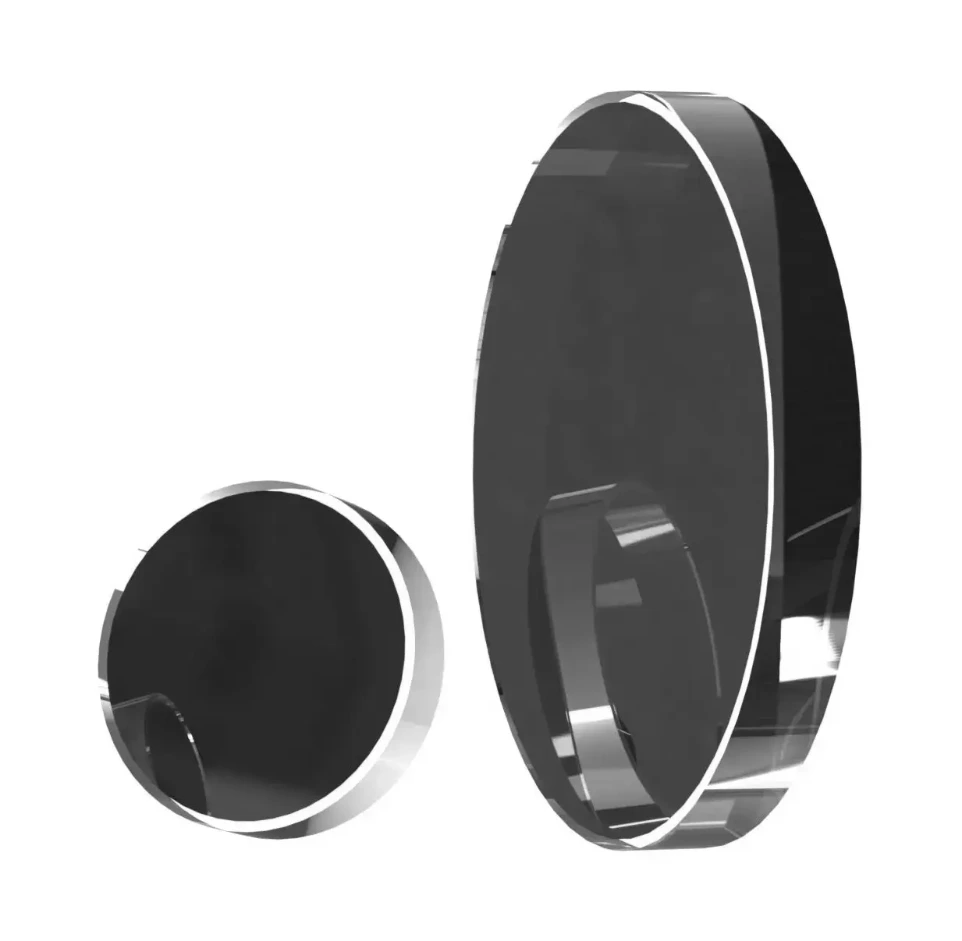
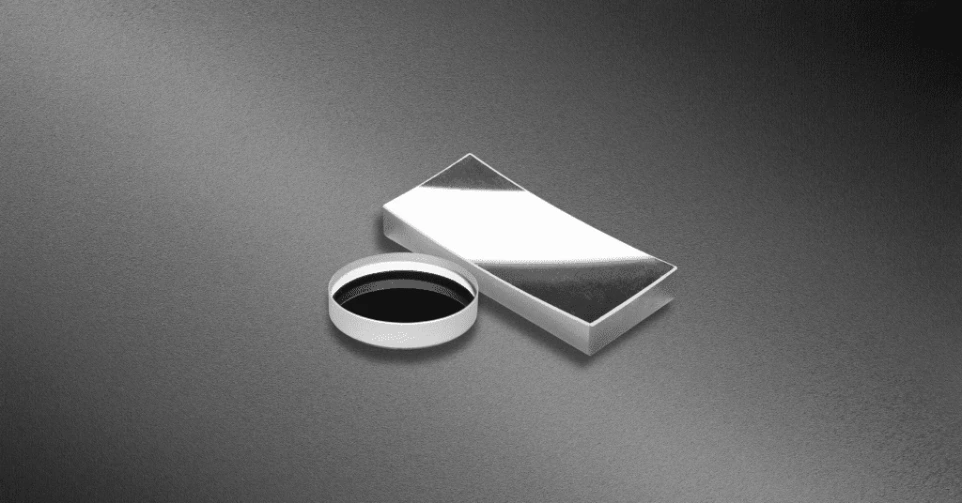
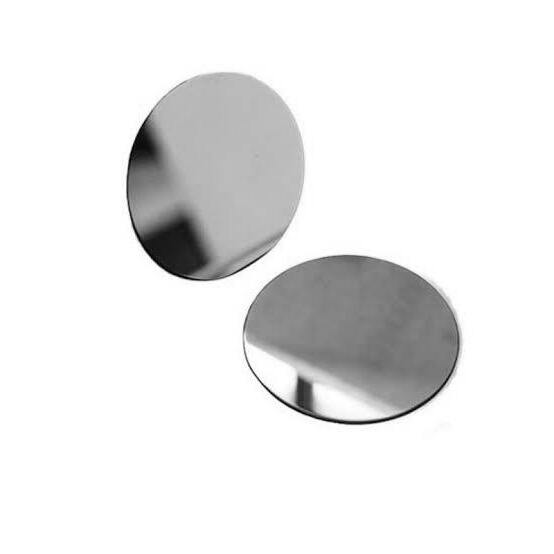
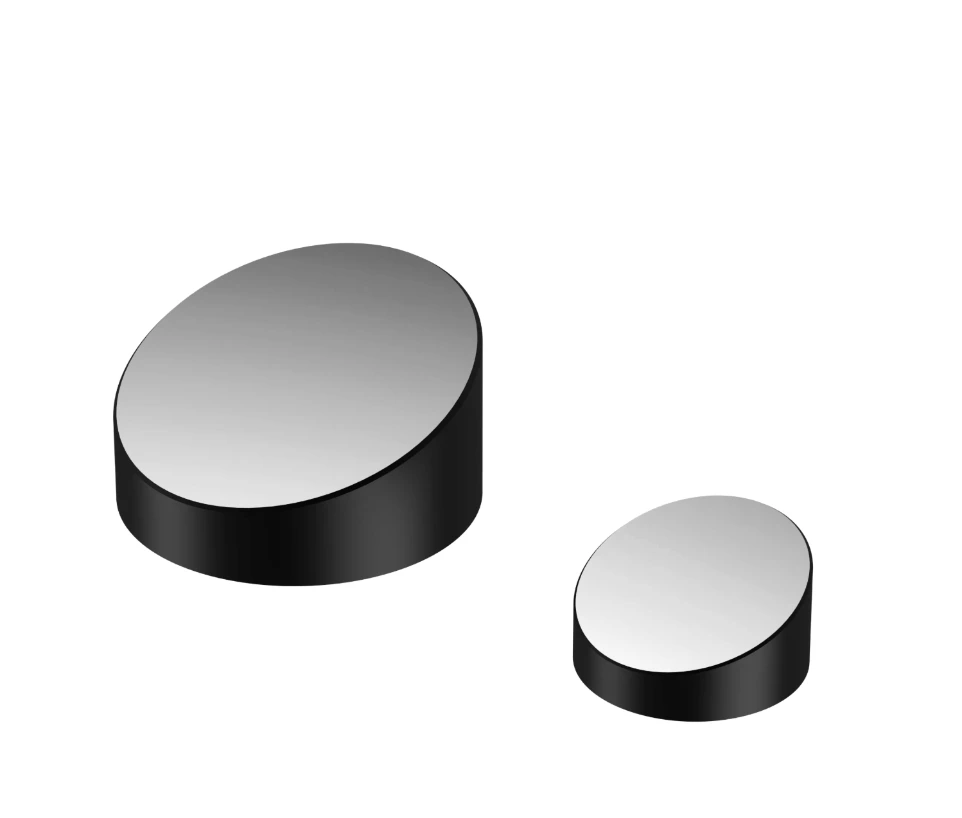
Laser Line Mirror
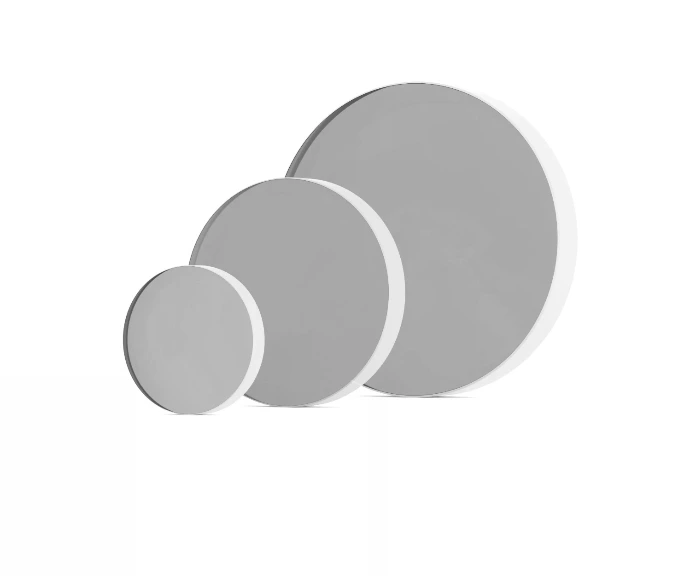
A dielectric mirror engineered for maximum reflectance at one specific laser wavelength — achieving reflectance values exceeding 99.9% that broadband metallic coatings cannot match. The standard high-efficiency, high-damage-threshold mirror for laser resonators, beam delivery, and any single-wavelength laser application where every fraction of a percent of reflectance matters.
Coating type
Narrowband dielectric stack
Reflectance
>99.5% to >99.99%
Bandwidth
Narrow (specific laser line)
LIDT
High (no metal absorption)
Overview
- A mirror coated with a multilayer dielectric stack precisely engineered for maximum reflectance at one specific laser wavelength (or a narrow set of wavelengths)
- Unlike broadband metallic coatings (aluminum, silver, gold) that reflect a wide spectral range at moderate efficiency, laser line coatings concentrate all design effort on a single wavelength to achieve the highest possible reflectance
- Standard laser line wavelengths include common laser sources: 355 nm, 532 nm, 633 nm, 780 nm, 808 nm, 1064 nm, and 1550 nm, among others
- Dual-band and multi-band laser line mirrors are available for systems using two or more discrete laser wavelengths simultaneously (e.g. a combined 532 nm/1064 nm mirror for a frequency-doubled Nd:YAG system)
- Dielectric coatings have essentially zero absorption compared to metallic coatings — virtually all incident energy not reflected is transmitted rather than absorbed, dramatically improving the laser damage threshold
- Standard mirror for laser resonator cavities, where even 0.1% additional loss per round-trip can significantly impact laser efficiency and output power
Key Features
Maximum single-wavelength reflectance
By optimizing the entire dielectric layer stack for one specific wavelength rather than a broad range, laser line mirrors achieve reflectance values from 99.5% up to 99.99%+ — far exceeding the 85–99% typical of broadband metallic coatings, critical in laser resonators where every round-trip loss directly reduces output efficiency.
High laser damage threshold
Dielectric coatings absorb negligible energy compared to metallic coatings — virtually all non-reflected energy is transmitted rather than converted to heat. This dramatically higher laser-induced damage threshold (LIDT) makes laser line mirrors essential for high-power and high-peak-power pulsed laser systems where metallic mirrors would be damaged.
Engineered phase & polarization control
Precise control of the dielectric layer stack allows laser line mirrors to be designed with specific phase response characteristics — important for ultrafast laser cavity dispersion compensation — and with minimized polarization-dependent reflectance variation for clean beam polarization preservation through multiple reflections.
Multi-band capability
Advanced coating designs achieve high reflectance simultaneously at two or more discrete laser wavelengths — useful in systems combining a fundamental laser with its harmonic outputs, or in dual-wavelength pump-probe experimental setups requiring identical beam paths for both wavelengths.
Design and Construction
Coating design
Stack architecture
- Quarter-wave stack of alternating high/low index dielectric layers, typically 15–40 layers
- Layer count and design optimized for the specific target wavelength and required reflectance level
- Higher reflectance specifications require more layers and tighter deposition control
Angle of incidence designs
- 0° (normal incidence) — standard for laser cavity end mirrors
- 45° — standard for beam-folding laser mirrors in beam delivery and resonator fold paths
- Custom angles available for specific resonator or beam path geometries
Specifications
Performance grades
- Standard laser line: >99.5% reflectance at design wavelength
- High-reflectance (HR) grade: >99.9% reflectance
- Ultra-high reflectance (UHR): >99.99% reflectance — used in high-finesse cavity applications
Surface & substrate requirements
- Surface figure: λ/8 to λ/20 — critical for laser cavity mode quality
- Surface quality: 10-5 to 5-2 scratch-dig — minimizes scatter loss in high-finesse applications
Optical Materials
Coating materials
Low-loss dielectric materials
- Ta₂O₅/SiO₂ — standard high-reflectance stack; very low absorption losses
- HfO₂/SiO₂ — used for UV laser line mirrors requiring high damage threshold
- Nb₂O₅/SiO₂ — alternative high-index material for specific wavelength designs
Substrate materials
Low-stress, high-stability substrates
- UV Fused Silica — standard substrate; low thermal expansion, high homogeneity
- N-BK7 — visible/NIR laser applications; cost-effective
- Zerodur / ULE — high-finesse cavity mirrors requiring extreme thermal and mechanical stability
Wavelength Options
UV laser lines
- 355 / 266 nm
- UVFS substrate
- >99% reflectance
Visible laser lines
- 532 / 633 nm
- N-BK7 / UVFS
- >99.5% reflectance
NIR laser lines
- 780 / 808 / 1064 nm
- N-BK7 / UVFS
- >99.7% reflectance
Telecom NIR
- 1550 nm
- UVFS
- >99.5% reflectance
Applications
Laser Systems
Resonator cavity mirrors
The standard end mirror in laser resonator cavities — maximum reflectance at the lasing wavelength minimizes round-trip cavity loss, directly improving laser efficiency, threshold, and output power compared to broadband metallic mirrors.
Industrial
High-power beam delivery
Used to route high-power laser beams (CO₂, fiber, Nd:YAG) in industrial cutting, welding, and marking systems — the high damage threshold of dielectric coatings withstands the kilowatt-level power densities that would damage metallic mirrors.
Research
Ultrafast laser cavities
Used in mode-locked femtosecond laser cavities where both high reflectance and engineered dispersion (chirped mirror designs) are required to maintain ultrashort pulse durations while minimizing intracavity loss.
Metrology
High-finesse optical cavities
Used in ultra-high-finesse reference cavities for laser frequency stabilization and precision spectroscopy — reflectance levels approaching 99.999% (supermirror grade) enable cavity finesse values exceeding 100,000 for the most demanding precision measurement applications.
Defense
Directed energy systems
Used in high-power laser weapon and countermeasure systems where maximum reflectance and damage threshold are essential for reliably handling extreme laser power densities without coating failure.
Telecommunications
Fiber laser & amplifier optics
Used in fiber laser pump combiners and free-space telecom laser test setups at 1550 nm and other telecom wavelengths where high reflectance and low insertion loss are required for efficient signal routing.
Why choose Laser Line Mirrors
Highest single-wavelength reflectance
Achieves reflectance levels (99.5–99.99%+) impossible with any broadband metallic coating — essential for laser resonators and high-finesse cavity applications.
Maximum damage threshold
Negligible absorption compared to metallic coatings provides dramatically higher laser-induced damage threshold — the standard choice for high-power and ultrafast pulsed laser systems.
Engineered dispersion control
Coating design can be tailored for specific phase/dispersion response — essential for ultrafast laser cavity dispersion compensation that broadband mirrors cannot provide.
Multi-band design flexibility
Custom coatings achieve high reflectance simultaneously at multiple discrete wavelengths — supporting complex multi-wavelength laser system architectures.
Frequently asked questions
Here are some common questions about achromatic lens.
In a laser resonator, the beam reflects between the cavity mirrors thousands to millions of times during the buildup of laser oscillation. Each reflection's loss compounds — a mirror with 99.9% reflectance (0.1% loss per bounce) versus one with 99.5% reflectance (0.5% loss per bounce) represents a 5× difference in single-pass loss. Over many round-trips, this difference dramatically affects the laser's threshold pump power, slope efficiency, and maximum achievable output power — which is why laser cavity designers specify dielectric laser line mirrors with the highest achievable reflectance rather than accepting the lower reflectance of metallic coatings.
No — by design, laser line mirrors achieve their exceptional reflectance by concentrating the coating design on one narrow spectral band. Outside this design bandwidth (typically a few nanometers to a few tens of nanometers wide), reflectance drops off rapidly. For applications requiring high reflectance across a broad spectral range, a broadband dielectric mirror (covering a wider band at somewhat lower peak reflectance) or a metallic mirror should be used instead.
Both use narrowband dielectric coatings, but supermirrors represent the extreme high end of the reflectance spectrum — achieving 99.99% to 99.999%+ reflectance using ultra-low-loss materials (often ion-beam sputtered Ta₂O₅/SiO₂) with extremely tight process control to minimize scatter and absorption losses. Standard laser line mirrors typically achieve 99.5–99.9% reflectance, sufficient for most laser systems. Supermirrors are reserved for the most demanding applications — high-finesse reference cavities, gravitational wave detector mirrors, and precision frequency metrology — where even 0.01% additional loss is significant.