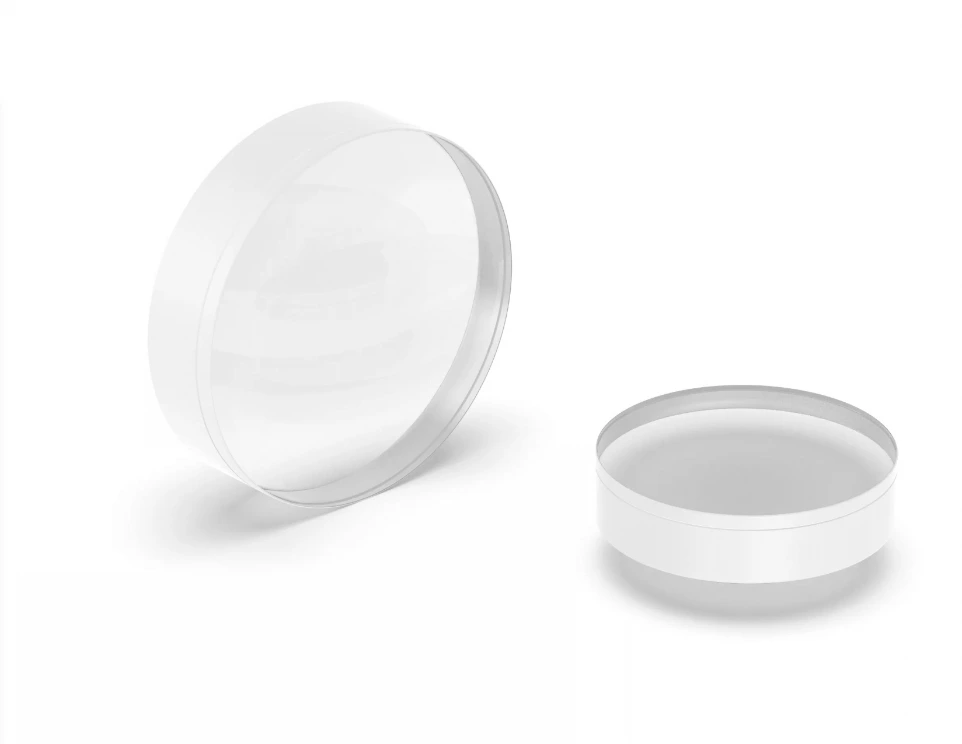
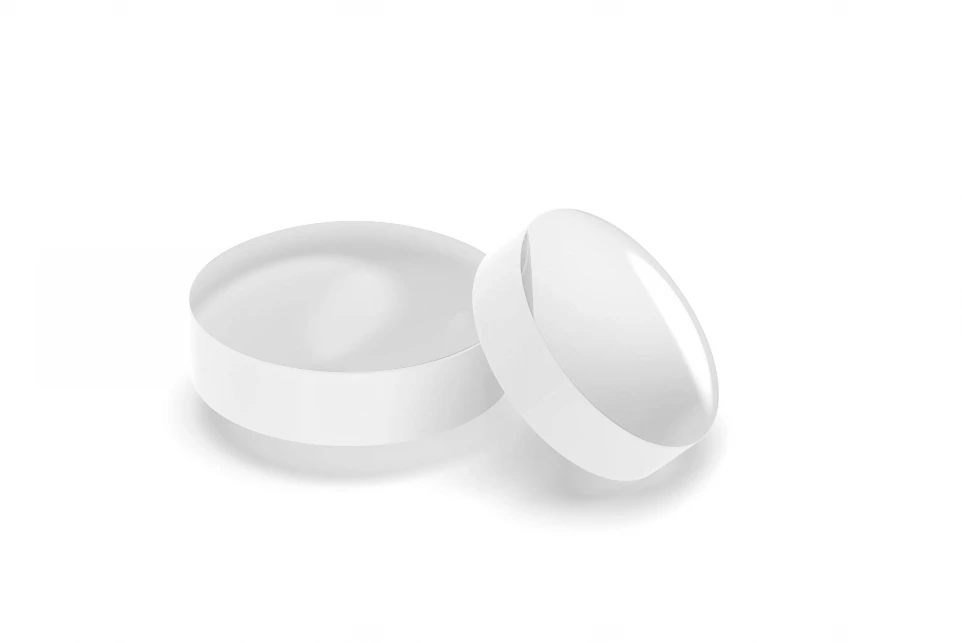
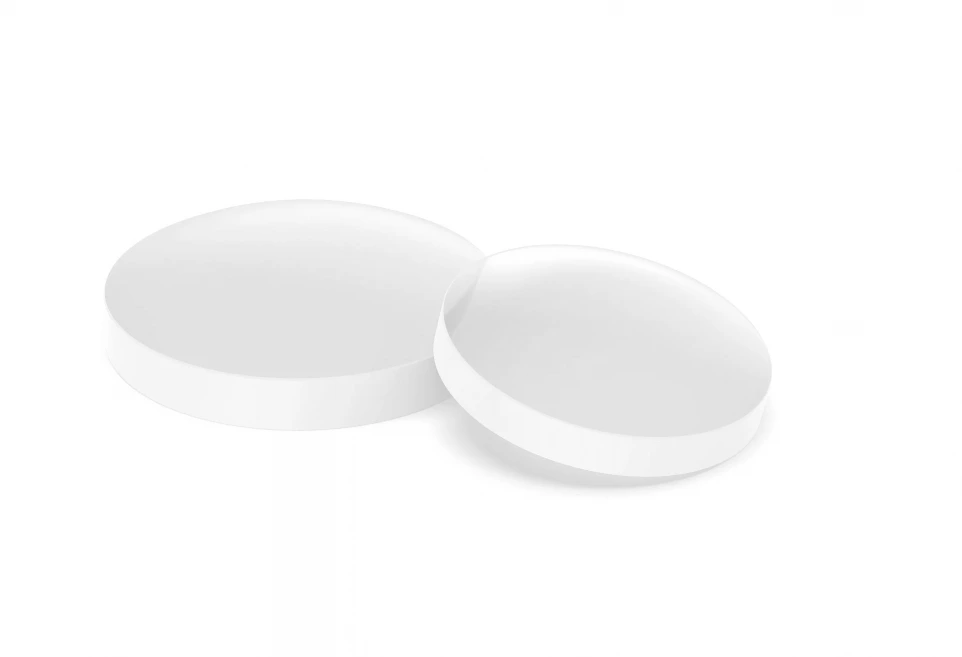
Meniscus Lens
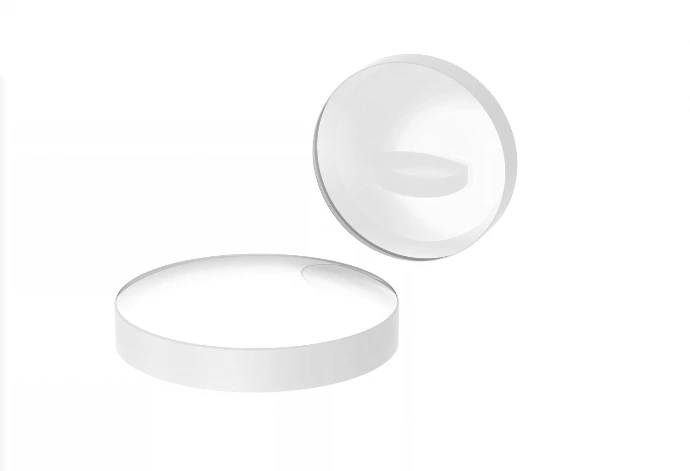
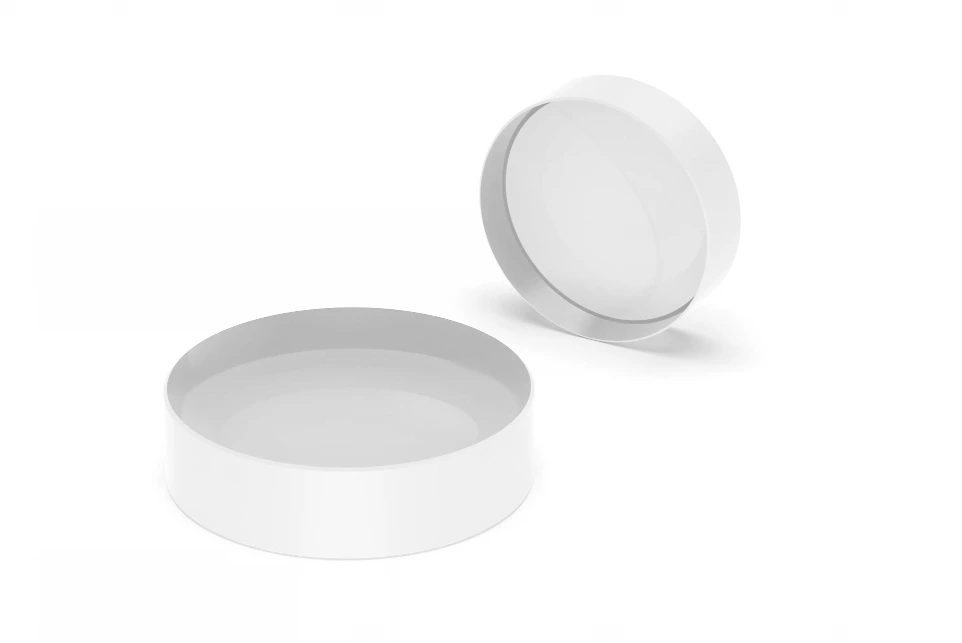
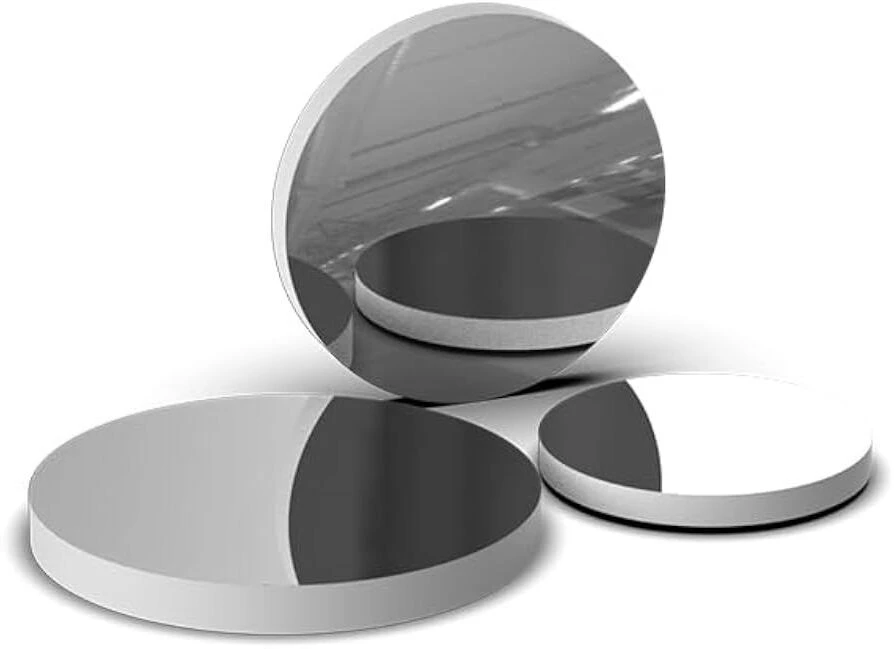
A lens with one convex and one concave surface — available in positive (converging) and negative (diverging) forms. Uniquely suited for minimizing spherical aberration in demanding low f-number systems, and the preferred lens form for high-refractive-index infrared materials where standard lens geometries would require impractically steep surface curvatures.
Overview
- One convex and one concave surface — can be positive or negative depending on curvature ratio
- Positive meniscus: convex side has shorter radius of curvature — converging lens, minimizes spherical aberration at moderate f-numbers
- Negative meniscus: concave side has shorter radius — diverging lens, preferred for high-index IR materials like germanium and ZnSe
- Optimal performance at f-numbers between f/2.5 and f/10 — where it outperforms plano-convex for spot size minimization
- Combines low aberration performance with a thin, compact physical profile compared to biconvex or plano-convex designs
- Can be used as a standalone lens or as an add-on element (aplanatic meniscus) to improve the performance of an existing lens assembly
Key Features
Spherical aberration minimization
At f-numbers between f/2.5 and f/10, a positive meniscus lens produces smaller spot sizes than any plano-convex alternative of the same focal length. This makes it the preferred choice for precision focusing in laser systems, optical sensors, and condensers operating at moderate apertures.
Thin, compact profile
The curved-on-both-sides geometry allows the lens to achieve a given optical power with a thinner center section than a biconvex or plano-convex lens. This reduces weight, material use, and mechanical housing depth — valuable in compact imaging systems and lightweight instrument designs.
Ideal for high-index IR materials
High-refractive-index materials like germanium (n≈4.0) and ZnSe (n≈2.4) require very shallow surface curvatures to achieve a given focal power due to their high index. The negative meniscus form achieves this naturally while maintaining low aberration levels — making it the standard form factor in IR lens design.
Aplanatic add-on capability
A meniscus lens can be used as an aplanatic element added to an existing objective to increase numerical aperture without introducing spherical aberration. This is a widely used technique in microscope objective design and in high-NA focusing heads for confocal microscopy.
Design and Construction
Positive vs negative meniscus
Positive meniscus
- Convex surface has shorter radius (greater curvature) — net converging power
- Used at f/2.5–f/10 for minimum spherical aberration focusing
- Convex surface should face the longer conjugate for best performance
- Common in laser focusing heads and optical sensor condensers
Negative meniscus
- Concave surface has shorter radius — net diverging power
- Standard form for high-index IR materials (Ge, ZnSe, Si)
- Used in beam-expanding IR telescope designs and as diverging elements in IR camera objectives
Design parameters
Optical parameters
- Focal length: 1/f = (n−1)[1/R₁ − 1/R₂]; sign depends on which radius is shorter
- For aplanatic use: radii chosen so the surface is concentric with the object point — introduces zero spherical aberration
- Center thickness thinner than biconvex at same focal length and diameter
Coating options
- Uncoated — standard for low-power applications
- BBAR visible, NIR, SWIR — reduced surface reflections
- BBAR IR — 3–5 µm or 8–12 µm for IR substrates
- DLC (diamond-like carbon) — for rugged IR systems requiring scratch resistance
Optical Materials
Standard glass
Visible & NIR
- N-BK7 — standard visible meniscus elements
- LaSFN9 (n=1.85) — high-index glass for compact short-focal-length positive meniscus lenses
- Sapphire — for rugged, high-temperature environments
UV-grade
- UV Fused Silica — UV spectrometer and laser applications
- CaF₂ — deep UV and broad UV-IR range
Infrared materials
High-index IR substrates
- Germanium (n=4.0) — LWIR 2–12 µm; meniscus form essential to achieve reasonable surface curvatures at this extreme index
- Zinc Selenide (n=2.4) — 0.5–20 µm; CO₂ laser and broadband IR
- Silicon (n=3.4) — 1.2–8 µm; lighter than Ge; MWIR camera designs
Contact lens applications
- Polycarbonate, hydrogel polymers — ophthalmic corrective contact lenses
- PMMA — hard contact lens material for specialty ophthalmic applications
Wavelength Options
Deep UV
- 185–350 nm
- CaF₂ or UVFS
- UV-optimized AR
Visible
- 400–700 nm
- N-BK7 standard
- MgF₂ or BBAR
NIR
- 700–2000 nm
- BK7 / Fused Silica
- VIS-NIR BBAR
MWIR
- 2–5 µm
- Silicon or CaF₂
- BBAR 3–5 µm
LWIR
- 8–12 µm
- Germanium or ZnSe
- BBAR 8–12 µm
Applications
Laser Systems
Precision focusing heads
Positive meniscus lenses are the preferred focusing element in laser scanning heads, confocal microscopes, and optical storage drives operating at moderate f-numbers — delivering smaller focused spots than plano-convex alternatives.
Thermal Imaging
IR objective elements
Negative germanium meniscus lenses are a standard building block of thermal camera objectives — providing controlled negative power with shallow, manufacturable surface curvatures that high-index germanium makes necessary.
Microscopy
High-NA aplanatic elements
Aplanatic meniscus lenses are added to microscope objectives to increase numerical aperture without adding spherical aberration. This technique is used in immersion objectives and high-NA dry objectives for confocal and super-resolution microscopy.
Sensing
Optical sensors & condensers
Used as condensing elements in spectrophotometers, flow cytometers, and optical sensors at f/3–f/8 where the meniscus form's reduced spherical aberration improves collection efficiency and reduces coupling losses to detectors.
Ophthalmology
Contact lenses & instruments
The meniscus form is the universal shape of corrective contact lenses — positive for hyperopia (farsightedness), negative for myopia — and is used in fundus cameras, slit lamps, and indirect ophthalmoscopes for retinal examination.
Defense
Rugged IR camera optics
DLC-coated germanium meniscus lenses are used in military and defense thermal imaging systems — providing LWIR focusing with high scratch resistance and environmental durability for field-deployed sensor equipment.
Why choose Achromatic Lenses
Best at f/2.5–f/10
In the moderate aperture range, positive meniscus lenses deliver smaller focused spots and lower spherical aberration than any plano-convex or biconvex lens of equivalent focal length.
Essential for high-index IR
The meniscus form is the only practical lens geometry for very high index materials like germanium — keeping surface curvatures manufacturable while achieving needed optical power.
Thin, lightweight design
Achieves the same optical power in a thinner, lighter form than biconvex or plano-convex alternatives — critical for space, weight, and power (SWaP)-constrained applications.
Aplanatic NA extension
A meniscus can increase the numerical aperture of an existing objective without adding aberration — enabling performance upgrades to existing optical systems without full redesign.
Frequently asked questions
Here are some common questions about achromatic lens.
At f-numbers below f/2.5, a plano-convex lens is typically the best single-element choice. Between f/2.5 and f/10, a positive meniscus lens delivers smaller spot sizes and lower spherical aberration for the same focal length and diameter. Above f/10, both designs perform comparably and cost becomes the differentiating factor.
Germanium has a very high refractive index (n≈4.0). This means that even small surface curvatures produce large amounts of optical power — and a biconvex or plano-convex germanium lens of moderate focal length would require very steep, difficult-to-polish surfaces. The meniscus form uses opposing curvatures that partially cancel, allowing shallower individual surface radii while still achieving the required net focal length with manageable manufacturing difficulty.
An aplanatic meniscus lens is one where the radii are chosen so that each surface is concentric with the object or image point — introducing zero spherical aberration and zero coma for a specific object distance. This allows it to be added directly to an existing lens assembly to increase numerical aperture without degrading image quality. It is extensively used in microscope objective design to extend NA into the 0.9–1.4 range.
Yes. A negative meniscus has a shorter radius on the concave side than on the convex side — giving net negative (diverging) focal power. Negative meniscus lenses are widely used in infrared systems with high-index materials, Tessar and triplet photographic lens designs, and as aberration-correcting field flatteners in imaging systems.
Yes — custom meniscus lenses are commonly produced in any substrate material, with specified radii of curvature, center thickness, diameter, and AR coatings. Custom germanium and ZnSe meniscus lenses for thermal cameras are a particularly common custom request given the wide variety of IR detector formats and working distances