PentaPrism
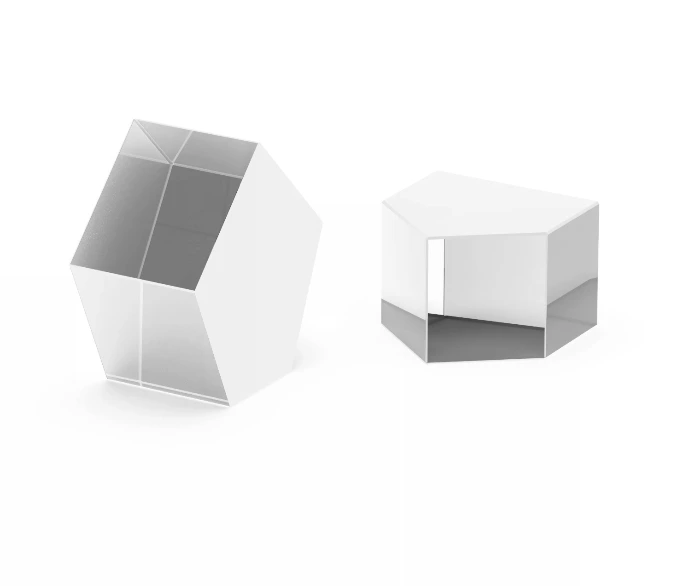
A five-sided prism that deflects a beam by exactly 90° regardless of minor rotational misalignment — while preserving image handedness (no inversion or reversal). The essential right-angle deflector for SLR camera viewfinders, surveying instruments, and precision alignment systems where a square, unflipped image is required.
Faces
5 (pentagon cross-section)
Beam deviation
Exactly 90°
Image effect
Neither inverted nor reversed
Reflections
2 (coated, not TIR)
Overview
- Five-sided prism with a pentagonal cross-section — light enters through one face and exits through an adjacent face at exactly 90°
- Two internal reflections from coated faces (not TIR) deviate the beam by 90° — unlike TIR prisms, the reflection geometry makes TIR impossible, so coatings are required
- The two-reflection path produces no image inversion or reversal — the output image is a right-handed, correct-orientation image of the input
- The 90° deviation is independent of slight rotational errors in prism orientation — a key advantage over mirrors in alignment-critical applications
- A wedge added to one reflecting face of the pentaprism (beamsplitter pentaprism) allows part of the beam to be diverted for viewfinder or monitoring purposes
- Standard element in SLR camera viewfinders, optical alignment instruments, laser leveling devices, and precision surveying equipment
Key Features
Exact 90° deviation
The pentaprism geometry is mathematically constrained to produce exactly 90° of beam deviation regardless of minor rotational misalignment of the prism about the beam axis. This property — shared with no other single reflective element except the pentaprism — is critical for surveying instruments and alignment tools where 90° accuracy must be maintained without precise prism positioning.
Right-handed image preservation
Unlike right angle prisms and Porro prisms that invert or reverse the image, the pentaprism's two-reflection path preserves image handedness — the output is a correctly oriented, non-mirrored image. This makes it the prism of choice for SLR viewfinders where the photographer must see an accurate, non-reversed view of the scene.
Rotation-insensitive 90° bend
Because the 90° deviation is a geometric property of the prism's internal angles — not dependent on precise alignment — a pentaprism maintains its 90° output even when the prism is rotated slightly about the beam axis. In contrast, a mirror must be aligned to ±arcseconds to maintain 90° deflection accuracy.
SLR viewfinder standard
The SLR camera's "hump" houses a pentaprism (or pentamirror in budget cameras) that directs light from the objective lens through the viewfinder eyepiece. The pentaprism's non-reversing property ensures the photographer sees the correct left-right orientation of the scene — a fundamental requirement for composition and aiming.
Design and Construction
Geometry & specifications
Reflecting face coatings required
- The two internal reflecting surfaces do not achieve TIR — coatings are mandatory
- Protected aluminum — standard; 85–88% reflectance per surface
- Enhanced silver — 96–97% per surface; significantly better total throughput
- Protected gold — 96–98%; for NIR and IR wavelengths
Entry/exit face coatings
- MgF₂ single-layer AR — cost-effective visible range
- BBAR multilayer — <0.5% per surface over defined waveband
- V-coat — specific laser wavelengths
Specifications
Critical tolerances
- 90° deviation accuracy: ±30 arcsec standard; ±5 arcsec precision
- Surface flatness: λ/4 standard; λ/8 precision
- Surface quality: 60-40 standard; 20-10 laser grade
- Clear aperture: typically 85–90% of the entry face Variants
- Beamsplitter pentaprism: wedge on one reflecting surface transmits ~50% through for viewfinder/ monitoring
- Roof pentaprism: adds a roof ridge for additional image axis control — used in compact SLR designs
Optical Materials
Visible & NIR
- N-BK7 — most common substrate for pentaprisms; excellent visible performance
- N-SF11 — compact high-index versions for space-constrained applications
UV-grade
- UV Fused Silica — for UV laser alignment tools and UV spectroscopy instruments
Specialty materials
Rugged & defense
- Sapphire — military surveying and laser leveling instruments; extreme scratch resistance
- BK7 HT (high homogeneity) — premium surveying instruments requiring minimum wavefront distortion
Wavelength Options
UV
- 250–400 nm
- UVFS
- UV-AR + Al coat
Visible
- 400–700 nm
- N-BK7
- Ag or Al reflect
NIR
- 700–2000 nm
- BK7 / UVFS
- Au or Ag reflect
Applications
Photography
SLR camera viewfinder
The pentaprism is the defining optical element of the SLR (single-lens reflex) camera's optical viewfinder — redirecting the image from the mirror box upward and forward to the eyepiece while maintaining correct left-right image orientation for the photographer.
Surveying
Optical squares & theodolites
Pentaprisms define an exact 90° angle in surveying instruments — used to establish perpendicular lines, right-angle corners, and reference directions in construction, land surveying, and alignment of large structures where mirror-based tools would be too sensitive to alignment error.
Alignment
Laser leveling & alignment
Rotating pentaprisms project a laser beam in a horizontal plane — sweeping a level laser line 360° around the prism without the line tilting as the prism rotates. Used in construction laser levels, machine alignment tools, and large-scale flatness measurement instruments.
Medical
Ophthalmic instruments
Used in ophthalmic instruments to redirect the observation path by 90° without altering image orientation — ensuring the examiner sees an anatomically correct view of the patient's eye structure in slit lamps, fundus cameras, and surgical microscopes.
Metrology
Coordinate measuring machines
Pentaprisms are built into the measurement heads of coordinate measuring machines (CMMs) and optical comparators to redirect the inspection beam or imaging axis by exactly 90° — providing measurement access to surfaces not visible along the primary instrument axis.
Defense
Targeting & sighting
Military sighting and targeting systems use pentaprisms to provide 90° viewing capability — allowing a soldier to look around a corner or over cover while maintaining correct image orientation for aiming accuracy.
Why choose Pentaprisms
Rotation-independent 90°
The only single-prism element that maintains exactly 90° beam deviation regardless of minor rotational misalignment — critical for surveying and alignment where precision is non-negotiable.
Correct-handedness image
Unlike right angle and Porro prisms, the pentaprism preserves image handedness — the output is neither inverted nor reversed, the only standard reflective prism with this property.
SLR viewfinder standard
The recognized standard element for SLR viewfinder systems worldwide — decades of proven reliability and optical quality in the most demanding consumer imaging application.
Available with beamsplitter
Beamsplitter pentaprism variant adds a monitoring output — enabling simultaneous viewing and metering from a single compact prism assembly without additional optical elements.
Frequently asked questions
Here are some common questions about Penta Prism.
In a pentaprism, the beam strikes each of the two reflecting faces at an angle of approximately 22.5° to the face normal — well below the critical angle for total internal reflection in any standard optical glass. TIR requires angles above the critical angle (~41° for BK7). Because 22.5° is insufficient, reflective coatings (aluminum, silver, or gold) are required on both reflecting faces. This is the main optical throughput difference between pentaprisms and TIR-based prisms like right angle and Porro designs.
An even number of reflections preserves image handedness; an odd number reverses it. A pentaprism uses two internal reflections — the even count means the output image has the same handedness as the input (not mirrored). A right angle prism using one TIR reflection would reverse the image. The two-reflection design of the pentaprism is specifically chosen to achieve 90° deviation without any image reversal.
A laser level spins a pentaprism (or equivalent reflective assembly) at 600–1800 rpm about a vertical axis while a collimated laser beam enters the prism along the rotation axis. Because the pentaprism's 90° deviation is independent of its rotational orientation, the exiting horizontal beam sweeps a perfect horizontal plane as the prism rotates — projecting a level reference line 360° around the instrument. The deviation accuracy of the pentaprism directly determines the flatness of the projected laser plane.