Roof Prism (Amici)
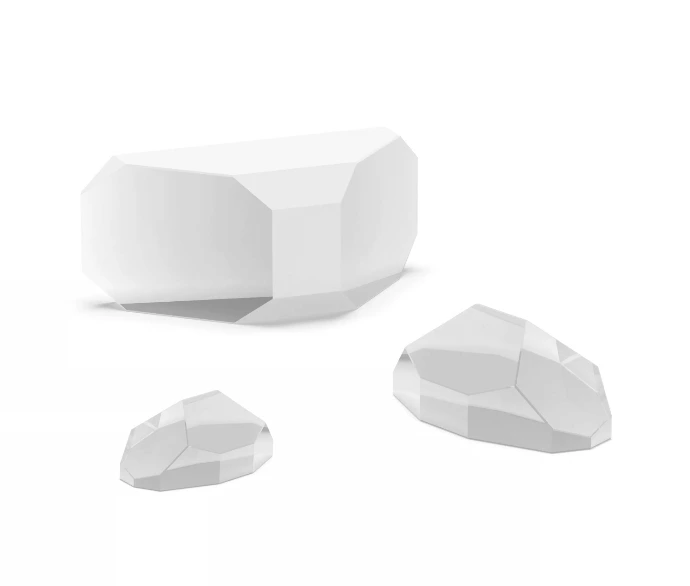
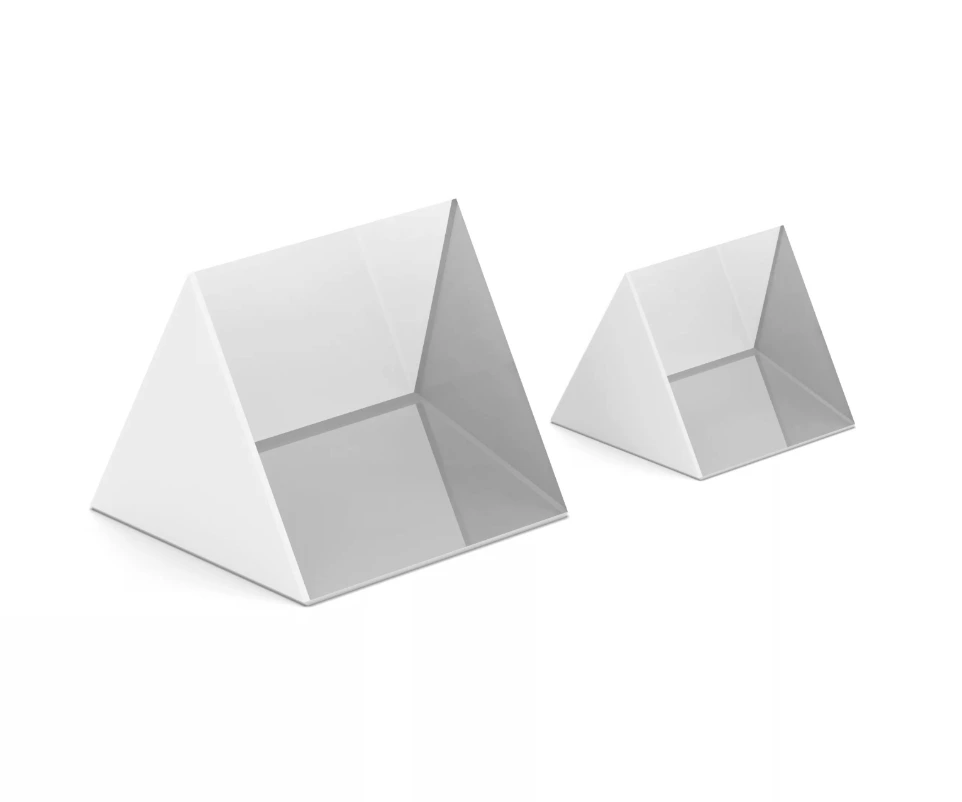
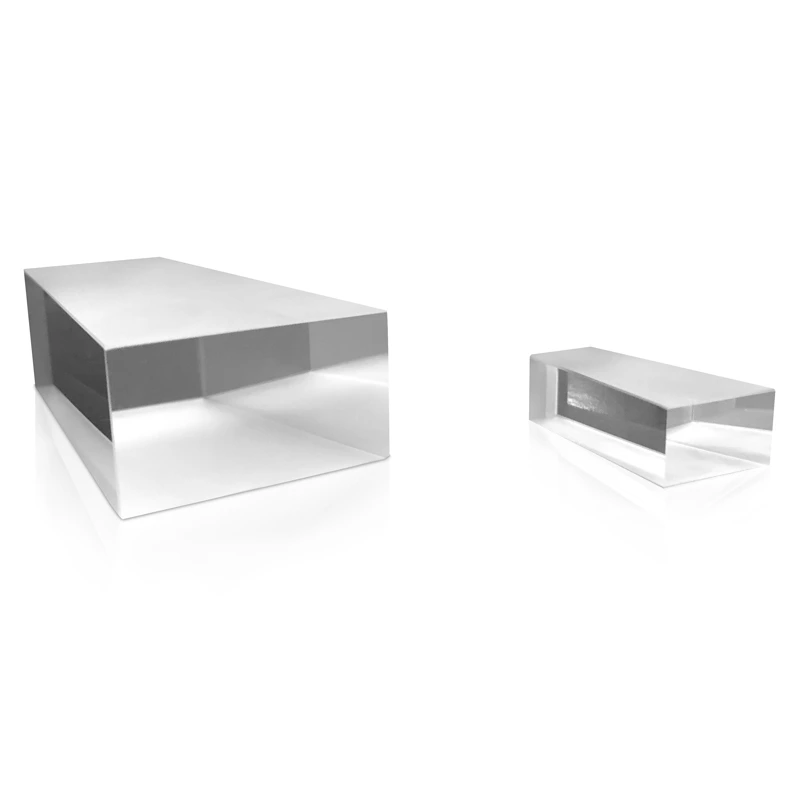
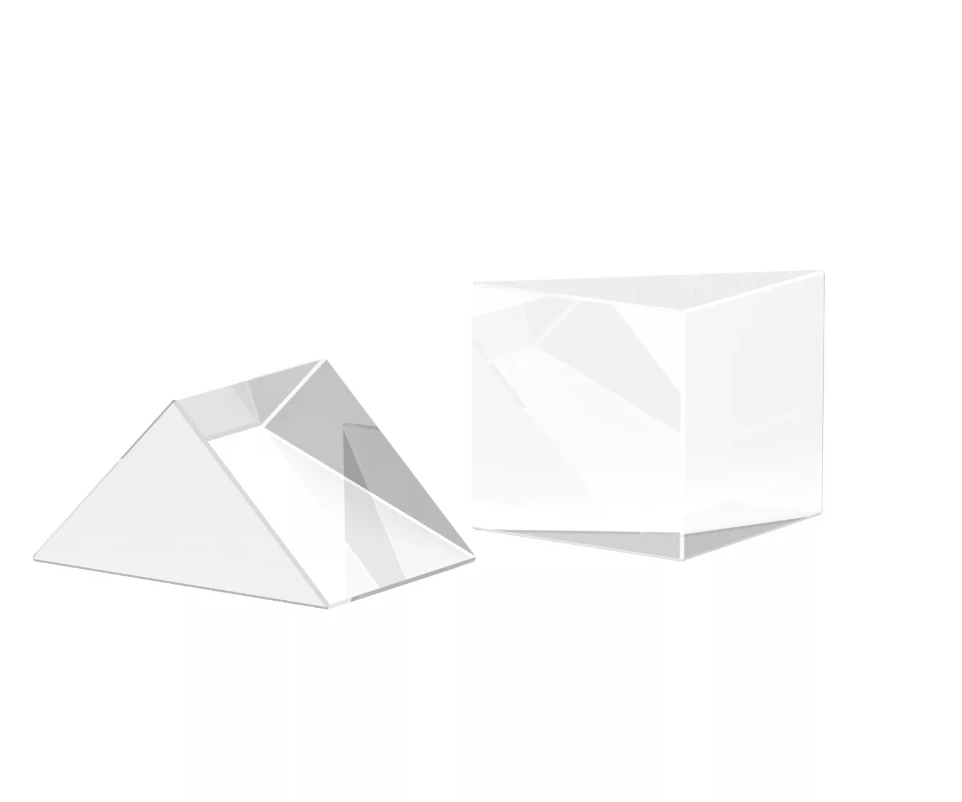
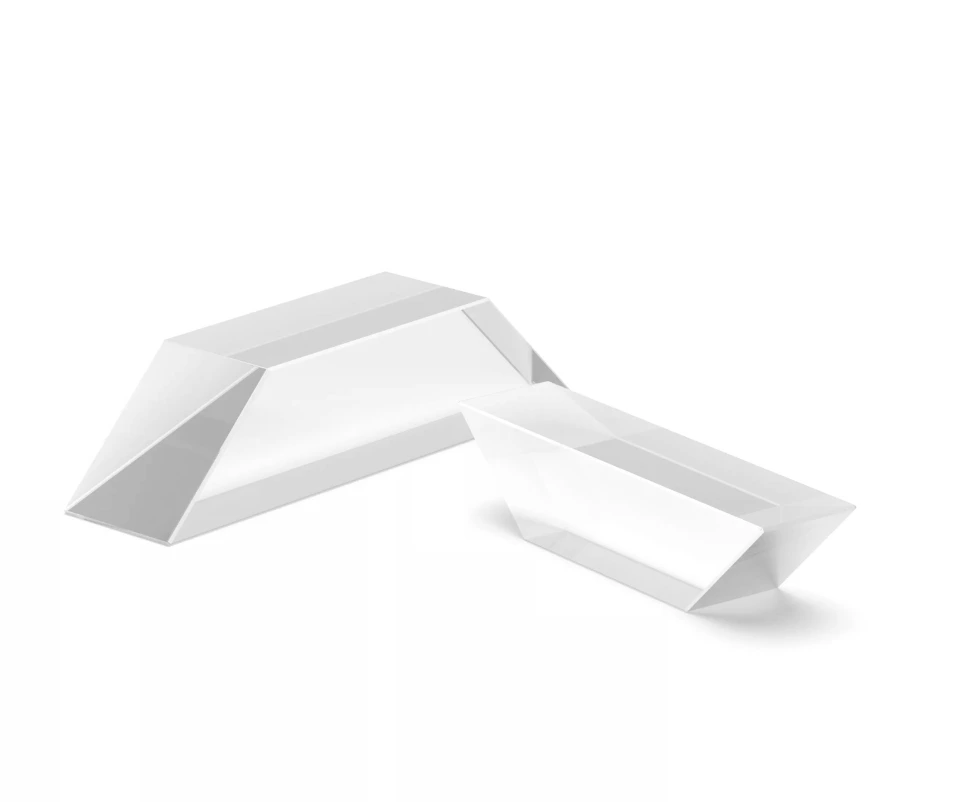
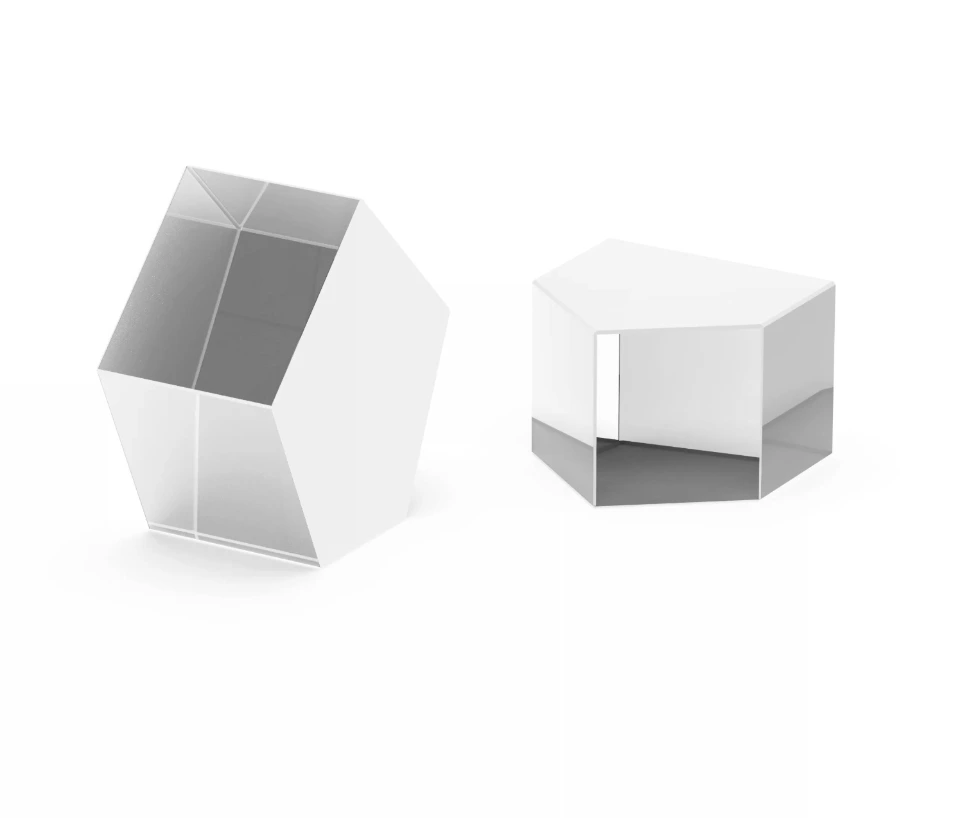
A right angle prism with the hypotenuse face replaced by a "roof" — two faces meeting at a precisely ground 90° ridge. The roof adds an extra image-axis inversion beyond a standard right angle prism, enabling a single compact prism to fully erect an image in both axes. Standard in compact binoculars, rangefinders, and spotting scopes.
Type
Right angle + roof ridge
Beam deviation
90°
Image effect
Fully erect (both axes)
Roof ridge accuracy
<2 arcsec required
Overview
- A right angle prism modified so the hypotenuse face is replaced by two faces meeting at a 90° roof angle along the prism's longitudinal axis
- Standard right angle prisms invert the image in one axis only; the roof addition inverts in the second axis as well — producing a fully erect image with a single prism
- The roof ridge must be ground and polished to better than 2 arcseconds of angular accuracy — the tightest tolerance of any standard prism, requiring specialist manufacturing
- Used in the Schmidt-Pechan and Abbe-König binocular roof prism configurations to produce compact, straight-body binoculars
- Phase-correction coatings on the roof faces are required for high-contrast performance — without them, phase shift between the two halves of the split wavefront reduces resolution and contrast
- More expensive to manufacture than Porro prism equivalents due to the stringent roof ridge tolerance requirement
Key Features
Full image erection in one prism
A single roof prism erects the image in both axes simultaneously — replacing the two-prism Porro pair in a more compact form. This enables the straight-body (in-line) binocular design where objective and eyepiece are co-axial, producing a slimmer, more compact instrument than traditional Porro-body binoculars.
Sub-arcsecond roof ridge
The 90° roof angle must be accurate to within 2 arcseconds — equivalent to the angular diameter of a coin seen from 50 km. Errors in the roof angle directly translate to double-image artifacts (image shear) in the output. Achieving this tolerance requires specialist CNC polishing, precision angle measurement, and 100% interferometric inspection of every roof prism.
Phase-correction coatings
When a wavefront reflects from the two faces of a roof prism, the two halves of the beam acquire different phase shifts due to TIR at different incidence angles. Without correction, this phase difference destroys interference and reduces contrast and resolution. Proprietary dielectric phase-correction coatings applied to both roof faces compensate this phase error — a critical quality differentiator between budget and premium binoculars.
Compact straight-body design
The single-prism image erection allows binoculars and spotting scopes to be designed with objectives and eyepieces on the same axis — producing a streamlined, pocket-friendly form factor that Porro-prism instruments cannot achieve. Roof prism designs dominate the compact and ultrac-compact binocular market.
Design and Construction
Roof ridge manufacturing
Critical ridge tolerance
- Roof angle: 90.000° ± 2 arcsec — the tightest standard angular tolerance in commercial optics
- Roof ridge sharpness: radius <0.002 mm to minimize diffraction from the ridge line
- Ridge parallelism to base face: <1 arcmin
- Inspection: 100% interferometric testing required; no sampling allowed
Common roof prism configurations
- Schmidt-Pechan: two separate prisms (a right angle and a half-pentagon) cemented or air-spaced; compact but requires phase correction
- Abbe-König: single-piece roof prism; longer but theoretically better TIR performance
- Amici: simple right-angle + roof combination; used in spotting scope eyepiece erectors
Coatings
Phase-correction coating
- Proprietary multilayer dielectric coating applied to both roof faces
- Compensates the phase difference between TIR reflections at the two roof face angles
- Without PC coating: contrast and resolution reduced by ~20–40% at the Rayleigh limit
- Premium binoculars: coatings certified to maintain phase error <15° across full visible spectrum
AR coatings
- Fully multi-coated (FMC) — BBAR AR coatings on all air-glass interfaces
- Each uncoated surface loses ~4–5% by reflection; FMC reduces this to <0.5% per surface
Optical Materials
Binocular-grade glass
High-homogeneity glass
- BAK4 — preferred; high index ensures full beam cross-section undergoes TIR at the required angles
- N-BK7 HT (high transmission) — used in premium binoculars with extra-white glass for color neutrality
- ED glass variants — extra-low dispersion glass for color-corrected roof prism binoculars
Specialty & research
Precision instruments
- UV Fused Silica — UV-range roof prisms for UV telescope erectors and microscope relay prisms
- Zero-CTE glass ceramic — thermally invariant roof prisms for precision instruments over wide temperature range
Wavelength Options
Visible
- 400–700 nm
- BAK4 / BK7 HT
- FMC AR coatings
UV
- 250–400 nm
- UV Fused Silica
- UV-AR coatings
NIR
- 700–1000 nm
- BK7 / UVFS
- NIR BBAR
Applications
Optics
Compact binoculars
The Schmidt-Pechan and Abbe-König roof prism systems are the standard erecting elements in all compact and pocket binoculars — enabling straight-body designs significantly slimmer and lighter than equivalent Porro-prism instruments.
Photography
Rangefinder cameras
Used in rangefinder and mirrorless camera viewfinder systems to produce an erect, correct-orientation image without the pentaprism's bulk — enabling slimmer camera body designs while maintaining optical viewfinder capability.
Nature
Spotting scopes & monoculars
Amici roof prisms in spotting scope eyepiece units erect the image inverted by the objective lens — producing a terrestrial-viewing correct-orientation image in a compact, straight-body spotting scope format.
Defense
Military compact optics
Compact military observation instruments, helmet-mounted vision systems, and clip-on night-vision devices use roof prism erectors to minimize package size while maintaining correct image orientation in tactical field environments.
Research
Microscope erector prisms
Amici prisms are used as erecting elements in stereo microscope observation tubes and comparison microscopes — correcting the inverted image of the objective in a compact housing without additional relay lenses.
Industrial
Endoscope image erectors
Precision roof prisms mounted in rigid endoscope relay chains erect the image in both axes at the distal end of the instrument — correcting the orientation of the endoscopic image before it is relayed to the eyepiece or camera.
Why choose Roof Prisms
Single-prism full erection
Replaces an entire Porro prism pair with one compact element — enabling straight-body optical instrument designs that Porro configurations cannot achieve.
Compact inline geometry
Allows objectives and eyepieces to be co-axial — the key design enabler for slim, lightweight compact binoculars, monoculars, and spotting scopes.
Phase-corrected for contrast
Phase-correction coatings on premium roof prisms eliminate the contrast-reducing phase artifact of the roof geometry — matching or exceeding the imaging quality of Porro designs.
Market standard
The dominant prism type in the compact binocular market — backed by decades of manufacturing refinement and widely available from dozens of precision optics suppliers.
Frequently asked questions
Here are some common questions about Roof Prism.
When a wavefront reflects from the roof of a roof prism, the two halves of the beam reflect from the two roof faces at slightly different effective angles. TIR at different incidence angles introduces different phase shifts for the p and s polarization components — creating a phase difference between the two halves of the beam. When these two halves recombine, destructive interference at certain spatial frequencies reduces contrast and resolution. Phase-correction (PC) coatings are thin-film dielectric stacks applied to the roof faces that compensate the phase error — restoring full contrast and making premium roof prism binoculars optically equivalent to Porro designs.
Schmidt-Pechan: two-prism assembly, shorter path length, more compact — standard in pocket binoculars; requires dielectric silver coatings on non-TIR faces reducing throughput. Abbe-König: single-prism design, longer path length but all reflections are TIR — theoretically higher throughput; used in premium European binoculars. In practice, modern high-reflectance coatings minimize the Schmidt-Pechan throughput penalty — and its compact form factor dominates the market.
Any error in the 90° roof angle causes the two halves of the reflected wavefront to be angularly misaligned — producing a shearing effect that appears as double imaging or reduced resolution. An error of 4 arcseconds in the roof angle produces visible image shear in a 10× binocular. The 2-arcsecond tolerance required for quality roof prisms is among the tightest angular tolerances in commercial optical manufacturing — demanding interferometric measurement of every individual prism.