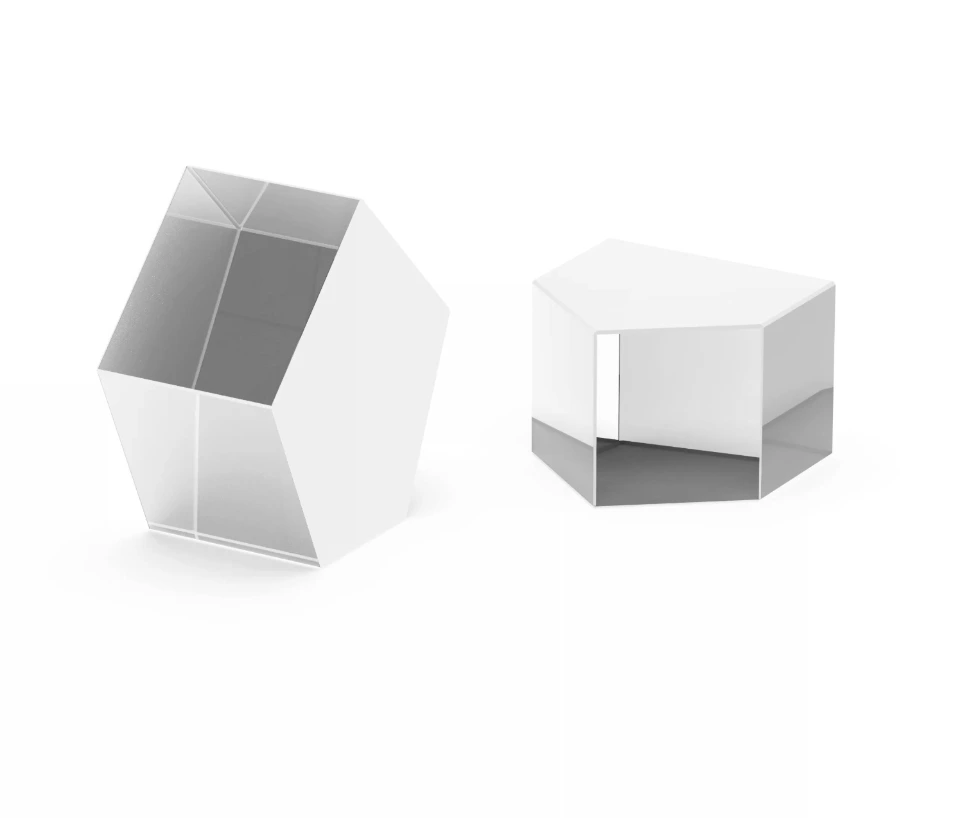
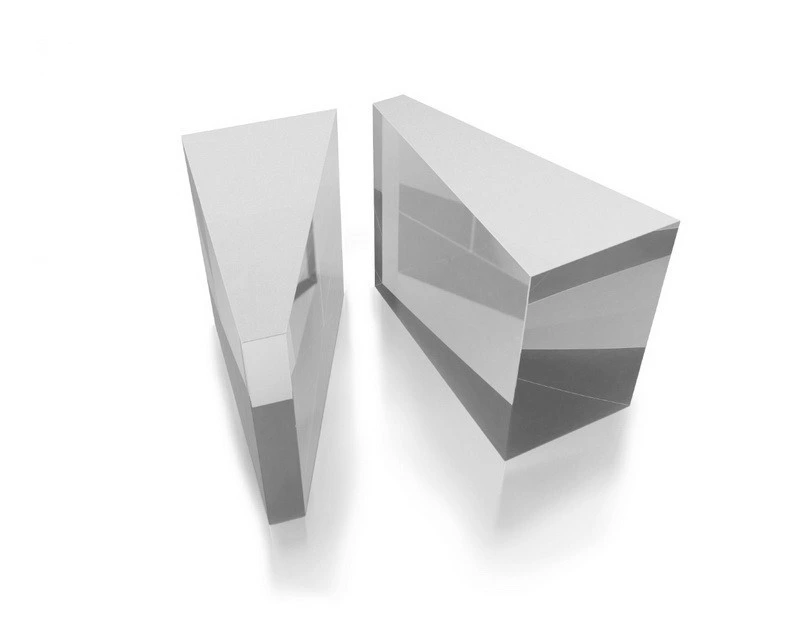
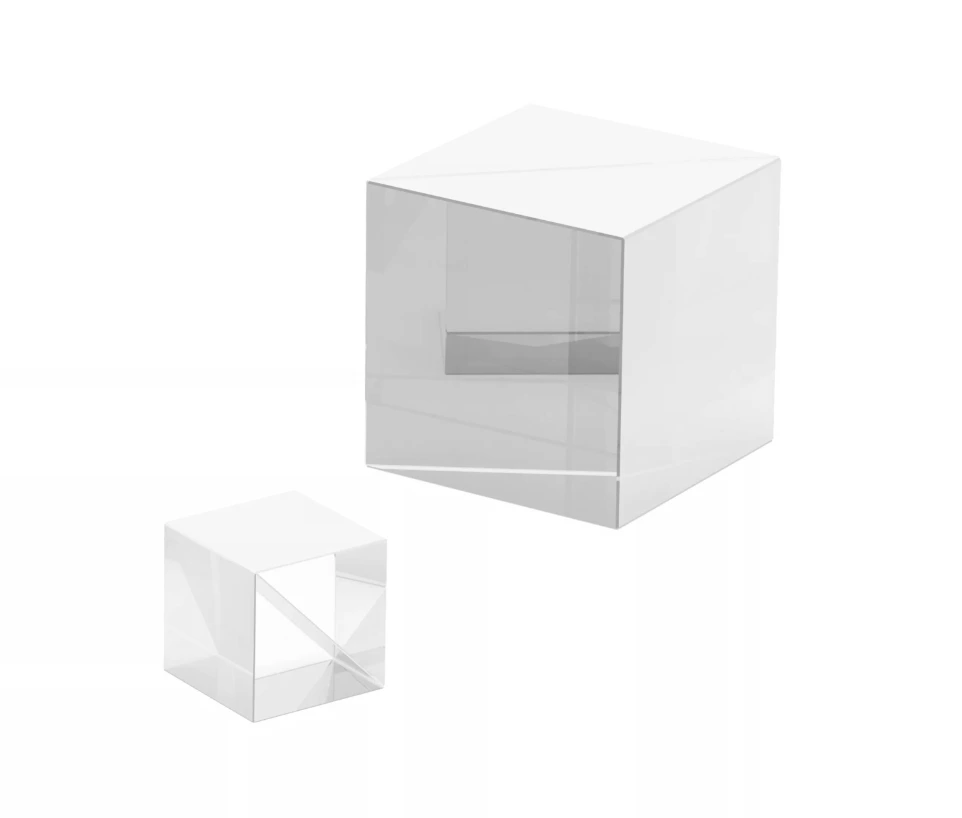
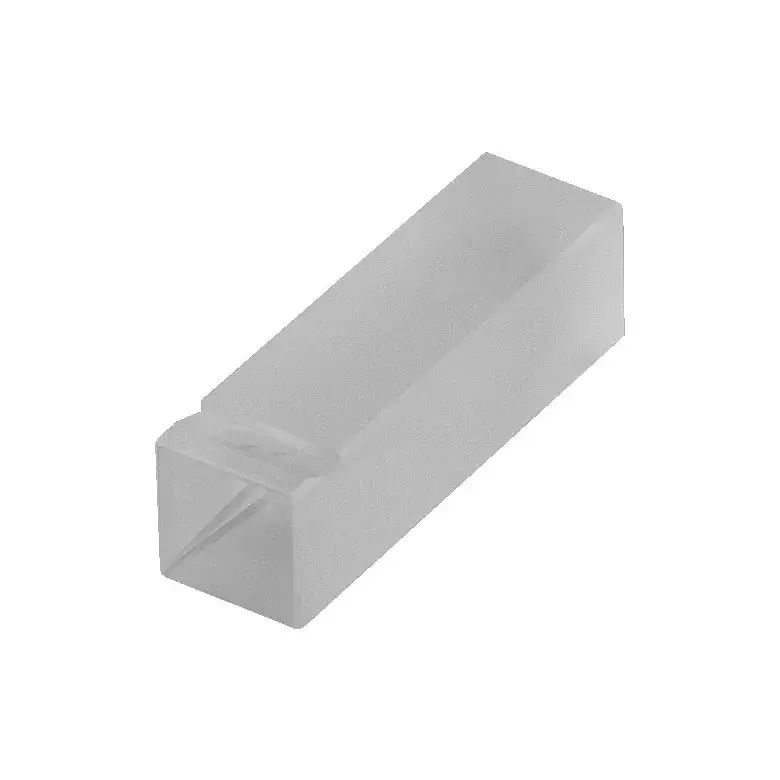
Wollaston Prism
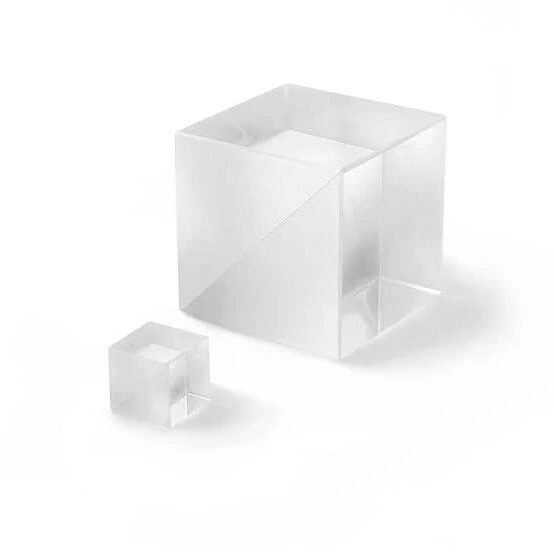
A birefringent crystal prism that separates an unpolarized beam into two orthogonally polarized output beams diverging symmetrically about the optical axis — producing complete polarization separation with both output beams containing usable light. The standard polarizing beam splitter for applications requiring both polarization states simultaneously.
Construction
Two cemented birefringent prisms
Outputs
Two diverging polarized beams
Separation angle
10°–45° (material & cut dependent)
Extinction ratio
>100,000:1 (calcite)
Overview
- Constructed from two birefringent crystal prisms (calcite, quartz, MgF₂, or α-BBO) cemented together with their optical axes perpendicular to each other
- At the interface, the ordinary and extraordinary ray directions swap — creating a refractive index discontinuity that bends p and s polarizations in opposite directions
- Both output beams diverge symmetrically about the input beam axis — both are completely and purely linearly polarized, orthogonal to each other
- Unlike Glan-type polarizers that block one polarization, the Wollaston transmits both — making it the only standard polarizer that recovers 100% of input photons into usable output
- Separation angle depends on the crystal birefringence (Δn) and prism apex angle — larger angle prisms give more separation
- Wavelength-dependent separation: the angular split increases with shorter wavelengths due to increased birefringence dispersion
Key Features
Both polarizations recovered
The Wollaston transmits both orthogonal polarization states into usable output beams — unlike Glan-Taylor and Glan-Thompson polarizers that dump one polarization state. This 100% photon efficiency makes it the only practical polarizing element for photon-limited applications such as single-molecule fluorescence and quantum key distribution where throwing away half the photons is unacceptable.
Ultra-high extinction ratio
Calcite Wollaston prisms achieve extinction ratios exceeding 100,000:1 — more than an order of magnitude higher than the best thin-film PBS cube. This extreme polarization purity is essential in ellipsometry, polarization spectroscopy, and Stokes parameter measurement instruments where residual cross-polarization contamination would introduce systematic measurement errors.
Symmetric output geometry
The two output beams diverge symmetrically and equally above and below the input beam axis — simplifying dual-detector optical designs. In differential detection schemes (used in magnetometry, polarimetric microscopy, and balanced homodyne receivers), both outputs illuminate identical detectors symmetrically placed about the prism axis.
Variable separation angleor
Wollaston prisms are available with separation angles from a few degrees to 45° depending on the crystal type and prism apex angle. The separation angle can be tuned to match the detector array spacing or the collimated beam diameter — placing the two output spots at exactly the required positions for a given detector geometry.
Design and Construction
Crystal geometry
Optical axis orientation
- First prism: optical axis vertical (parallel to the entry face, perpendicular to beam)
- Second prism: optical axis horizontal (rotated 90° from first prism at interface)
- At interface: ordinary ray in first prism becomes extraordinary in second, and vice versa — refraction angles differ, producing angular separation
Separation angle control
- Larger apex angle → more separation (up to material limit)
- Higher birefringence material (calcite Δn=0.172) → more separation than quartz (Δn=0.009) at same angle
- Standard angles: 10°, 15°, 20° separation for most analytical applications
Specifications
Performance parameters
- Extinction ratio: calcite >100,000:1; quartz >50,000:1; α-BBO >10,000:1
- Transmission: typically 92–96% per beam (per polarization channel, accounting for surface and cement losses)
- Angular field of view: ±10–25° depending on crystal and prism cut
- Chromatic dispersion of separation angle: significant — separation varies with wavelength
Optical Materials
Crystal materials
Highest birefringence
- Calcite (CaCO₃) — Δn=0.172; widest separation angle; 350–2300 nm; standard material for Wollaston prisms in most laboratory applications
- α-BBO (barium borate) — UV-extended range 190–2500 nm; harder than calcite; preferred for UV applications
Lower birefringence
- Crystalline Quartz (SiO₂) — Δn=0.009; smaller separation; 200–2700 nm; lower chromatic dispersion; used when small, precise separation and wide angular field are needed
- MgF₂ — UV range 120–6000 nm; used for deep UV polarization splitting
Selection guide
When to choose each material
- Calcite: maximum separation angle; visible through NIR; most cost-effective; sensitive to humidity
- α-BBO: UV applications below 350 nm; harder and more robust than calcite; slightly lower birefringence
- Quartz: small, precise separation angle; lower chromatic variation of separation; deep UV to NIR; mechanically robust
- MgF₂: only material for deep UV below 190 nm; requires specialized polishing
Wavelength Options
Deep UV
- 190–350 nm
- α-BBO / MgF₂
- UV-AR faces
UV-VIS
- 350–700 nm
- Calcite / α-BBO
- BBAR or uncoated
NIR
- 700–2000 nm
- Calcite / Quartz
- NIR BBAR
SWIR
- 2000–2700 nm
- Quartz
- SWIR coatings
Applications
Polarimetry
Stokes parameter measurement
Used in polarimeters and ellipsometers to simultaneously measure orthogonal polarization components — both outputs are simultaneously captured on dual detectors, enabling real-time Stokes vector measurement without rotating wave plates or sequential measurements.
Microscopy
DIC & polarized microscopy
Wollaston and Nomarski prisms are the essential elements of differential interference contrast (DIC) microscopy — splitting the illumination into two laterally displaced, orthogonally polarized beams that sample slightly different parts of the specimen, producing interference contrast sensitive to specimen phase gradients.
Quantum Optics
Photon pair splitting
Used in quantum key distribution (QKD) and entanglement-based quantum optics experiments to separate orthogonally polarized photon pairs — the 100% photon efficiency (both polarizations transmitted) is essential when single photon sources and detectors operate at the shot-noise limit.
Sensing
Balanced optical receivers
Wollaston prisms split a signal beam into two orthogonal polarization channels that illuminate a balanced detector pair — enabling polarization-sensitive balanced homodyne detection in optical coherence tomography, fiber sensors, and laser Doppler velocimetry.
Spectroscopy
Polarization spectroscopy
Used in polarization-resolved spectroscopy to simultaneously record spectra of both polarization states — essential for measuring optical activity (circular dichroism), birefringence, and magneto-optical effects in materials science and biochemistry.
Laser
Polarization-based beam combining
Used in reverse (as a beam combiner) to combine two orthogonally polarized laser beams into one co-propagating beam — enabling polarization multiplexing of two independent laser channels or power combination of two laser sources into a single output beam.
Why choose Wollaston Prisms
100% photon efficiency
Transmits both polarization states into usable beams — the only polarizing element that recovers all input photons into two clean polarized outputs without discarding any light.
Highest extinction ratio
Calcite Wollaston prisms achieve >100,000:1 extinction — far exceeding any thin-film PBS cube, making them essential for precision polarimetric and ellipsometric measurements.
Symmetric dual output
Both polarization beams emerge symmetrically about the input axis — ideal for balanced detector designs in differential measurement schemes.
DIC microscopy standard
The established standard element for differential interference contrast microscopy — decades of proven performance in the most quantitative biological imaging technique available.
Frequently asked questions
Here are some common questions about Wollaston.
Wollaston prism: use when you need both polarization states simultaneously — the Wollaston transmits both into usable beams with 100% photon efficiency. Higher extinction ratio (>100,000:1) than PBS cubes. Angularly dispersive (separation angle varies with wavelength). Glan-Taylor: use when you need only one polarization state with maximum extinction, or with high-power lasers (air-spaced, high LIDT). Discards the rejected polarization. Outputs a single beam with lower wavefront distortion. If your application measures both polarizations simultaneously, use Wollaston. If you need a single clean polarization for a laser or spectrometer, use Glan-Taylor.
The separation angle depends on the birefringence of the crystal: Δn = nₑ − nₒ. For calcite, both nₑ and nₒ depend on wavelength, and their difference Δn also varies with wavelength — it is larger at shorter wavelengths and smaller at longer wavelengths. This means the angular separation between the two output beams changes with wavelength — blue light splits more than red. For broadband polarimetry, this chromatic variation of separation angle must be accounted for in the detector geometry.
A Nomarski prism is a modified Wollaston where the optical axis of one or both prisms is tilted relative to the prism face. This shifts the convergence point of the two output beams outside the physical body of the prism (to a virtual location above the prism face). This shifted focal plane matches the condenser or objective pupil plane in a DIC microscope — making the Nomarski the preferred version for DIC microscopy over the standard Wollaston.