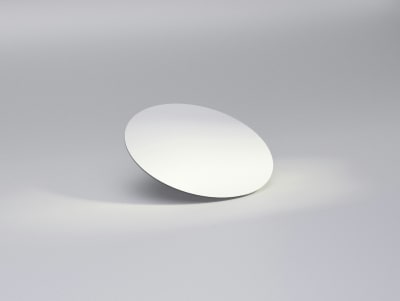
Dall- Kirkham Reflector
A Cassegrain variant that simplifies mirror fabrication by pairing an elliptical primary mirror with a spherical (rather than hyperboloidal) secondary — easing manufacturing at the cost of leaving coma uncorrected off-axis, making it best suited to planetary and narrow-field visual work rather than wide-field imaging.
Primary mirror
Concave ellipsoid
Secondary mirror
Convex sphere
Aberration left uncorrected
Coma (more than classical Cassegrain)
Best suited to
Narrow-field planetary/lunar viewing
Overview
- Uses an elliptical primary mirror — a figure notably easier to fabricate and test accurately than a true paraboloid or hyperboloid — paired with a fully spherical secondary mirror, the simplest and least expensive mirror figure to produce of any curved-surface shape
- This combination corrects spherical aberration on-axis just as effectively as a classical Cassegrain, but leaves a more pronounced degree of off-axis coma than even a classical Cassegrain design, narrowing the usably sharp field considerably
- The appeal is manufacturing simplicity and lower cost: a spherical secondary requires none of the complex aspheric figuring and testing a hyperboloidal secondary demands, making the Dall-Kirkham attractive for smaller-scale or amateur telescope makers producing high-quality on-axis optics without hyperboloid-figuring capability
- Because the usably sharp, coma-free field is narrow, the design is best matched to applications centered on a small field of view — planetary and lunar observation and imaging — rather than wide-field deep-sky work where off-axis coma would visibly degrade stars away from the center
- Historically valued by amateur telescope makers (ATMs) specifically because figuring an elliptical primary and spherical secondary is within reach of skilled hand-figuring techniques that a true hyperboloid would make substantially more difficult
Key Features
Simplified mirror fabrication
A spherical secondary is dramatically easier and cheaper to produce and test than the hyperboloidal secondary a classical Cassegrain or RC design requires.
Excellent on-axis correction
Delivers spherical-aberration-free, high-contrast images at the exact field center — well suited to planetary observation where the target sits centered in the field.
High light throughput
Applied anti-reflection coatings allow biconvex lenses to achieve transmission above 99% per surface — making them highly efficient for light collection and concentration in condensers, laser setups, and medical illumination systems.
Narrow usable field
More pronounced off-axis coma than a classical Cassegrain limits the design's usably sharp field, making it a poor fit for wide-field deep-sky imaging.
Design and Construction
Elliptical primary
- A conic figure between a sphere and a paraboloid, calculated together with the spherical secondary's power to cancel spherical aberration for the specific focal ratio combination chosen
Spherical secondary
- The simplest curved mirror figure to produce and verify, requiring only standard spherical testing methods rather than the specialized null-testing setups an aspheric secondary demands
Optical Materials
Mirror substrates
- Borosilicate or standard low-expansion glass, commonly used by amateur telescope makers given the design's accessibility to smaller-scale, hand-figuring production methods
Coatings
- Standard or enhanced aluminum coatings on both mirrors, consistent with the Cassegrain family's need to maintain throughput across two reflective surfaces
Applications
Planetary Observation
High-contrast narrow-field visual & imaging
Excellent on-axis correction suits detailed planetary and lunar observation, where the target sits at the field's coma-free center.
Amateur Telescope Making
Hand-figured optics projects
A historically popular design among amateur telescope makers for its more accessible mirror-figuring requirements.
Why choose a Dall-Kirkham Reflector
Lower-cost Cassegrain-family option
Simplified spherical secondary fabrication makes it more accessible to produce than a classical Cassegrain or Ritchey-Chrétien.
Strong on-axis, narrow-field performance
Well matched to planetary and lunar observation, where the field-center performance is what matters most.
Frequently asked questions
Here are some common questions about achromatic lens.
Coma correction in a two-mirror telescope depends on how closely the combined primary and secondary figures approach the specific mathematical relationship (fully hyperboloidal primary and secondary, as in a Ritchey-Chrétien) that cancels coma entirely. A classical Cassegrain's paraboloid-primary/hyperboloid-secondary combination is closer to that ideal relationship than the Dall-Kirkham's ellipse-primary/sphere-secondary combination, which trades further away from coma correction in exchange for the sphere's much simpler fabrication — meaning the Dall-Kirkham accepts a narrower usably sharp field as the direct cost of its manufacturing simplicity.