Laser Window
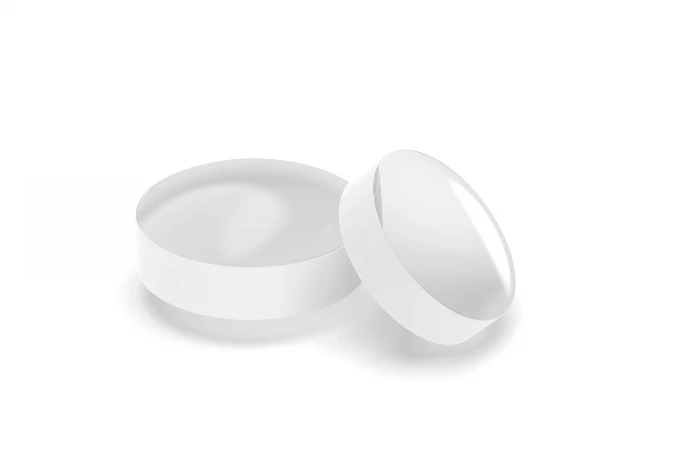
A window engineered specifically for high laser-induced damage threshold (LIDT) — combining ultra-low-absorption substrate material, premium surface polishing, and specialized AR coatings to reliably transmit high-power laser beams without optical damage. The essential beam-delivery and sealing element across every high-power laser system.
LIDT
High (J/cm² to MW/cm² class)
Surface quality
10-5 to 5-2 scratch-dig
Coating
LIDT-rated V-coat or BBAR
Substrate purity
Ultra-low absorption grade
Overview
- A flat (or occasionally wedged) window engineered and specified specifically for high laser-induced damage threshold — the maximum optical power or energy density the window can withstand before sustaining permanent damage
- Combines several engineering factors simultaneously: ultra-low-absorption substrate grade material, premium surface polishing to minimize scatter centers, rigorous subsurface damage control during fabrication, and specialized AR coatings rated for high LIDT
- LIDT specifications differ dramatically between continuous-wave (CW) and pulsed laser regimes — CW damage is typically thermally driven (absorption-induced heating), while pulsed (especially short-pulse and ultrafast) damage is often driven by different mechanisms including dielectric breakdown and multi-photon absorption
- Surface and subsurface defects — even those invisible to the naked eye — act as localized absorption or field-enhancement sites that can initiate laser damage well below the bulk material's theoretical damage threshold, making fabrication quality control as important as material selection
- Used throughout high-power laser systems as beam delivery windows, vacuum/gas seal windows for laser tubes, output couplers, and protective covers wherever the full power or energy of the laser beam must pass through the optic
- Damage threshold specifications are typically quoted for specific test conditions (wavelength, pulse duration, repetition rate, spot size) since LIDT scales differently with these parameters — a window's rated LIDT at one set of conditions cannot be directly assumed to apply at different operating conditions
Key Features
Engineered for maximum LIDT
Every aspect of the window's design and fabrication — substrate selection, polishing process, subsurface damage removal, and coating design — is optimized specifically to maximize the laser power or energy density the window can withstand before sustaining damage, often achieving LIDT values many times higher than standard-grade optical windows of the same material.
Ultra-low absorption substrate
Laser-grade substrate material is selected and processed for minimal bulk absorption — even trace impurities or inclusions in standard-grade glass can act as localized absorption sites that initiate thermal damage under high laser power, making laser-grade material certification a critical specification beyond standard optical glass.
Subsurface damage control
Specialized polishing processes minimize subsurface damage — microscopic fractures and stress regions beneath the visible polished surface left by grinding and polishing operations — that can act as damage initiation sites under high laser fluence even when the visible surface quality appears excellent.
LIDT-rated coating technology
AR coatings for laser windows use specialized low-defect-density deposition techniques (often ion-beam sputtering) and coating designs specifically optimized to maximize damage threshold — standard commercial-grade AR coatings, while optically similar in reflectance, often have substantially lower LIDT than purpose-built laser coatings.
Design and Construction
Fabrication for high LIDT
Surface preparation
- Surface quality: 10-5 to 5-2 scratch-dig — significantly tighter than standard 60-40 commercial grade
- Subsurface damage removal through extended fine-polishing and etching processes
- Surface flatness: λ/8 to λ/10 — minimizes wavefront distortion under high-power operation
Damage threshold regimes
- CW laser damage: typically thermally driven, scales with absorption coefficient and thermal conductivity
- Long-pulse (ns) damage: often defect/inclusion driven; surface and coating quality dominate
- Ultrashort-pulse (fs/ps) damage: dominated by nonlinear multi-photon absorption and dielectric breakdown mechanisms
Coating & testing
Coating deposition methods
- Ion-beam sputtering (IBS) — produces the highest-density, lowest-defect coatings for maximum LIDT applications
- E-beam evaporation with ion-assisted deposition — good LIDT performance at lower cost than IBS
LIDT testing & certification
- Tested per industry standards (e.g. ISO 21254) at specified wavelength, pulse duration, and spot size conditions
- Certified LIDT ratings provided with traceable test reports for critical high-power system applications
Optical Materials
Laser-grade substrate materials
UV to visible high-LIDT substrates
- UV-grade Fused Silica (Suprasil-type) — premium purity for high-power UV and visible laser windows
- CaF₂ — excellent UV transmission and high LIDT for excimer and UV laser applications
NIR & IR high-LIDT substrates
- N-BK7 (laser grade) — high-LIDT visible/NIR applications where fused silica is not required
- ZnSe (laser grade) — high-power CO₂ laser windows with optimized low-absorption purity
Coating materials
Low-loss dielectric coatings
- Ta₂O₅/SiO₂ — standard high-LIDT dielectric AR coating combination
- HfO₂/SiO₂ — alternative for specific wavelength or high-power UV laser window designs
Wavelength Options
UV laser
- 193–400 nm
- UVFS / CaF₂
- LIDT-rated AR
Visible/NIR laser
- 400–1100 nm
- N-BK7 / UVFS (laser grade)
- LIDT-rated V-coat
Telecom/fiber laser
- 1064–1550 nm
- UVFS
- High-power V-coat
CO₂ laser
- 10.6 µm
- ZnSe (laser grade)
- LIDT-rated V-coat
Applications
Industrial
High-power laser beam delivery
Beam delivery windows in industrial laser cutting, welding, and additive manufacturing systems handling kilowatt-level continuous or pulsed laser power, where damage would cause costly system downtime and potential equipment damage.
Defense
Directed energy & high-energy laser systems
Output and beam delivery windows for high-energy laser weapon and countermeasure systems, where reliable performance at extreme power densities is a mission-critical requirement.
Research
Ultrafast & high-peak-power laser facilities
Beam path windows in femtosecond and petawatt-class laser research facilities, where extreme peak power densities demand the highest available LIDT performance to avoid catastrophic optic failure.
Semiconductor
Laser annealing & lithography systems
High-LIDT windows in laser annealing, laser drilling, and photolithography systems used in semiconductor manufacturing, where consistent high-power performance directly affects production yield and uptime.
Medical
Surgical & therapeutic laser systems
Beam delivery windows in high-power surgical and therapeutic laser systems, where reliable transmission at the prescribed treatment power level is essential for both clinical efficacy and patient safety.
Telecommunications
High-power fiber laser & amplifier windows
Used in high-power fiber laser and amplifier systems for telecommunications and industrial applications, handling the increasing power levels of modern fiber laser sources without optical damage.
Why choose Laser Windows
Purpose-built for high power
Every fabrication step — substrate, polishing, and coating — is specifically optimized to maximize laser damage threshold, unlike standard optical windows adapted for laser use.
Certified, traceable LIDT ratings
Tested and certified to industry standards under specified conditions, providing the reliable performance data needed for critical high-power system design.
Subsurface quality control
Rigorous subsurface damage removal addresses failure modes invisible to standard surface inspection — a key differentiator from commercial-grade optics.
Available across all laser wavelengths
Laser-grade substrates and coatings span UV through CO₂ laser wavelengths — covering the full range of industrial, research, and defense laser system requirements.
Frequently asked questions
Here are some common questions about achromatic lens.
Standard commercial-grade optical windows are manufactured to specifications adequate for general imaging and illumination applications, but are not optimized for high laser power handling. They may contain trace material absorption, surface and subsurface defects, and coatings deposited by lower-cost methods — all of which can act as damage initiation sites well below the power level a purpose-built laser window of the same nominal material could handle. Using a standard-grade window in a high-power laser system risks premature optical damage, costly downtime, and potential cascading damage to downstream components from the resulting beam disruption.
Different pulse duration regimes damage optics through fundamentally different physical mechanisms. Continuous-wave and long-pulse (microsecond to millisecond) damage is generally thermally driven — absorbed energy heats the material faster than it can dissipate, leading to thermally induced fracture or melting. Nanosecond-pulse damage is often driven by localized defects and inclusions that absorb disproportionately and reach damage threshold before the bulk material does. Ultrashort pulses (picosecond and femtosecond) can damage even defect-free material through nonlinear processes like multi-photon absorption and avalanche ionization, which become significant only at the extreme instantaneous intensities found in ultrashort pulses. Because of these different mechanisms, a window's LIDT rating at one pulse duration cannot be assumed to predict its performance at a very different pulse duration.
Standard practice in laser system design applies a safety factor — commonly operating at no more than 50% (and often less, such as 25–30%, for critical or continuously operating systems) of the window's certified LIDT rating, measured under conditions matching or exceeding your actual operating wavelength, pulse duration, repetition rate, and beam spot size. This margin accounts for manufacturing variability between production lots, gradual degradation of optical coatings over operational lifetime, and any uncertainty in actual operating conditions compared to the rated test conditions, helping to ensure long-term reliable operation rather than operating at the edge of failure.