Dichroic Mirror
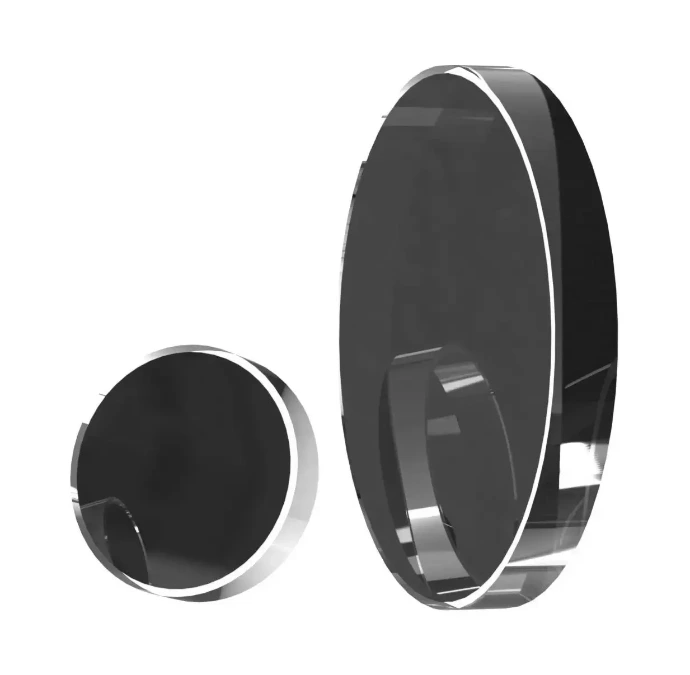
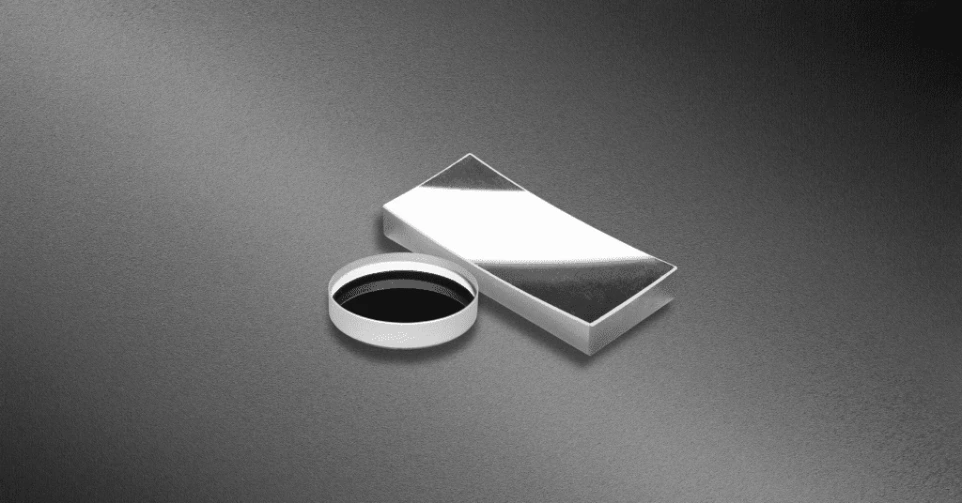
A mirror engineered with multilayer dielectric coatings to reflect one wavelength band while transmitting another — splitting or combining light by color rather than intensity. The defining optical element of fluorescence microscopy, laser harmonic separation, and any system requiring wavelength-selective beam routing.
Function
Wavelength-selective reflect/transmit
Coating type
Multilayer dielectric thin-film
Typical use angle
45°
Edge steepness
As sharp as a few nm
Overview
- A dielectric multilayer-coated mirror designed to have substantially different reflectance for two distinct wavelength regions — high reflectance in one band, high transmission in another
- The wavelength-dependent reflection arises from constructive and destructive thin-film interference engineered through precise control of layer thicknesses and refractive indices in the coating stack
- Used as harmonic separators in nonlinear optics setups — splitting a fundamental laser wavelength from its second or third harmonic generated by frequency conversion crystals
- The dichroic edge wavelength (the transition point between high reflection and high transmission) can be engineered to fall anywhere across the optical spectrum by appropriate coating design
- Performance is angle-dependent — the spectral position of the transmission/reflection edge shifts toward shorter wavelengths as the angle of incidence increases from normal
- The fundamental beam-splitting element in fluorescence microscopy, separating excitation light (reflected to the sample) from longer-wavelength emission light (transmitted to the detector)
Key Features
Wavelength-selective splitting
Unlike a neutral beamsplitter that divides light by intensity regardless of wavelength, a dichroic mirror divides light by color — directing one spectral band along the reflected path and a different spectral band along the transmitted path, with minimal loss in either channel.
Fluorescence microscopy core element
Reflects the shorter-wavelength excitation light toward the specimen while transmitting the longer-wavelength (Stokes-shifted) fluorescence emission to the detector — the fundamental optical principle that makes epifluorescence and confocal microscopy possible, efficiently separating weak emission signal from strong excitation light along the same optical path.
Laser harmonic separation
Used to separate the fundamental wavelength of a laser from harmonics generated by nonlinear frequency-doubling or tripling crystals — for example, separating residual 1064 nm IR light from 532 nm green light generated by a KTP doubling crystal, routing each wavelength to its intended downstream application.
Custom spectral edge engineering
The reflection/transmission edge wavelength, edge steepness, and out-of-band performance are all precisely engineered through the dielectric layer stack design — allowing dichroic mirrors to be customized for virtually any required spectral splitting point, from steep single-nanometer transitions to broad gradual edges.
Design and Construction
Coating design
Multilayer stack architecture
- Alternating high- and low-refractive-index dielectric layers (e.g. TiO₂/SiO₂) deposited by ion-beam sputtering or e-beam evaporation
- Layer count: typically 20–100+ layers depending on required edge steepness and out-of-band suppression
- Each layer thickness precisely controlled to quarter-wave or custom optical thickness for the target spectral response
Performance specifications
- Reflection band: typically >95–99% reflectance
- Transmission band: typically >90–95% transmission
- Edge steepness: from a few nm (steep edge filters) to 50+ nm (gradual dichroic beamsplitters)
Angle dependence & substrate
Angle-of-incidence effects
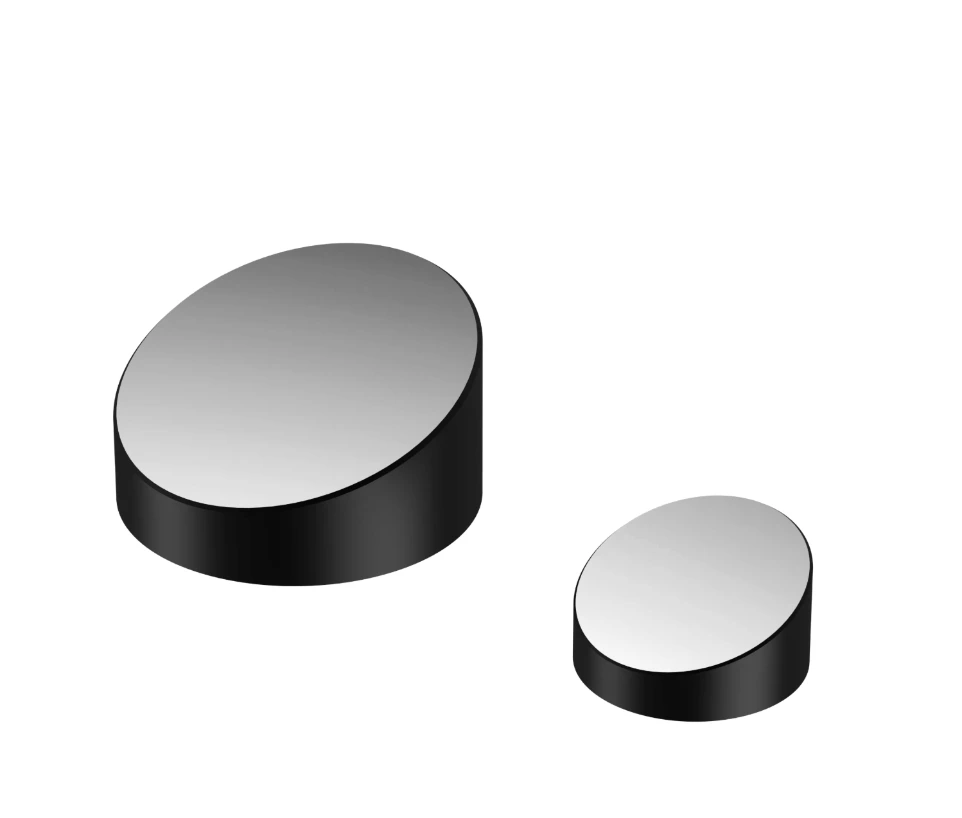
- Standard design angle: 45° (most common for beam-folding dichroic applications)
- Edge wavelength shifts toward shorter wavelengths as AOI increases from normal incidence
- Polarization-dependent performance at non-normal angles — s and p polarizations see slightly different edge positions
Substrate options
- BK7 / fused silica plates — standard substrates for visible and NIR dichroic mirrors
- Glass thickness affects flatness and wavefront distortion of the transmitted beam
Optical Materials
Coating materials
High-index layer materials
- TiO₂ (titanium dioxide) — n≈2.4; standard high-index layer for visible/NIR dichroics
- Ta₂O₅ (tantalum pentoxide) — n≈2.1; lower absorption, used for high-power laser dichroics
- Nb₂O₅ (niobium pentoxide) — alternative high-index material for specific spectral designs
Low-index layer materials
- SiO₂ (silicon dioxide) — n≈1.46; standard low-index layer across all dichroic designs
- MgF₂ — alternative low-index material for UV-extended dichroic coatings
Substrate materials
By wavelength range
- N-BK7 — standard visible/NIR dichroic substrate
- UV Fused Silica — UV-extended dichroic mirrors and high-power laser harmonic separators
- CaF₂ — deep UV dichroic mirrors for excimer laser harmonic separation
Wavelength Options
UV
- 250–400 nm
- UVFS / CaF₂
- UV dichroic coating
Visible
- 400–700 nm
- N-BK7
- Standard dichroic
NIR
- 700–1600 nm
- BK7 / UVFS
- NIR dichroic / harmonic
SWIR/MIR
- 1.6–5 µm
- Specialty substrate
- IR dichroic coating
Applications
Microscopy
Fluorescence excitation/emission splitting
The essential element of every epifluorescence and confocal microscope filter cube — reflecting excitation light toward the sample while transmitting the longer-wavelength fluorescence emission to the detector along the same optical axis, enabling efficient single-objective fluorescence imaging.
Laser Systems
Harmonic & wavelength separation
Separates fundamental and harmonic laser wavelengths in nonlinear frequency conversion setups (e.g. separating 1064 nm from 532 nm in frequency-doubled Nd:YAG systems), routing each wavelength to its intended downstream optical path or application.
Imaging
Multi-spectral beam combining
Used in RGB laser projectors, multi-wavelength confocal scanning systems, and multi-color imaging instruments to combine or split multiple discrete laser wavelengths along a single optical path with minimal loss in any channel.
Telecommunications
WDM channel separation
Dichroic-coated mirrors and filters separate individual wavelength channels in coarse wavelength division multiplexing (CWDM) optical communication systems — routing each wavelength channel to its designated receiver.
Solar
Spectrum-splitting photovoltaics
Used in spectrum-splitting concentrated photovoltaic systems to direct different portions of the solar spectrum to different photovoltaic cell types optimized for absorption in that specific wavelength band, improving overall conversion efficiency.
Projection
Digital cinema & projector optics
Combines separate red, green, and blue laser or LED light sources into a single co-axial beam for projection display systems — the X-cube and dichroic prism assemblies in digital projectors rely on this wavelength-selective combining function.
Why choose Dichroic Mirrors
Wavelength-selective, not intensity-based
Splits light by color rather than power fraction — enabling efficient simultaneous routing of two different wavelength bands with minimal loss in either channel, unlike a neutral beamsplitter.
Fluorescence microscopy standard
The defining optical element of every fluorescence microscope filter cube worldwide — decades of proven performance in the most demanding biological imaging application.
Engineered spectral edge
Edge wavelength, steepness, and out-of-band performance are all customizable through coating design — enabling precise tailoring to virtually any wavelength-splitting requirement.
High efficiency in both channels
Properly designed dichroics achieve >95% reflectance and >90% transmission simultaneously — far more efficient than splitting by a neutral 50:50 beamsplitter for wavelength-separated applications.
Frequently asked questions
Here are some common questions about achromatic lens.
Thin-film interference coatings are designed based on the optical path length within each layer, which depends on the angle at which light travels through the layer. As the angle of incidence increases from normal (0°), the effective optical path length through each layer decreases — shifting the entire interference pattern, and therefore the reflection/transmission edge, toward shorter wavelengths. This is why dichroic mirrors are specified and manufactured for a particular design angle (commonly 45°), and why using one at a significantly different angle than designed shifts its spectral performance from the specification.
The terms are often used interchangeably, but "dichroic mirror" typically implies use at an angle (commonly 45°) to fold the optical path while splitting wavelengths — combining the beam-folding function of a mirror with spectral selectivity. "Dichroic filter" more commonly implies use at normal incidence (0°) purely for spectral filtering without beam redirection. The underlying multilayer dielectric coating technology is the same in both cases; the distinction is primarily about the angle of use and resulting beam geometry function.
Hot and cold mirrors are specific categories of dichroic mirrors with a fixed splitting point at the visible/infrared boundary (typically around 700–750 nm). A cold mirror reflects visible light and transmits infrared (used to remove heat from a light beam while preserving the visible image). A hot mirror does the opposite — transmits visible light and reflects infrared back toward the source. General-purpose dichroic mirrors can be designed with any edge wavelength anywhere in the spectrum, not just at the visible/IR boundary, making "dichroic mirror" the broader category term.