Right Angle Prism
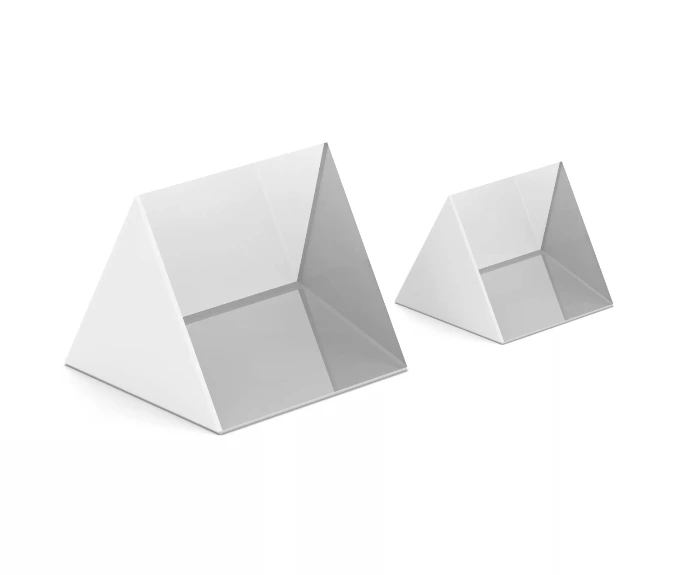
The most fundamental and widely used optical prism — a solid glass triangular prism with angles of 45°–90°–45°. Used to redirect beams by 90° or 180° through total internal reflection, and to invert or reverse images in imaging systems from binoculars to industrial cameras.
Angles
45° – 90° – 45°
Beam deviation
90° or 180°
Image effect
Inverts or reverses
Reflection type
TIR (no coating needed)
Overview
- Triangular cross-section with one 90° face (hypotenuse) and two 45° faces — the simplest reflective prism geometry
- When light enters through the hypotenuse and strikes one 45° face at normal incidence, it reflects 90° via TIR and exits through the other 45° face
- When light enters one 45° face at normal incidence, TIR occurs at the hypotenuse, and the beam exits 90° deflected from the other 45° face
- Two right angle prisms placed hypotenuse-to-hypotenuse form a beamsplitter cube or a 180° retroreflector depending on orientation
- TIR at the hypotenuse face requires no reflective coating — total internal reflection is lossless and wavelength-independent
- The most stocked, most affordable, and most widely deployed prism in the optics industry worldwide
Key Features
90° beam deflection
Redirects a collimated or diverging beam by exactly 90° with a single element — replacing a mirror and mount combination in a more compact, thermally stable, and vibration-resistant package. The right angle between entry and exit faces guarantees the 90° deviation regardless of minor rotational misalignment.
Image inversion & reversal
A single right angle prism used as a beam folder inverts the image in one axis. Two prisms in sequence (Porro configuration) invert in both axes — erecting the image for binoculars and riflescopes. The specific image effect depends on the orientation and number of reflections.
TIR — no coating loss
When the angle of incidence at the hypotenuse exceeds the critical angle for the glass-air interface (~41° for BK7), total internal reflection is achieved — reflecting 100% of the light with no metal or dielectric coating required. This makes TIR-based right angle prisms more efficient than silvered or gold-coated mirrors.
Interferometric stability
A glass prism is mechanically stiffer and thermally more stable than a mirror-and-mount assembly. The monolithic glass body eliminates flexure and vibration-induced pointing errors — making right angle prisms the preferred beam-folding element in interferometers, laser cavities, and precision metrology instruments.
Design and Construction
Geometry & specifications
Face geometry
- Two legs (45° faces): square aperture, polished to high flatness
- Hypotenuse face: rectangular, polished; used for TIR or as an entrance/exit face depending on orientation
- Roof variants: hypotenuse replaced by a roof (two faces meeting at 90°) for additional image axis control
Key tolerances
- Angle accuracy: ±3 arcmin standard; ±30 arcsec precision; ±5 arcsec laser grade
- Surface flatness: λ/4 standard; λ/8 to λ/10 precision
- Surface quality: 60-40 standard; 20-10 laser grade
- Dimensional tolerance: ±0.1 mm standard; ±0.01 mm precision
Coating options
TIR configurations (no coating)
- Uncoated hypotenuse — TIR at angles above critical angle; >99.9% reflectance
- Suitable for beam angles within the TIR acceptance cone of the glass type
Coated configurations
- Protected aluminum — hypotenuse reflective coating for non-TIR geometries; 85–90% reflectance
- Protected silver — 95–97% reflectance visible through NIR
- Enhanced silver or gold — for NIR and IR; 96–99% reflectance
- AR coatings on entry/exit faces — MgF₂, BBAR, V-coat
Optical Materials
Standard optical glass
Visible & NIR
- N-BK7 — industry standard; excellent transmission 350–2000 nm; most common right angle prism material
- N-SF11 — high-index flint; critical angle 34° vs 41° for BK7; used where wider TIR cone is needed
- Sapphire (Al₂O₃) — hardest optical material; UV through 5.5 µm; autoclavable; rugged environments
UV-grade
- UV Fused Silica — transmission 185–2100 nm; laser-grade excimer and UV prisms
- CaF₂ — 130 nm–10 µm; deep UV spectroscopy and UV laser beam folding
Infrared materials
MWIR & LWIR
- Silicon (Si) — 1.2–8 µm; lightweight; MWIR imaging system beam folders
- Germanium (Ge) — 2–12 µm; high index (n=4.0); LWIR and thermal imaging beam folding
- Zinc Selenide (ZnSe) — 0.5–20 µm; low absorption; CO₂ laser beam routing prisms
- Zinc Sulfide (ZnS) — 0.4–12 µm; harder than ZnSe; rugged defense and FLIR applications
Wavelength Options
Deep UV
- 185–350 nm
- UVFS / CaF₂
- UV-AR on faces
Visible
- 400–700 nm
- N-BK7
- BBAR or uncoated
NIR
- 700–2000 nm
- BK7 / UVFS
- NIR BBAR
MWIR
- 2–5 µm
- Si / ZnSe
- BBAR 3–5 µm
LWIR
- 8–12 µm
- Ge / ZnSe
- BBAR + DLC
Applications
Laser Systems
Beam folding & routing
Redirects laser beams by 90° within compact laser heads, interferometers, and laser scanners without the mounting flexibility and vibration sensitivity of mirrors. TIR-based prisms add no reflectivity loss at visible and NIR wavelengths.
Imaging
Image inversion
Used in imaging instruments to invert the image in one axis — correcting the inverted image produced by camera lenses, periscopes, and relay systems. Pairs with a second prism for two-axis erection in binocular and telescope designs.
Metrology
Interferometers
The monolithic rigidity and thermal stability of glass prisms makes right angle prisms the preferred beam-folding element in precision interferometers, where mirror flexure or resonance would introduce wavefront error and fringe instability.
Sensing
Optical sensors
Used in compact sensor assemblies to redirect beams through enclosed packages, align optical paths between non-coaxial source and detector, and fold optical paths for path-length extension in gas absorption and fluorescence sensors.
Defense
Periscopes & sights
Forms the image-erecting element in periscope assemblies and rifle sight systems. The rugged monolithic glass construction withstands shock and vibration environments that would knock a mirror out of alignment.
Telecoms
Fiber & photonic routing
Miniature right angle prisms (2–10 mm) are used in free-space optical switches, optical isolator assemblies, and photonic integrated circuit coupling structures to redirect light within the package footprint.
Why choose Right Angle Prisms
TIR — zero coating loss
Total internal reflection at the hypotenuse reflects 100% of incident light with no metal or dielectric coating required — more efficient than any mirrored surface at visible and NIR wavelengths.
Monolithic rigidity
A solid glass prism has no flexure, no adjustment screws, and no resonant modes — far more mechanically stable than a mirror-and-mount combination in vibration or shock environments.
Widest material range
Available in UV fused silica, BK7, germanium, ZnSe, and sapphire — covering UV through LWIR with consistent geometry and the same optical function across all wavelengths.
Most available prism type
Stocked in the largest range of sizes, materials, and coatings by all major suppliers — enabling fast prototyping and system assembly without custom manufacturing lead times.
Frequently asked questions
Here are some common questions about achromatic lens.
Total internal reflection requires the angle of incidence at the hypotenuse to exceed the critical angle: arcsin(1/n). For N-BK7 (n=1.517) this is ~41°. A beam entering at exactly normal incidence hits the hypotenuse at 45° — well above 41° — so TIR is reliable. However, if the beam is highly convergent or divergent, marginal rays may arrive at angles below the critical angle, reducing reflectance. For high-NA beams, a reflective coating on the hypotenuse is recommended.
Orientation A (beam enters hypotenuse, exits a 45° leg after one TIR): beam is deviated 90°, image is inverted in one axis. Orientation B (beam enters one 45° leg, TIR at hypotenuse, exits other 45° leg): beam is deviated 90°, image is rotated. The specific image transformation depends on which faces the beam enters and exits through — critical in imaging applications where image orientation must be controlled.
Yes, with appropriate material and surface quality selection. UV fused silica prisms with laser-grade surfaces (20-10 scratch-dig, λ/8 flatness) and LIDT-rated AR coatings on entry/exit faces handle multi-watt CW and pulse laser beams. The TIR surface requires no coating — eliminating the coating damage threshold as a failure mechanism. Avoid N-BK7 at UV wavelengths due to two-photon absorption.
A roof prism replaces the flat hypotenuse face with two faces meeting at a precisely ground 90° "roof" ridge. The two roof faces together act as a retroreflector in the plane perpendicular to the original reflection — adding an additional image-axis inversion. This allows a single compact prism to erect an image in both axes, used in spotting scopes and binoculars where a Porro prism pair would be too bulky.
Yes. Custom right angle prisms are available in any aperture size (standard range 2–150 mm), any optical glass or crystal substrate, with specified angle tolerances, surface quality grades, and AR or reflective coatings. Custom sizes in germanium and ZnSe for thermal imaging beam-folding are particularly common requests.