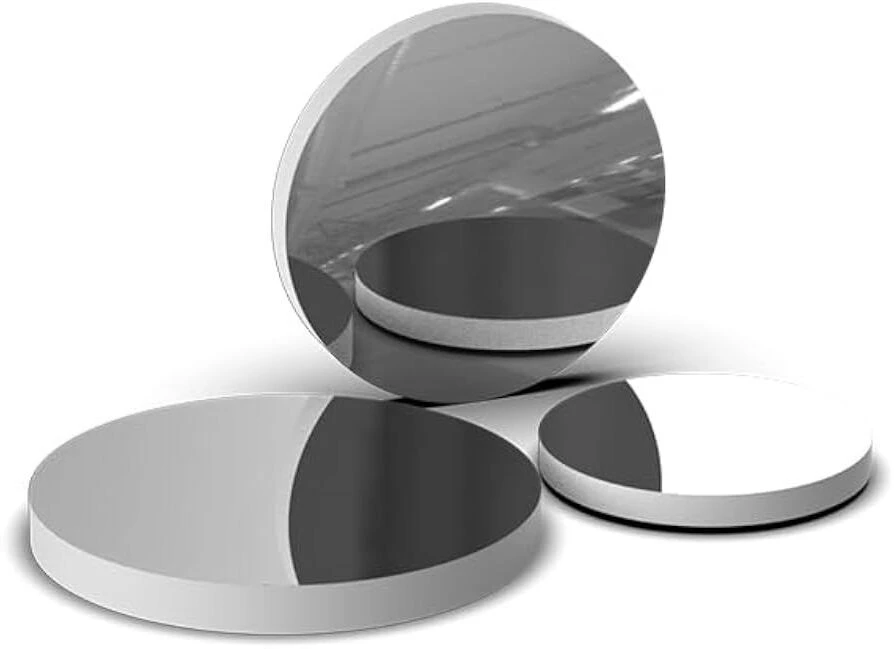
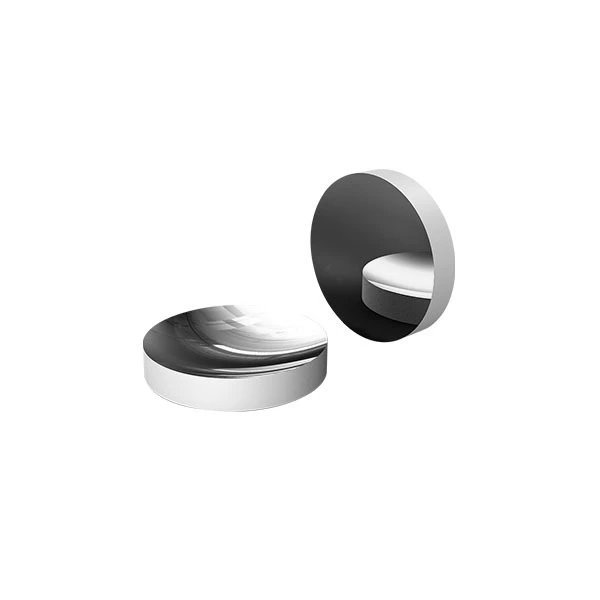
Cylindrical Mirror
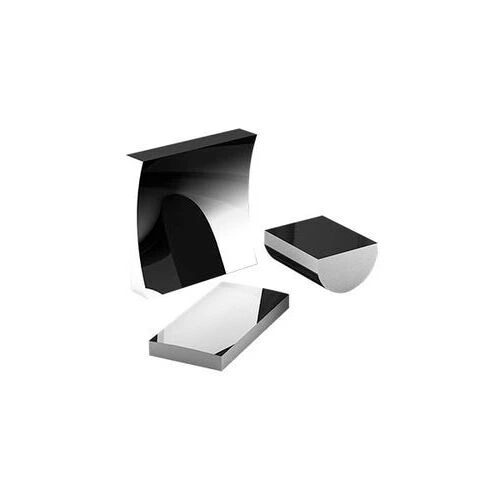
A mirror curved in only one axis — focusing or expanding light into a line rather than a point, while leaving the orthogonal axis unaffected. The reflective analog of the cylindrical lens, used for one-dimensional beam shaping, line focusing, and astigmatic beam correction wherever transmissive optics would introduce unwanted chromatic or absorption effects.
Surface form
Cylindrical (1-axis curvature)
Function
Line focus / 1D beam shaping
Variants
Concave or convex cylinder
Chromatic aberration
None
Overview
- A mirror with curvature in only one axis — the perpendicular axis remains flat, producing optical power in a single direction only
- A concave cylindrical mirror focuses a collimated beam into a line; a convex cylindrical mirror diverges a beam in one axis only, useful for one-dimensional beam expansion
- Used in pairs (crossed at 90°) for complete two-axis beam shaping, similar to crossed cylindrical lenses but without chromatic or absorption losses
- Standard application: generating laser line illumination for industrial inspection, laser leveling, and structured-light 3D scanning systems
- Achromatic by nature — unlike a cylindrical lens, a cylindrical mirror produces identical line focus performance across all wavelengths simultaneously
- Available with both spherical-cylindrical (constant radius in the powered axis) and aspheric-cylindrical (custom profile, e.g. Powell-mirror-equivalent uniform line intensity) surface forms
Key Features
Achromatic line focus
Unlike a cylindrical lens, which suffers chromatic aberration causing different wavelengths to focus at different distances along the line axis, a cylindrical mirror focuses every wavelength to exactly the same line position — essential for broadband or multi-wavelength laser line generation applications.
High-power line generation
Reflective focusing avoids the bulk material absorption that limits the power-handling capability of transmissive cylindrical lenses — making cylindrical mirrors the preferred choice for high-power laser line generation in industrial cutting, marking, and processing systems operating at multi-kilowatt power levels.
Astigmatic beam correction
Used to correct the inherent astigmatism of laser diode output, similar in function to a cylindrical lens fast-axis collimator — but with reflective designs offering zero chromatic dispersion, important for ultrafast or broadband diode array sources where transmissive optics would introduce dispersion penalties.
Spectrometer slit imaging
In Czerny-Turner and related spectrometer designs, cylindrical (or toroidal) mirrors are used to image the entrance slit onto the grating and detector with controlled astigmatism correction — maintaining slit sharpness across the full spectral range without the chromatic focal shift a lens-based slit imaging system would introduce.
Design and Construction
Geometry & specifications
Surface forms
- Spherical cylindrical — constant radius of curvature in the powered axis; simplest and most common form
- Toroidal — different radii in the two orthogonal axes; used for astigmatism-correcting off-axis applications such as spectrometer mirrors
- Aspheric cylindrical — custom profile for specialized line intensity distributions
Tolerances
- Radius of curvature: ±0.5% standard; ±0.1% precision applications
- Surface figure: λ/4 standard; λ/8 to λ/10 for laser and spectroscopy applications
- Orientation accuracy of the powered axis: critical — misalignment introduces unwanted astigmatism in the output beam
Manufacturing & coatings
Manufacturing methods
- Diamond turning of metal substrates — common for IR and high-power industrial applications
- Precision glass grinding/polishing — visible and laser-grade cylindrical mirrors
Coating options
- Protected aluminum, silver, or gold — selected based on wavelength range
- Dielectric high-reflectance coatings — high-power laser line generators requiring maximum damage threshold
Optical Materials
Substrate materials
Standard substrates
- BK7 / fused silica — precision optical and laser-grade cylindrical mirrors
- Aluminum — diamond-turned industrial laser line generators
- Copper — high thermal conductivity for high-power CO₂ laser line processing applications
Coating types
Reflective options
- Protected aluminum — broadband; general laser line generation
- Protected silver — high-efficiency visible/NIR laser systems
- Protected gold — CO₂ laser and LWIR line generation applications
Wavelength Options
Visible
- 400–700 nm
- Protected Ag
- >97% reflectance
NIR
- 700–2000 nm
- Protected Ag
- >97% reflectance
CO₂ LWIR
- 10.6 µm
- Protected Au
- >98% reflectance
Applications
Industrial
High-power laser line generation
Used in laser cutting, scribing, and annealing systems to generate a focused line from a high-power laser beam — reflective focusing avoids the absorption-induced thermal lensing that would limit a transmissive cylindrical lens at multi-kilowatt power levels.
Spectroscopy
Czerny-Turner spectrometer mirrors
Toroidal and cylindrical mirrors image the entrance slit onto the diffraction grating and detector in Czerny-Turner spectrometer designs — correcting astigmatism introduced by the off-axis mirror geometry to maintain spectral resolution across the instrument bandwidth.
Laser Diodes
Reflective fast-axis collimation
Used as an alternative to cylindrical lens fast-axis collimators for laser diode bars and stacks — particularly valuable in high-power diode pump arrays where the reflective design's superior thermal handling and zero chromatic dispersion provide advantages over lens-based collimation.
3D Scanning
Structured light line projectors
Generates the laser line pattern used in structured-light 3D scanning and machine vision profilometry systems — the achromatic focus ensures consistent line sharpness even when multiple laser wavelengths are combined for color-coded structured light patterns.
Defense
IR line scanning systems
Used in IR line-scan thermal imaging systems and laser rangefinders requiring one-dimensional beam shaping without the material absorption and dispersion limitations of germanium or ZnSe cylindrical lenses at high power.
Metrology
Laser leveling instruments
Used in rotating laser level and laser alignment tools to generate a sharp, achromatic reference line projected across a work area — providing more consistent line quality across the full power and temperature range than transmissive cylindrical optics.
Why choose Cylindrical Mirrors
Achromatic line focusing
Every wavelength focuses to exactly the same line position — essential for broadband or multi-wavelength laser line applications where a cylindrical lens would introduce chromatic blur.
High power handling
Reflective focusing eliminates the bulk absorption and thermal lensing risk of transmissive cylindrical lenses — the preferred choice for multi-kilowatt industrial laser line generation.
Spectrometer-grade precision
Toroidal and cylindrical mirror forms provide the astigmatism correction needed for high-resolution spectrometer slit imaging across broad spectral ranges.
Available across all wavelengths
A single cylindrical mirror geometry with appropriate coating spans UV through far-IR — no material transmission limits unlike cylindrical lens substrates.
Frequently asked questions
Here are some common questions about achromatic lens.
Use a cylindrical mirror when: high laser power requires avoiding bulk material absorption and thermal lensing; broadband or multi-wavelength operation requires achromatic line focusing; or the application is in a wavelength range (deep UV, far-IR, THz) where no good transmissive material exists. Use a cylindrical lens when: lower power, single-wavelength operation makes a simpler, often more compact transmissive solution preferable, or when the mechanical/alignment simplicity of an in-line lens system is valued over the off-axis geometry a mirror typically requires.
A cylindrical mirror has curvature in one axis only — flat in the perpendicular direction. A toroidal mirror has different (non-zero) radii of curvature in both orthogonal axes — like the surface of a donut. Toroidal mirrors are used specifically to correct the astigmatism introduced when a spherical mirror is used off-axis (as in Czerny-Turner spectrometers) — the two different radii compensate for the tangential/sagittal focal difference that off-axis spherical mirrors exhibit, restoring a sharp, non-astigmatic image or line focus.