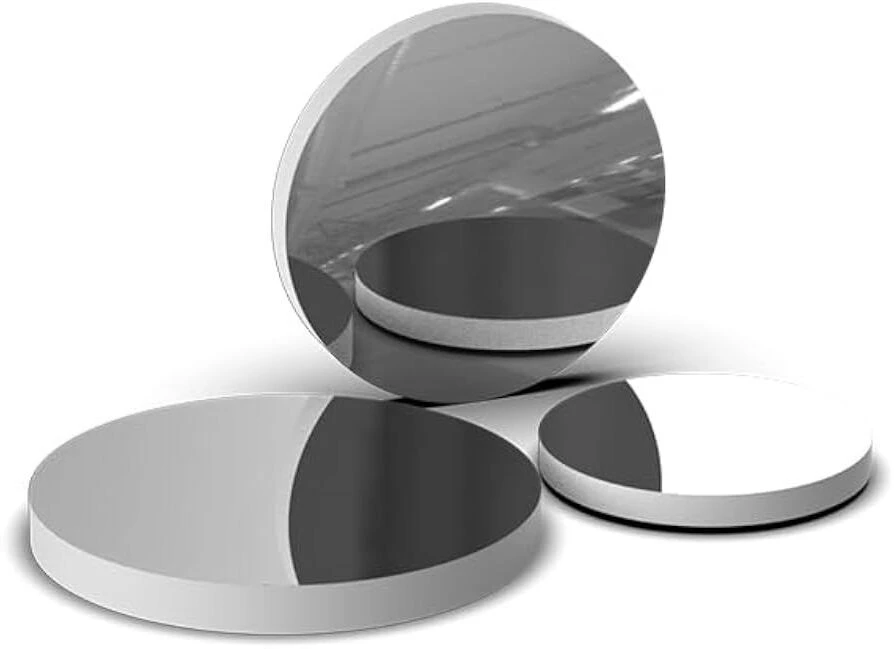
Concave Mirror
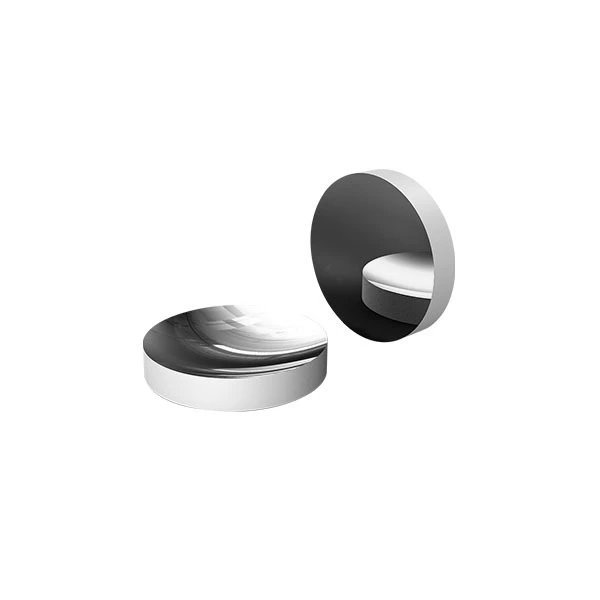
A spherical mirror curving inward toward the light source — converging reflected light to a real focal point. The fundamental focusing element of reflecting telescopes, laser resonators, and light collection systems, achieving high reflectance with zero chromatic aberration across an unlimited spectral range.
Surface form
Spherical, concave
Focal length
f = R/2 (normal incidence)
Image type
Real (object outside f)
Chromatic aberration
None
Overview
- A mirror with a spherical concave (inward-curving) reflective surface that converges incoming parallel or diverging light to a real focal point
- For normal incidence, focal length f = R/2, where R is the radius of curvature of the spherical surface — exactly half the radius
- For non-normal incidence at angle θ, the focal length splits into tangential (R/2 · cosθ) and sagittal (R/2 / cosθ) components — introducing astigmatism off-axis
- Unlike a refractive lens, a mirror has zero chromatic aberration — all wavelengths reflect and focus identically, since reflection doesn't depend on refractive index
- Spherical concave mirrors exhibit spherical aberration at large apertures relative to focal length — rays at the mirror edge focus closer than paraxial rays
- The basic building block of all reflecting telescope designs — from simple Newtonian to complex Cassegrain and Ritchey-Chrétien configurations
Key Features
Achromatic focusing
Because reflection geometry is wavelength-independent (unlike refraction), a concave mirror focuses all wavelengths to exactly the same point with zero chromatic aberration — a fundamental advantage over any refractive lens for broadband or multi-wavelength applications, including from deep UV through far-infrared in a single element.
Light collection & concentration
The large numerical aperture achievable with concave mirrors makes them highly efficient light collectors — used in solar concentrators, astronomical telescopes, and condenser optics where maximizing the solid angle of light collection from a source or onto a target is the primary design goal.
High reflectance, no absorption loss
Dielectric and metallic mirror coatings achieve reflectance from 95% to over 99.999% (supermirror grade) — with the reflective surface absorbing minimal energy compared to a refractive lens that must transmit through bulk material, making concave mirrors the preferred choice for high-power laser resonators and high-energy beam delivery.
Spherical aberration at large aperture
As with refractive lenses, spherical mirrors at large aperture-to-focal-length ratios exhibit spherical aberration — marginal rays focus closer to the mirror than paraxial rays. For aperture ratios below approximately f/10, this aberration is small; faster mirrors require a parabolic or other aspheric surface to maintain diffraction-limited performance.
Design and Construction
Geometry & tolerances
Surface specifications
- Radius of curvature tolerance: ±0.5% standard; ±0.1% precision grade
- Surface figure (form accuracy): λ/4 standard; λ/8 to λ/20 for precision laser and telescope mirrors
- Surface quality: 60-40 standard; 20-10 to 10-5 for laser and astronomical applications
Aperture ratio considerations
- f/8 to f/15 — spherical aberration negligible for most applications
- f/4 to f/8 — spherical aberration becomes noticeable; parabolic surface often preferred
- Below f/4 — spherical mirrors generally unsuitable; aspheric surfaces required
Manufacturing methods
Conventional polishing
- Grinding and polishing of glass or glass-ceramic blanks to spherical form
- Standard method for telescope primary and secondary mirrors
- Achieves λ/8 to λ/20 surface accuracy with skilled polishing
Diamond turning
- Single-point diamond turning of metal substrates (aluminum, copper)
- Fast production for IR and laser system mirrors
- Typical accuracy λ/4 to λ/10; lower than glass polishing but much faster
Optical Materials
Substrate materials
Glass & glass-ceramic
- BK7 / float glass — standard commercial concave mirrors; cost-effective
- Fused Silica — low CTE; precision and laser-grade mirrors
- Zerodur / ULE — near-zero CTE; astronomical telescope mirrors and reference optics requiring thermal stability
Metal substrates
- Aluminum — lightweight; diamond-turned IR system mirrors
- Beryllium — extremely lightweight and stiff; used in space telescope mirrors (e.g. James Webb Space Telescope)
- Silicon carbide (SiC) — high stiffness-to-weight ratio; large lightweight space and ground telescope mirrors
Coating types
Reflective coatings
- Protected aluminum — broadband UV-IR; standard telescope and general-purpose mirrors
- Protected silver — high reflectance visible/NIR; premium telescope mirrors
- Protected gold — IR-optimized; thermal and CO₂ laser system mirrors
- Enhanced dielectric coatings — laser cavity mirrors requiring >99.9% reflectance
Wavelength Options
UV
- 250–400 nm
- UV-enhanced Al
- >88% reflectance
Visible
- 400–700 nm
- Protected Al/Ag
- 85–99% reflectance
NIR
- 700–2000 nm
- Protected Ag
- >97% reflectance
MWIR/LWIR
- 2–20 µm
- Protected Au
- >96% reflectance
Applications
Astronomy
Reflecting telescopes
The primary mirror of every reflecting telescope design — from amateur Newtonian telescopes to the largest ground-based and space observatories — collects and focuses starlight with zero chromatic aberration across the full astronomical spectrum from UV to far-IR.
Laser Systems
Resonator end mirrors
Concave mirrors form the end mirrors of stable laser resonator cavities — the curvature defines the cavity mode size and stability condition, with high-reflectance dielectric coatings minimizing intracavity loss for efficient laser oscillation.
Solar Energy
Solar concentrators
Large concave mirrors (parabolic trough and dish concentrators) focus sunlight onto a small receiver area — achieving high concentration ratios for concentrated solar power generation and solar furnace applications requiring extreme temperatures.
Illumination
Reflector lamps & headlights
Used in projector lamps, automotive headlights, and stage lighting fixtures to collect light from a source and direct it into a controlled beam — concave mirrors behind the source collect a much larger solid angle than refractive optics alone could capture.
Medical
Diagnostic & surgical instruments
Used in ophthalmoscopes, dental mirrors, and ENT examination instruments to provide magnified, illuminated views of internal anatomical structures with the focusing power needed for close-range diagnostic observation.
Spectroscopy
Collection & collimation optics
Used in spectrometer and monochromator designs as collecting and collimating mirrors — achromatic focusing across the full instrument wavelength range without the chromatic focal shift a lens would introduce.
Why choose Concave Mirrors
Zero chromatic aberration
All wavelengths focus to exactly the same point — a fundamental advantage over refractive lenses for broadband, multi-wavelength, or UV-to-IR spanning applications.
Unlimited spectral range
A single mirror design with appropriate coating can operate from deep UV through far-IR — no material absorption limits the usable wavelength range as it does with refractive optics.
High power handling
Reflective focusing avoids the bulk absorption and thermal lensing of transmissive lenses — making concave mirrors the preferred choice for high-power laser resonators and beam delivery systems.
Scalable to large apertures
Concave mirrors scale to apertures of meters (telescope primaries) far beyond what is practical for refractive lenses — enabling the largest optical collecting apertures ever built.
Frequently asked questions
Here are some common questions about achromatic lens.
A spherical concave mirror has a constant radius of curvature across its entire surface — simple and inexpensive to manufacture, but introduces spherical aberration at large apertures (fast f-numbers). A parabolic mirror has a surface that follows a parabola of revolution — it perfectly focuses on-axis collimated light to a single point with zero spherical aberration, but is more expensive to manufacture and only achieves this perfect focus exactly on-axis. For slow mirrors (f/8 or slower), the difference between spherical and parabolic performance is negligible; for fast mirrors, parabolic (or other aspheric) surfaces are required.
For normal (on-axis) incidence, the focal length is exactly half the radius of curvature: f = R/2. For example, a mirror with R=200 mm has f=100 mm. For off-axis (non-normal) incidence at angle θ, the focal length splits into two components due to astigmatism: the tangential focal length is (R/2)·cos(θ), and the sagittal focal length is (R/2)/cos(θ). At larger angles of incidence, this astigmatic splitting becomes more significant — a key consideration in off-axis mirror system designs.
Refractive lenses must transmit the full laser power through bulk glass material — any absorption in the glass generates heat, causing thermal lensing (a temperature-dependent refractive index gradient) that distorts the beam at high power. Mirrors only need to reflect the surface — the reflective coating absorbs a much smaller fraction of the incident power (typically <1% for dielectric coatings), and any heat generated is concentrated at the surface where it can be more effectively managed with cooling. This makes mirrors the preferred focusing and steering element for high-power laser systems above roughly 100 W average power.