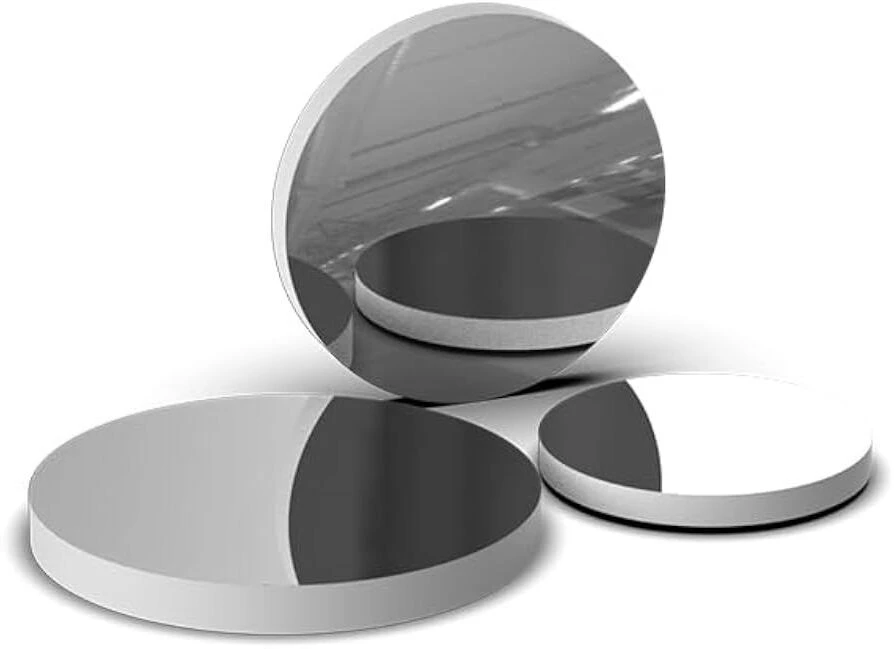
Off- Axis Parabolic Mirror
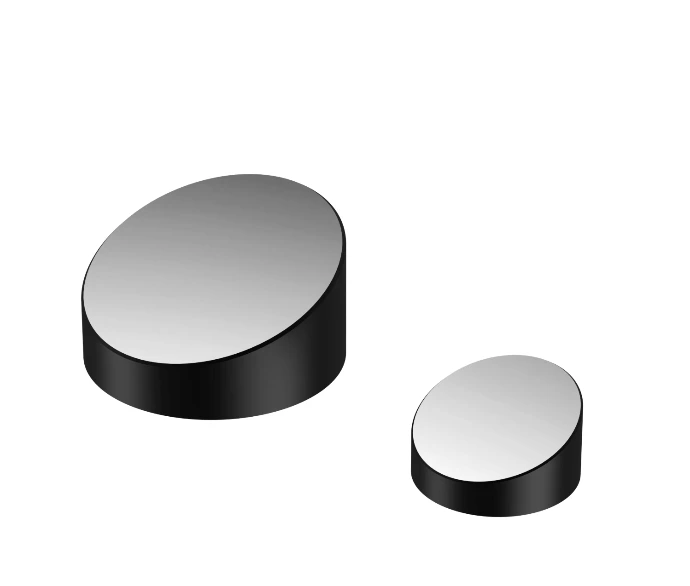
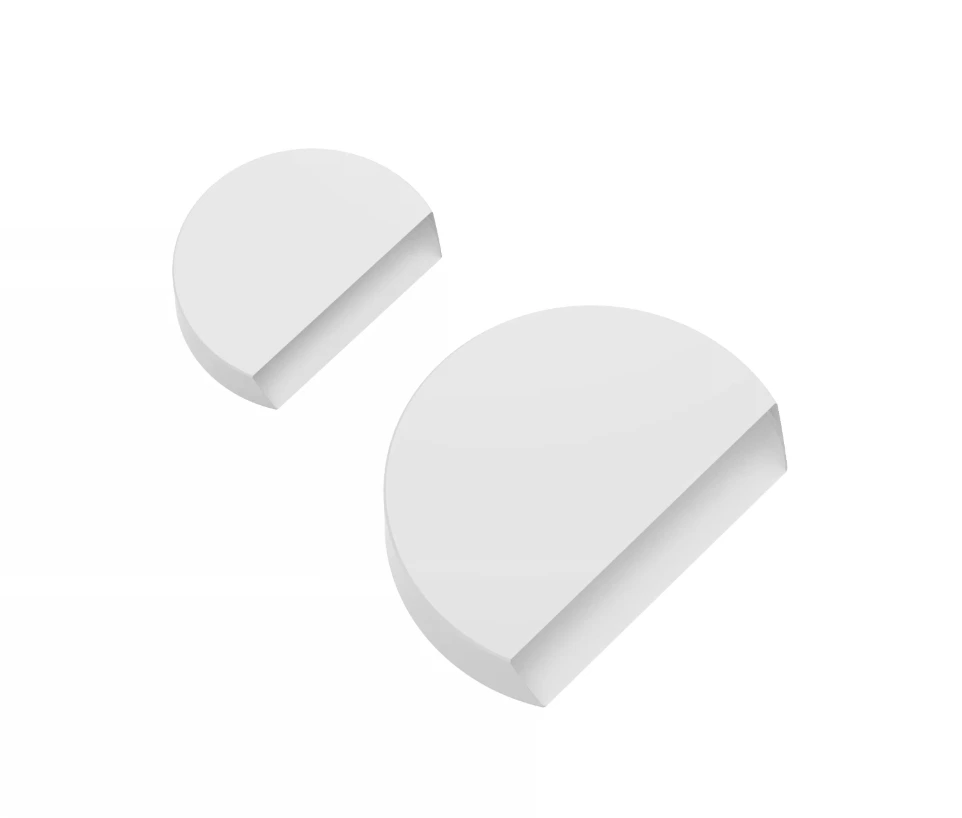
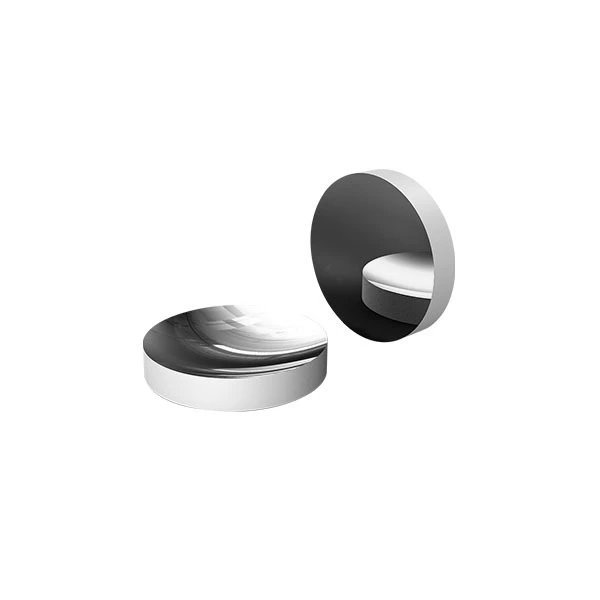
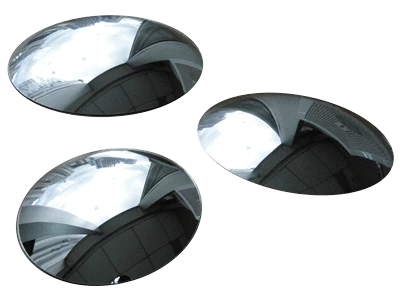
A segment cut from an off-axis portion of a parent paraboloid — achromatically focusing a collimated beam or collimating a point source with zero spherical aberration, while physically separating the focal point from the incoming beam path. The standard focusing element for femtosecond lasers, FTIR spectrometers, and any application demanding perfect aberration-free focusing with full optical access.
Surface form
Off-axis paraboloid segment
Off-axis angle
15°, 30°, 45°, 90° standard
Spherical aberration
Zero (on-axis design point)
Chromatic aberration
None
Overview
- A mirror surface that is a segment cut from a parent parabolic mirror at an off-axis position — rather than using the vertex region of the parabola where a beam would obstruct itself
- Achromatically focuses a collimated beam to a perfect diffraction-limited point (or collimates a point source) with zero spherical aberration — a fundamental property of the parabolic form for on-axis collimated input
- The off-axis design physically separates the focal point from the optical axis of the incoming beam — eliminating the beam obstruction problem of an on-axis parabolic mirror
- The "off-axis angle" describes the angle between the incoming collimated beam and the outgoing focused beam — common standard angles are 15°, 30°, 45°, and 90°
- Reflective design eliminates phase delays, group velocity dispersion, and absorption losses introduced by any transmissive lens — making OAP mirrors the standard focusing element for femtosecond and attosecond pulse laser systems
- Manufactured by diamond turning of metal substrates (typically aluminum) to achieve the precise off-axis paraboloid surface form
Key Features
Zero spherical aberration
For a collimated beam parallel to the parent parabola's optical axis, every ray reflects to exactly the same focal point regardless of where it strikes the mirror surface — eliminating spherical aberration completely. This is a defining mathematical property of the parabolic surface and is not achievable with any spherical mirror at fast f-numbers.
Zero dispersion for ultrafast pulses
Because the OAP focuses by reflection rather than refraction, it introduces no group velocity dispersion (GVD) or group delay dispersion (GDD) — critical for femtosecond and attosecond laser pulses where even a few millimeters of glass would stretch the pulse duration through chromatic dispersion. OAP mirrors are the standard focusing solution in ultrafast laser laboratories.
Unobstructed focal access
By using an off-center segment of the parent parabola, the focal point is positioned away from the incoming beam path — giving full physical and optical access to the focal point for placing samples, detectors, fiber tips, or other optics without any obstruction from the focusing mirror itself.
Broadband achromatic operation
The reflective focusing mechanism works identically at every wavelength — a single OAP mirror with appropriate coating can be used from deep UV through far-infrared with no chromatic focal shift, enabling broadband applications such as FTIR spectroscopy and white-light continuum focusing that no refractive lens combination could match.
Design and Construction
Manufacturing & geometry
Diamond turning process
- Single-point diamond turning of aluminum (or other metal) substrates to the precise off-axis paraboloid form
- Achieves surface accuracy of 1/10 to 1/20 wave RMS in skilled manufacturing
- Surface roughness <50 Å RMS for vacuum-compatible, low-scatter applications
Off-axis angle selection
- 15°/30° — minimal beam deviation; preferred for applications sensitive to polarization changes from large-angle reflection
- 45° — common general-purpose angle; balances deviation and compactness
- 90° — maximum beam separation; used where focal access from a perpendicular direction is required
Variants & coatings
Through-hole OAP mirrors
- Centered bore through the substrate allows a second beam to propagate collinearly with the focused/collimated beam
- Used in pump-probe and co-axial alignment laser configurations
Coating options
- UV-enhanced aluminum — 250–450 nm; >90% average reflectance
- Protected aluminum — 450 nm–20 µm; broadband general purpose
- Protected silver — 450 nm–2 µm; >97% reflectance; visible/NIR premium performance
- Protected/unprotected gold — 800 nm–20 µm; >96% reflectance; IR and ultrafast laser standard
Optical Materials
Substrate materials
Standard substrate
- Aluminum — most common; diamond-turns easily; good thermal conductivity for moderate power handling
- Copper — superior thermal conductivity; used for high-power CO₂ laser OAP mirrors requiring active cooling
- Electroless nickel-plated aluminum — improves diamond-turned surface quality and polish finish
Specialty options
Vacuum & precision grades
- Vacuum-compatible OAP mirrors — outgassing-tested materials and coatings for UHV laser and spectroscopy systems
- Off-axis ellipsoid mirrors — related aspheric variant used for finite-conjugate (point-to-point) imaging rather than collimated-to-point focusing
Wavelength Options
UV
- 250–450 nm
- UV-enhanced Al
- >90% reflectance
Visible
- 450 nm–2 µm
- Protected Ag
- >97% reflectance
NIR-MIR
- 800 nm–20 µm
- Protected Au
- >96% reflectance
Broadband
- 250 nm–20 µm
- Protected Al
- 85–96% reflectance
Applications
Ultrafast Optics
Femtosecond laser focusing
The standard focusing element for femtosecond and attosecond laser systems — zero dispersion preserves the ultrashort pulse duration through focusing operations where any refractive lens would introduce unacceptable pulse stretching from group velocity dispersion.
Spectroscopy
FTIR & broadband spectroscopy
Used extensively in FTIR (Fourier-transform infrared) spectrometers and broadband spectroscopy systems to collimate and focus light across very wide spectral ranges without the chromatic focal shift that would degrade spectral resolution with refractive optics.
Terahertz
THz beam focusing
THz time-domain spectroscopy systems use OAP mirrors to focus and collect THz radiation — at these long wavelengths, no practical refractive lens material exists with low absorption, making reflective focusing the only viable option.
Research
High-harmonic generation
Used to tightly focus intense femtosecond laser pulses into gas jets or solid targets for high-harmonic generation (HHG) experiments — the zero-dispersion, zero-aberration focusing is essential for achieving the peak intensities required to drive nonlinear HHG processes.
Telecommunications
Free-space optical coupling
Used in free-space-to-fiber coupling systems and optical test setups where broadband, achromatic, low-loss focusing across multiple telecom wavelength bands is required without the chromatic dispersion of lens-based coupling optics.
Defense
Directed energy & IR systems
Used in high-power laser beam delivery and IR sensor focusing systems where the combination of broadband achromatic performance and high damage threshold from reflective focusing is required for military and aerospace applications.
Why choose Off-Axis Parabolic Mirrors
Zero aberration, zero dispersion
The only standard focusing element that simultaneously eliminates spherical aberration and chromatic/group velocity dispersion — unmatched for ultrafast and broadband applications.
Unobstructed beam access
The off-axis geometry provides full physical access to the focal point — no obscuration from the focusing element itself, unlike on-axis reflective or even some refractive systems.
Femtosecond laser standard
The recognized standard focusing solution in ultrafast optics laboratories worldwide — trusted for HHG, attosecond science, and laser-plasma physics experiments.
Unlimited spectral range
A single OAP design with appropriate coating operates from deep UV through far-IR — covering ranges no single refractive lens design could span without severe chromatic compromise.
Frequently asked questions
Here are some common questions about achromatic lens.
The off-axis angle is the angle between the incoming collimated beam (parallel to the parent parabola's axis) and the outgoing beam toward the focal point. Because the mirror segment is cut from an off-center region of the parent paraboloid, the reflected beam exits at this defined angle relative to the input — common standard values are 15°, 30°, 45°, and 90°. The off-axis angle determines how much physical separation exists between the input beam path and the focused beam/focal point.
An OAP mirror's zero-aberration performance is only achieved when the input collimated beam is precisely parallel to the parent parabola's optical axis and centered correctly on the off-axis segment. Small angular or translational misalignment introduces coma and astigmatism that degrade focus quality — significantly more sensitive to alignment errors than a simple spherical mirror, where small misalignments produce comparatively gentler aberration growth. OAP mirror mounts typically include fine-pitch adjusters for both tip/tilt and translation to achieve and maintain proper alignment.
Yes — by reciprocity, the same OAP mirror design that focuses a collimated beam to a point can also collimate a point source placed at that focal point. This bidirectional property is exploited in many optical systems: one OAP mirror collimates light from a fiber tip or source, and a second matched OAP mirror refocuses the collimated beam onto a detector, sample, or fiber — forming a fully achromatic, dispersion-free relay system commonly used in spectrometer input/output coupling and ultrafast pulse delivery.