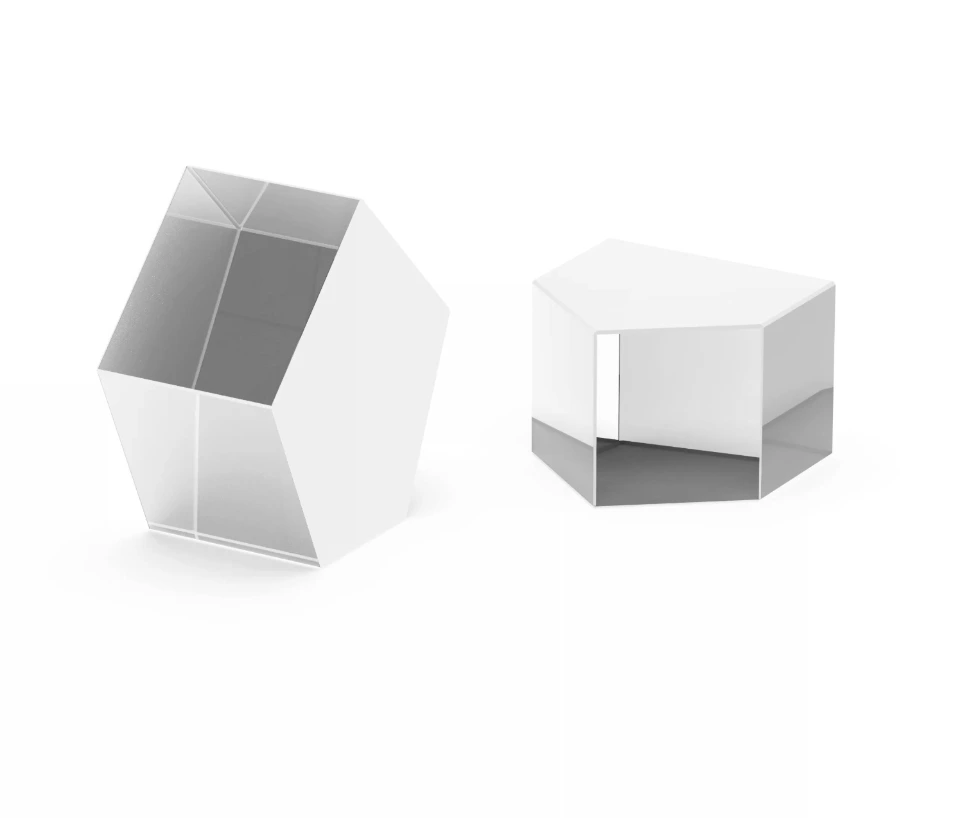
Dove Prism
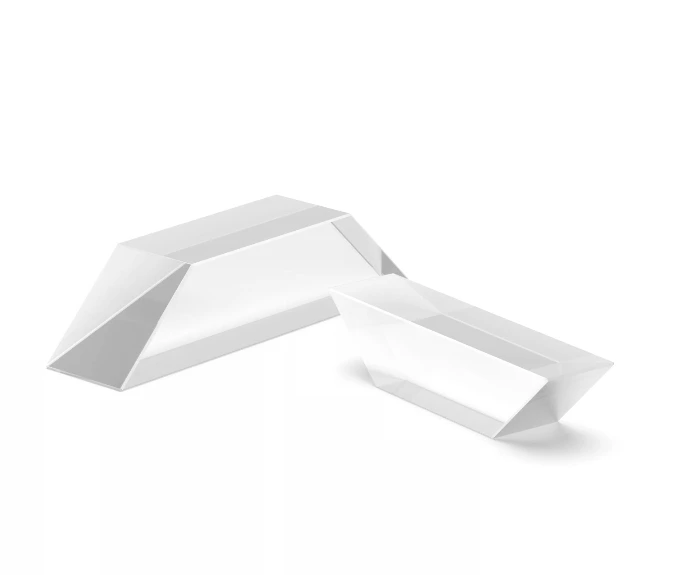
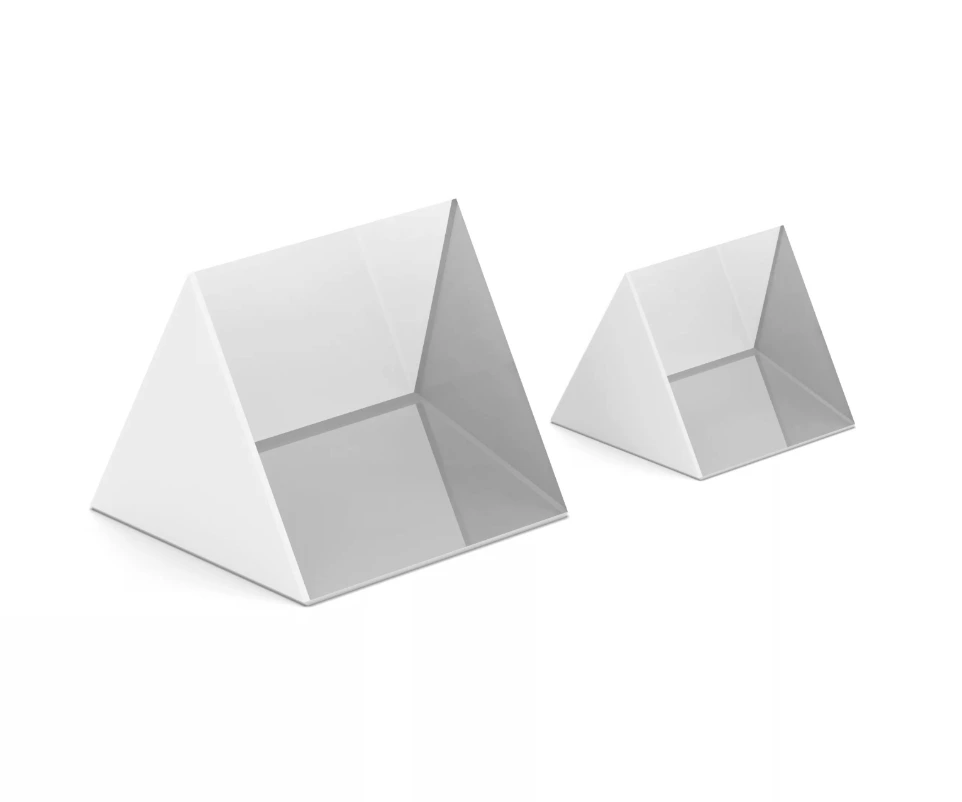
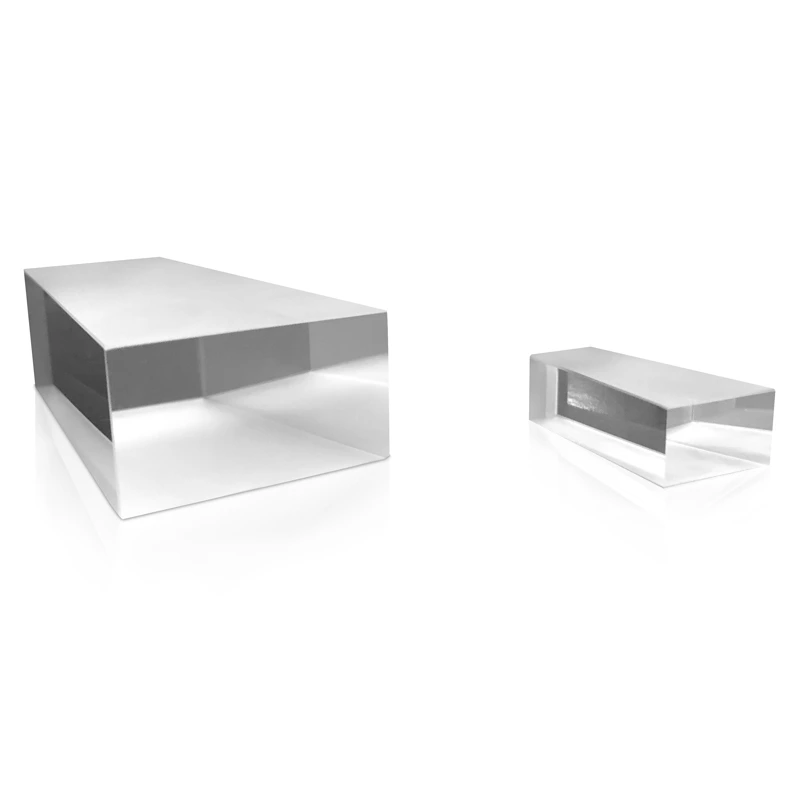
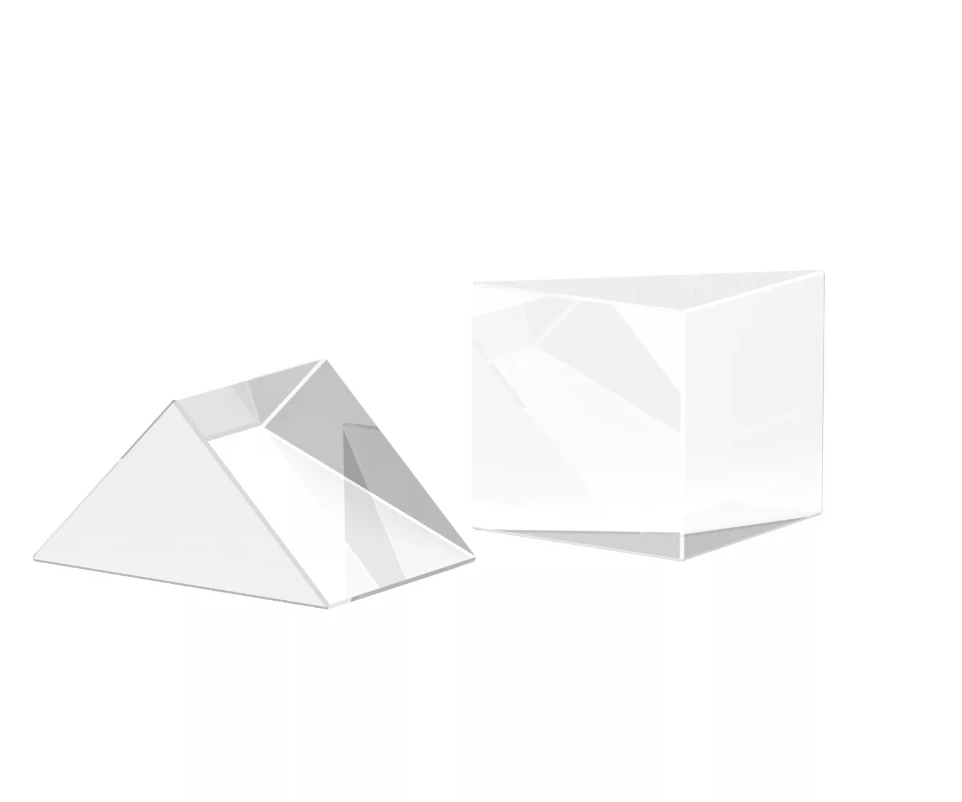
An image rotator prism — a truncated right angle prism that rotates the image without deflecting the beam direction. When rotated about its longitudinal axis by an angle θ, the image rotates by exactly 2θ — making it the primary optical element for continuously variable image rotation in laser and imaging systems.
Angles
45° – 90° – 45°
Beam deviation
0° (straight through)
Image effect
Rotates 2θ for θ rotation
Reflection type
1 TIR
Overview
- A truncated right angle prism — top section removed, leaving a trapezoidal cross-section with two angled entry/exit faces and one flat TIR face
- Light enters through one angled face, undergoes one TIR reflection at the long flat face, and exits through the other angled face — emerging parallel to the input
- The output beam is co-linear with the input beam (no angular deviation) but the image is inverted in one axis
- Rotating the Dove prism by angle θ about its optical axis rotates the image by 2θ — the 2:1 rotation ratio is a fundamental optical property
- Must be used with collimated or near-collimated light — focusing or diverging beams entering a Dove prism produce astigmatic aberrations
- Can be used as a retroreflector in one axis (image inverted) when stationary; as a variable image rotator when spun
Key Features
2:1 image rotation ratio
A Dove prism rotated by θ degrees produces an image rotation of exactly 2θ. This precise 2:1 mechanical-to-optical ratio is a fixed property of the single-reflection geometry — making it a predictable and controllable image rotator for laser beam and imaging applications where the rotation angle must be precisely commanded.
Inline (zero-deviation) beam path
The input and output beams of a Dove prism are co-axial — the beam direction is not changed. This allows the prism to be inserted into an existing straight optical path (like a relay lens train or laser beam expander) without requiring any realignment of downstream optics.
Compact image-erection element
Stationary, a Dove prism inverts the image in the plane of its TIR surface. This makes it useful as a compact image-erecting element in relay systems, periscopes, and camera adapters where the full Porro prism pair would be physically too large.
Beam rotation for interference
In stellar interferometry and optical coherence tomography, a rotating Dove prism introduces a controllable angular shear between two beams — enabling pupil rotation, image derotation in alt-azimuth telescopes, and variable aperture synthesis in astronomical interferometers.
Design and Construction
Geometry & specifications
Critical geometry
- Entry and exit faces: angled at 45° to the optical axis; must be highly parallel to each other
- TIR face: long flat bottom face; must be flat to λ/4 or better to preserve wavefront quality
- Face perpendicularity tolerance critical: error introduces image shear and astigmatism
- Length-to-aperture ratio: typically 3:1 to 4:1 — longer prisms are used with larger beam diameters
Key tolerances
- Angle tolerance: ±1 arcmin standard; ±30 arcsec precision grade
- Surface flatness: λ/4 standard; λ/8 precision; all faces must be flat — no wedge
- Parallelism of entry/exit faces: <30 arcsec; deviations cause output beam tilt
Usage requirements
Collimation requirement
- Dove prisms must be used in collimated (parallel) beams only
- Diverging or converging beams cause astigmatic aberrations — the beam path length varies across the aperture
- For non-collimated use, a K-mirror (three-mirror equivalent) or other rotator design is preferred
Coating options
- Uncoated — TIR at the flat face requires no coating for standard angles
- BBAR AR on entry/exit faces — reduces 4% per-surface reflection loss
- Protected Al or Ag coating on TIR face for non-standard beam angles
Optical Materials
Standard optical glass
Visible & NIR
- N-BK7 — standard material; excellent visible transmission; most common Dove prism substrate
- N-SF11 — high-index for compact short-length Dove prisms at the same aperture
UV-grade
- UV Fused Silica — UV imaging and UV laser beam rotation applications
- CaF₂ — deep UV image rotation in photolithography and UV spectroscopy systems
Specialty
Precision & rugged
- Sapphire — hardest available; scratch-resistant; usable UV through 5.5 µm
- Zero-CTE glass ceramics — for thermally stable rotating prism assemblies in precision instruments
Wavelength Options
Deep UV
- 185–350 nm
- UVFS / CaF₂
- UV-AR faces
Visible
- 400–700 nm
- N-BK7
- BBAR or uncoated
NIR
- 700–2000 nm
- BK7 / UVFS
- NIR BBAR
Applications
Astronomy
Alt-azimuth derotation
In alt-azimuth mounted telescopes, the field of view rotates as the telescope tracks a celestial object. A rotating Dove prism inserted in the optical path counter-rotates the image to keep it stationary on the detector — essential for long-exposure astrophotography with alt-az instruments.
Laser
Beam rotation & mode shaping
Used to rotate the polarization, mode structure, or astigmatic axis of a laser beam about the optical axis — important in laser material processing where the orientation of a line focus or astigmatic spot must be controlled for directional cutting or scribing.
Imaging
Image orientation correction
Inserted into relay lens trains or camera adapters to correct image orientation when a camera is mounted at a non-standard rotation angle — enabling correct-orientation display from cameras fixed at oblique or inverted positions.
Interferometry
Stellar & aperture synthesis
Used in stellar interferometers to introduce controlled angular shear between beams — enabling aperture synthesis imaging where multiple baseline orientations are sampled by rotating the Dove prism rather than rotating the entire interferometer baseline.
Defense
Seeker stabilization
Rotating Dove prisms are used in missile seeker heads and gyrostabilized camera platforms to derotate the image against platform roll — maintaining the correct image orientation on the sensor as the vehicle body rotates about its longitudinal axis.
OCT
En-face OCT imaging
Dove prisms rotating in optical coherence tomography systems introduce the angular scanning needed for en-face volumetric imaging — rotating the illumination and collection beam to build up two-dimensional cross-sections of the sample.
Why choose Right Angle Prisms
Only inline image rotator
The only standard prism that rotates the image without deflecting the beam — can be inserted directly into a straight optical path without system realignment.
Precise 2:1 rotation ratio
The 2:1 mechanical-to-optical rotation ratio is a fixed, fundamental property — providing predictable, commandable image rotation with simple mechanical control of the prism angle.
Single-element solution
Replaces complex multi-mirror K-mirror rotator assemblies with a single solid glass element — simpler alignment, lower cost, and better mechanical stability for rotation-sensitive applications.
Compact form factor
More compact than a Porro pair for simple one-axis image inversion tasks — saves axial length in relay lens trains and beam conditioning systems.
Frequently asked questions
Here are some common questions about Dove Prism.
Inside a Dove prism, the path length varies across the beam cross-section — rays at the top of the prism travel a different distance through glass than rays at the bottom. For a parallel beam, this is corrected by the prism geometry. For a converging or diverging beam, the different path lengths introduce astigmatism — the beam focuses at different distances in different planes. This is the fundamental limitation of Dove prisms and why collimated input is required.
Practical rotation speeds depend on the dynamic balance of the prism mount and the optical system's tolerance for vibration-induced wavefront error. In precision instruments, rotation rates up to several hundred rpm are achievable. At high speeds, dynamic imbalance of the asymmetric prism shape introduces vibrations that degrade image quality — symmetric K-mirror assemblies are preferred for very high-speed rotation applications.
A K-mirror is a three-flat-mirror assembly configured to perform the same image rotation function as a Dove prism. Advantages of the K-mirror: works with non-collimated (focusing or diverging) beams; dynamically balanced when rotated; suitable for very high rotation speeds. Advantages of the Dove prism: single solid element; simpler alignment; no metallic mirror reflectance loss. For collimated beams at modest rotation speeds, the Dove prism is simpler and more efficient.