Wedge Prism
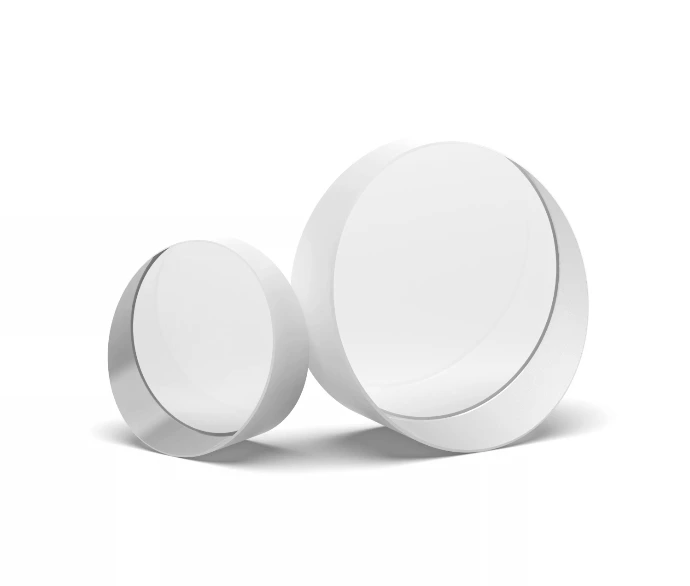
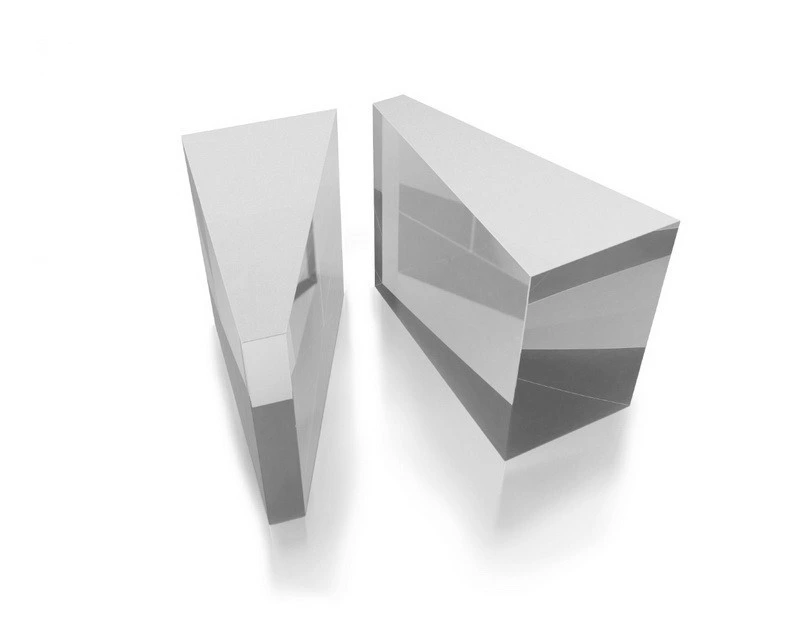
A prism with a very small wedge angle between its two faces — producing a controlled, small-angle beam deviation with minimal chromatic dispersion. The standard element for precise beam steering, back-reflection elimination, and Risley prism scanning systems in laser, metrology, and defense applications.
Wedge angle
Typically 0.5°–10°
Beam deviation
Small angle (few arcmin to degrees)
Image effect
Slight deviation, no inversion
Pair function
360° beam steering (Risley)
Overview
- A flat glass plate with a small but precisely controlled angle between its two faces — the "wedge angle" typically ranges from a few arcminutes to several degrees
- Refracts a passing beam by a fixed angle determined by the wedge angle and the glass refractive index: δ ≈ (n−1)α for small wedge angles α
- Introduces controlled beam deviation without the large angular deviation of conventional prisms — ideal for fine beam steering in laser systems
- Eliminates specular back-reflections from flat optical elements — the wedged surfaces deflect reflected beams away from the source, preventing optical feedback
- Two wedge prisms used in combination (a Risley pair) provide full 360° beam steering by rotating each wedge independently — a compact, two-element beam scanner
- Available in very large aperture sizes (up to 150 mm) since the thin geometry requires less glass than any other prism type
Key Features
Precise small-angle deviation
Produces a small but highly precise angular beam deviation — controllable to arcseconds by selecting the wedge angle. Unlike mirror tilts that change the angle by 2θ for a θ tilt, a wedge prism's deviation is determined by the glass alone — independent of mechanical tilt errors in the mount.
Risley pair scanning
Two wedge prisms mounted co-axially and rotated independently provide full 360° beam steering within a cone angle determined by the individual prism deviation. Counter-rotating the prisms reduces deviation toward zero; co-rotating them maintains maximum deviation and steers the beam in a circle — enabling compact, wide-angle laser scanning with no moving mirror required.
Back-reflection suppression
Even a small wedge angle (30 arcsec) deflects the surface reflection of a transmitted beam away from the optical axis by the full deviation angle — preventing the reflected beam from coupling back into a laser source or upstream optic. Wedged windows and wedged laser output couplers use this property to eliminate etalon fringes and optical feedback in precision laser systems.
Large aperture capability
Because wedge prisms are thin optical plates with a small angle, they can be manufactured in very large apertures without the weight and material cost of conventional prisms. Large-aperture wedges are used in laser beam expanding telescopes, astronomical adaptive optics tip-tilt correctors, and wide-beam atmospheric propagation experiments.
Design and Construction
Specifications
Wedge angle tolerances
- Commercial grade: ±5 arcsec; standard beam steering and back-reflection elimination
- Precision grade: ±1–2 arcsec; interferometry and adaptive optics applications
- Custom: specific deviation angles specified in arcseconds or milliradians
Surface quality
- Surface flatness: each face flat to λ/4 standard, λ/8 precision
- Surface quality: 60-40 standard; 20-10 laser grade; 10-5 for interferometry
- Parallelism of faces: controlled to the specified wedge angle ± tolerance
Coating options
Anti-reflection coatings
- BBAR — both faces for minimum insertion loss in laser beam paths
- V-coat — specific laser wavelengths (355, 532, 1064, 1550 nm)
- LIDT-rated — for high-power laser beam steering applications
Reflective coatings
- Partial reflective coating on one face — beam sampler wedge for power monitoring
- HR coating — wedge prism used as a laser cavity output coupler
Optical Materials
Standard glass
Visible & NIR
- N-BK7 — most common; excellent transmission; standard beam steering and isolation wedges
- N-SF10 — higher refractive index for stronger deviation per degree of wedge angle
UV-grade
- UV Fused Silica — UV laser beam steering and isolation; excimer and harmonic laser systems
- CaF₂ — deep UV and broad UV-IR wedge prisms
Infrared materials
IR beam steering
- Germanium — LWIR beam steering; high index (n=4.0) gives large deviation per unit wedge angle
- ZnSe — CO₂ laser and LWIR Risley scanning systems; low absorption
- Silicon — MWIR beam steering; lightweight Risley scanner elements
Wavelength Options
UV
- 193–400 nm
- UVFS / CaF₂
- BBAR UV faces
Visible
- 400–700 nm
- N-BK7
- BBAR or V-coat
NIR
- 700–2000 nm
- BK7 / UVFS
- NIR BBAR
MWIR/LWIR
- 2–12 µm
- Si / ZnSe / Ge
- BBAR 3–5 / 8–12
Applications
Laser Systems
Risley beam scanning
Counter-rotating wedge prism pairs (Risley scanners) sweep laser beams in programmable circular, spiral, and raster patterns — used in LiDAR systems, laser radar, free-space optical communication pointing acquisition tracking, and laser material processing without galvanometer mirrors.
Optics
Back-reflection elimination
Wedged windows and wedged optical elements eliminate the etalon fringes and optical feedback from parallel-face components — critical in CW laser systems, optical coherence tomography instruments, and spectroscopy where back-reflected light would destabilize the laser or add unwanted interference.
Adaptive Optics
Tip-tilt correction
Large-aperture wedge prisms are used as tip-tilt correctors in astronomical adaptive optics systems — providing arcsecond-level atmospheric image motion correction with a simple transmissive element that avoids the pupil rotation issues of mirror-based tip-tilt stages.
Defense
IR and LWIR scanning
ZnSe and germanium Risley prism scanners are used in thermal imaging systems, IR countermeasures, and directed energy systems — providing large-angle beam steering of IR laser or thermal imaging beams in compact, two-element scanner packages.
Metrology
Beam angle adjustment
Used in interferometers and optical test equipment to make fine adjustments to beam angle — introducing precise, repeatable angular offsets to align collimated beams with reference optics or to introduce controlled tilt in wavefront testing setups.
Optical Comms
Free-space link steering
Motorized wedge prism pairs steer free-space optical communication beams toward moving platform receivers — providing faster angular scan rates and more compact scanner packages than gimbaled mirror systems for air-to-ground and inter-satellite laser communication links.
Why choose Wedge Prisms
Precise small-angle control
The only standard transmissive element for introducing a precisely specified small angular beam deviation — independent of mechanical mount tilt and thermally stable once mounted.
Risley 360° scanning
Two wedge prisms provide full 360° beam steering in a compact two-element package — no moving mirror, no galvanometer, no complex scanning head required.
Back-reflection elimination
Even the smallest wedge angle completely deflects the surface reflection out of the optical path — the simplest and most effective anti-feedback solution for CW laser systems.
Large aperture scalability
Thin geometry allows wedge prisms to be manufactured in very large apertures — scaling to beam diameters far beyond what other deflecting prisms can accommodate.
Frequently asked questions
Here are some common questions about Wedge Prism.
For a small wedge angle α (in radians), the beam deviation δ ≈ (n−1)α, where n is the glass refractive index. For example, N-BK7 glass (n=1.517) with a 1° wedge angle produces a deviation of approximately 0.517° ≈ 31 arcmin. A germanium wedge (n=4.0) with the same 1° angle produces approximately 3° of deviation — demonstrating how high-index IR materials amplify the deviation for a given mechanical wedge angle.
Two identical wedge prisms are mounted co-axially with independent rotations. When both prisms' thick edges point in the same direction, their deviations add — maximum beam deflection. When thick edges point opposite, deviations cancel — zero deviation (straight through). By independently controlling each prism's rotation angle, the beam can be directed to any point within a cone of half-angle 2δ (twice the single prism deviation). Continuous rotation of both prisms at different speeds produces spiral scan patterns used in LiDAR and communications pointing.
Yes, but less than an equilateral dispersing prism. The chromatic dispersion of a wedge is proportional to the wedge angle and the glass dispersion (1/Abbe number). For a small wedge angle (1–5°) in BK7, the color dispersion is small enough to be acceptable for broadband beam steering. For high-dispersion-sensitive applications, two identical wedge prisms used back-to-back (their dispersions canceling while deviations add) create an achromatic beam deflector with minimal chromatic spread.