Anamorphic Prism Pair
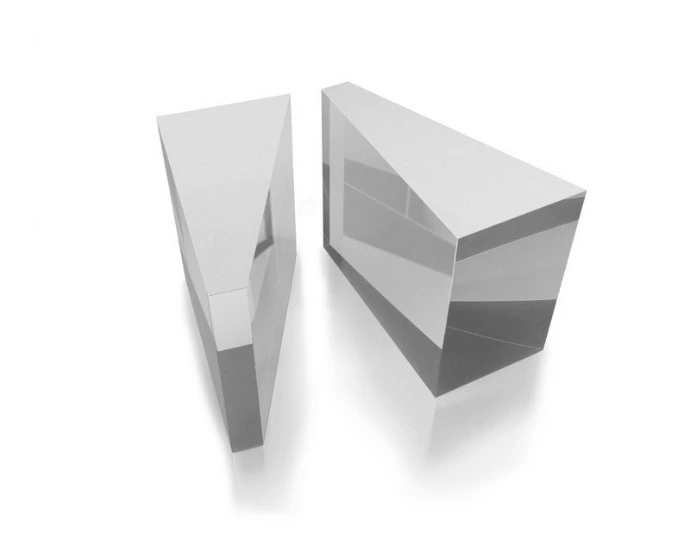
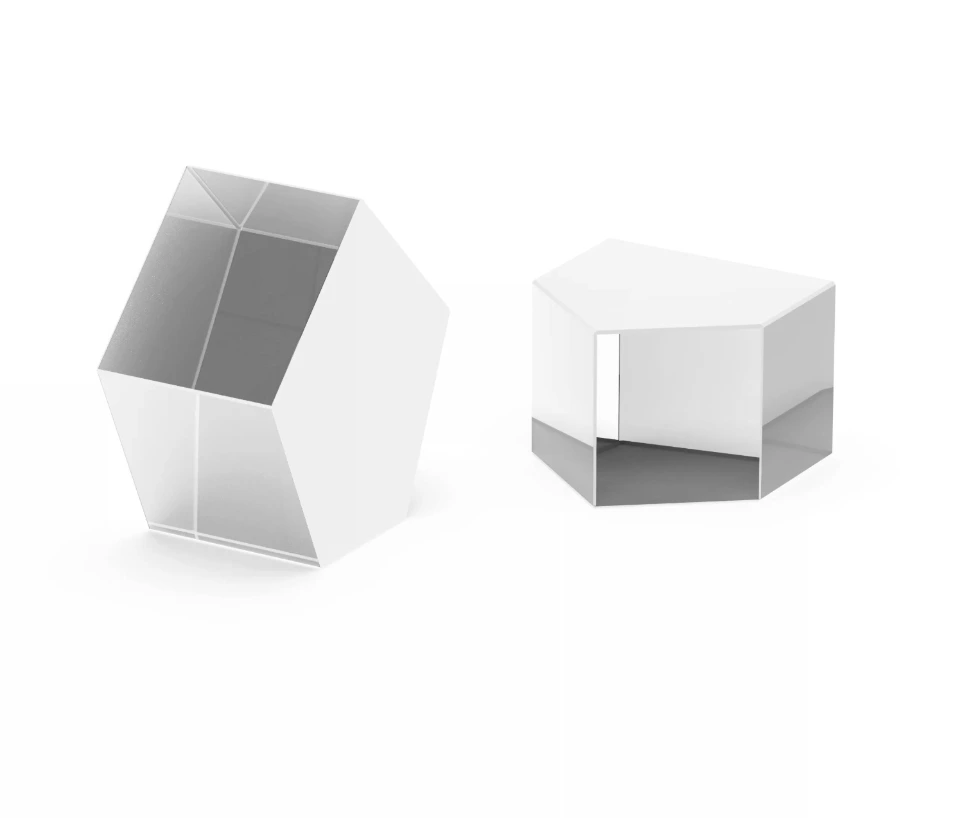
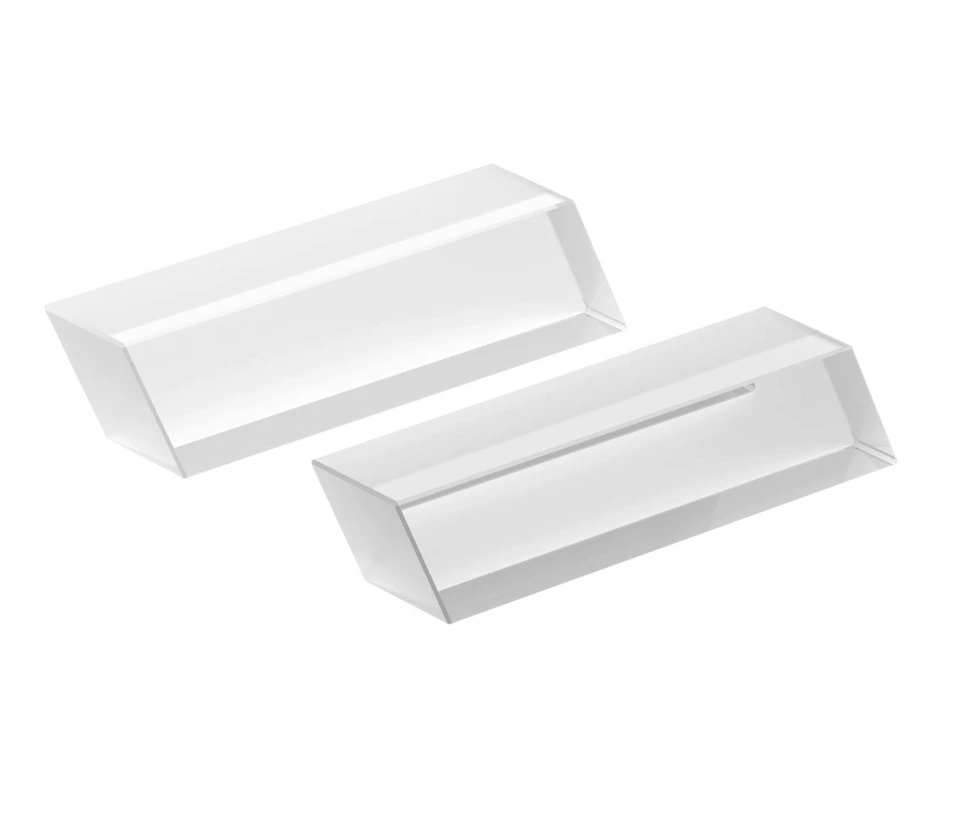
A matched pair of prisms used to expand or compress a beam in one axis without affecting the perpendicular axis — converting the elliptical output of a laser diode into a circular beam, or anamorphically compressing a wide rectangular beam to a smaller size. The standard beam-shaping solution for laser diode systems and compact beam-conditioning assemblies.
Function
1D beam expansion/compression
Magnification
Typically 2× to 6×
Beam deviation
Zero (pair cancels)
Image effect
1-axis magnification only
Overview
- Two matched flat-face prisms arranged so their anamorphic (one-axis) magnifications cancel any beam deviation while combining their beam-shaping effects
- Each prism refracts the beam at a non-normal angle — stretching the beam cross-section in one axis by the factor cos(θ₁)/cos(θ₂) where θ₁ and θ₂ are the entry and exit angles
- The second prism in the pair reverses the angular deviation introduced by the first — the output beam travels parallel to the input with zero net angular change
- Standard use: converting the elliptical output of a laser diode (fast-axis NA 0.5, slow-axis NA 0.1) into a circular beam — after cylindrical fast-axis collimation, the anamorphic pair compresses the slow axis to match the fast axis beam width
- Expansion ratios from 1.5× to 6× are available; higher ratios require larger prism angles and introduce more insertion loss from surface reflections
- Used at the Brewster angle for maximum transmission of p-polarized light — typical for linearly polarized laser diode sources
Key Features
Ellipse-to-circle conversion
Laser diodes emit an inherently elliptical beam — the fast axis (perpendicular to the junction) has 3–5× more divergence than the slow axis. After separate collimation of each axis, the fast-axis beam is narrower than the slow axis. An anamorphic pair compresses the slow axis to match the fast axis — producing a circular collimated beam suitable for precision optics, fiber coupling, and diffraction-limited focusing.
Brewster angle operation
Anamorphic prisms are typically used at or near Brewster's angle — the incidence angle at which p-polarized light is transmitted with zero surface reflection. At Brewster's angle, no AR coating is needed and transmission approaches 100% for p-polarized laser diode beams. This makes anamorphic prisms uniquely efficient for polarized laser sources compared to cylindrical lens beam expanders.
Lossless anamorphic magnification
Unlike cylindrical lens beam expanders that lose some beam area due to divergence mismatch, anamorphic prisms expand the beam cross-section geometrically — preserving the divergence angle in the expanded axis (reducing the divergence angle inversely with the expansion ratio) while leaving the orthogonal axis unchanged.
Compact pair configuration
Two small prisms side by side occupy minimal axial space — far more compact than a pair of cylindrical lenses separated by a relay distance for the equivalent beam transformation. This compactness is critical in the tight space budgets of laser diode module and laser bar pump collimator assemblies.
Design and Construction
Pair geometry
Standard configurations
- Equal-angle pair: both prisms identical, used in reverse orientation — deviations cancel, magnifications add
- Brewster angle cut: faces cut at Brewster angle for the design wavelength; zero reflection for p-polarization
- Standard wedge angles: 5.8° (2× magnification), 15° (2.5×), and higher for greater anamorphic ratios
Tolerances
- Prism angle tolerance: ±5 arcsec — controls magnification accuracy and residual beam deviation
- Matching of pair: prisms matched within ±2 arcsec of each other — critical for zero-deviation output
- Surface flatness: λ/8 — important for wavefront quality of expanded beam
Coating options
Brewster angle (no coating)
- At Brewster angle: p-polarized reflection = 0%; no AR coating required for p-polarized laser diodes
- s-polarized light at Brewster angle: ~15% reflected per surface — prisms effective for p-polarization only
AR coated (off-Brewster)
- BBAR AR — for broadband or unpolarized sources; <0.5% per surface
- V-coat — for specific single-wavelength non-Brewster designs
Optical Materials
Standard glass
Visible & NIR diode wavelengths
- N-SF11 (n=1.784) — most common; Brewster angle 60.7°; standard for 780–980 nm and visible diodes
- N-BK7 (n=1.517) — Brewster angle 56.6°; lower index; used where N-SF11 absorption is a concern
- N-SF10 (n=1.728) — intermediate; used for specific magnification-angle combinations
UV & specialty
UV and IR diodes
- UV Fused Silica — UV diode lasers (375, 405, 445 nm); Brewster angle 55.4°
- CaF₂ — deep UV diodes; Brewster angle ~54°; minimal autofluorescence for UV fluorescence applications
- ZnSe — CO₂ laser anamorphic shaping; Brewster angle 67°
Wavelength Options
UV Diodes
- 375–450 nm
- UVFS / CaF₂
- Brewster angle
Red / NIR
- 630–980 nm
- N-SF11
- Brewster or V-coat
Telecom NIR
- 1310 / 1550 nm
- N-SF11 / UVFS
- Brewster angle
CO₂ LWIR
- 10.6 µm
- ZnSe
- Brewster angle
Applications
Laser Diodes
Beam circularization
The primary application — converting the elliptical collimated output of single-mode laser diodes into a circular beam for coupling into single-mode optical fiber, diffraction-limited focusing, and use with standard circular-aperture optics without anamorphic losses.
Holography
Beam expansion & shaping
Anamorphic prisms expand a laser beam in one axis to illuminate a large holographic recording medium — producing the wide, thin illumination stripe needed for holographic exposure without the diffraction losses and wavefront distortions of cylindrical lens expanders.
Data Storage
Optical disc pickup
CD, DVD, and Blu-ray disc pickup units use anamorphic prism pairs to circularize the laser diode beam before focusing it to the diffraction-limited spot needed to read and write data tracks on the disc surface — enabling the tight focusing needed for high data density.
Sensing
Structured light projection
Anamorphic prism pairs shape laser diode beams into specific aspect ratios for structured light and 3D sensing illumination — producing rectangular illumination patterns optimized for ToF cameras, LiDAR line illumination, and machine vision structured light projectors.
Spectroscopy
Spectrometer entrance beam
Used to reshape the spectrometer source beam to match the rectangular entrance slit — maximizing coupling efficiency from a circularly symmetric laser or fiber source into the narrow height of the spectrometer entrance slit through anamorphic compression in the slit-height axis.
Industrial
Laser processing beam shaping
Anamorphic prism assemblies shape diode bar outputs into uniform rectangular beams for laser hardening, soldering, and annealing applications — producing a flat-top rectangular intensity profile that uniformly treats a linear zone of the workpiece surface.
Why choose Anamorphic Prism Pairs
Highest efficiency for polarized diodes
At Brewster's angle, p-polarized laser diode beams pass through with zero surface reflection — no coating required, no absorption, no laser damage threshold limitation. The most efficient beam circularization method for polarized sources.
Zero net beam deviation
The second prism cancels the angular deviation of the first — the output beam travels parallel to the input. No realignment of downstream optics needed after inserting the pair.
Compact form factor
Two small prisms replace a longer cylindrical lens relay — fitting within the space budget of laser diode modules, optical disc pickups, and compact fiber coupling assemblies.
Preserves wavefront quality
Geometric beam transformation without focusing — the wavefront is scaled without passing through a focal point, preserving coherence and beam quality better than equivalent lens-based expanders for high-brightness diode sources.
Frequently asked questions
Here are some common questions about Anamorphic Prisms.
A single anamorphic prism magnifies the beam in one axis but also deviates the beam direction — the output beam travels at an angle to the input. The second prism, oriented to produce the same magnification in the same axis, exactly cancels the angular deviation of the first while doubling the total magnification. Without the second prism, the output beam would travel at an angle to the input — requiring realignment of all downstream optics.
After collimating a single-mode laser diode with separate fast-axis (FAC) and slow-axis (SAC) collimating lenses, the slow-axis beam is typically 2–4× wider than the fast-axis beam. An anamorphic pair is selected with a magnification ratio equal to (slow-axis beam width) / (fast-axis beam width) — compressing the slow axis to match the fast axis. For a typical diode with 3× size ratio, a 3× magnification pair (e.g. two N-SF11 prisms at the appropriate angle) produces a circular output beam.
Brewster's angle is the incidence angle at which p-polarized light is transmitted through a glass-air interface with zero reflection — all light passes through, none is reflected. For N-SF11 glass (n=1.784), Brewster's angle is arctan(1.784) ≈ 60.7°. Laser diodes typically emit linearly polarized light aligned with the p-polarization direction. Cutting the anamorphic prisms at Brewster's angle therefore allows zero-loss transmission — no AR coating, no reflection, no laser damage risk from coating surfaces — making Brewster-angle anamorphic prisms uniquely efficient for polarized diode laser sources.