Brewster Window
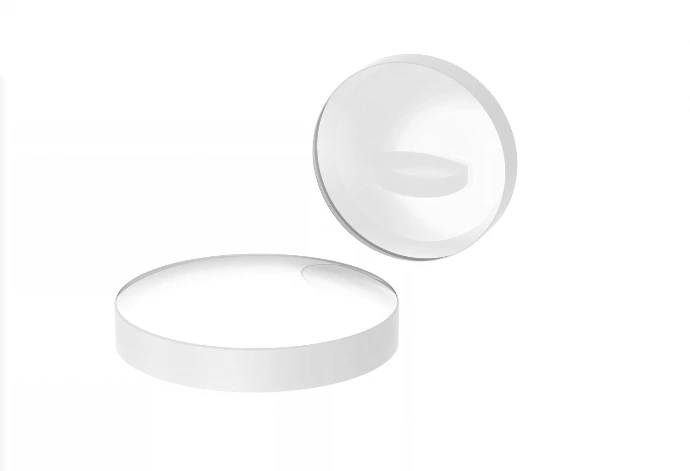
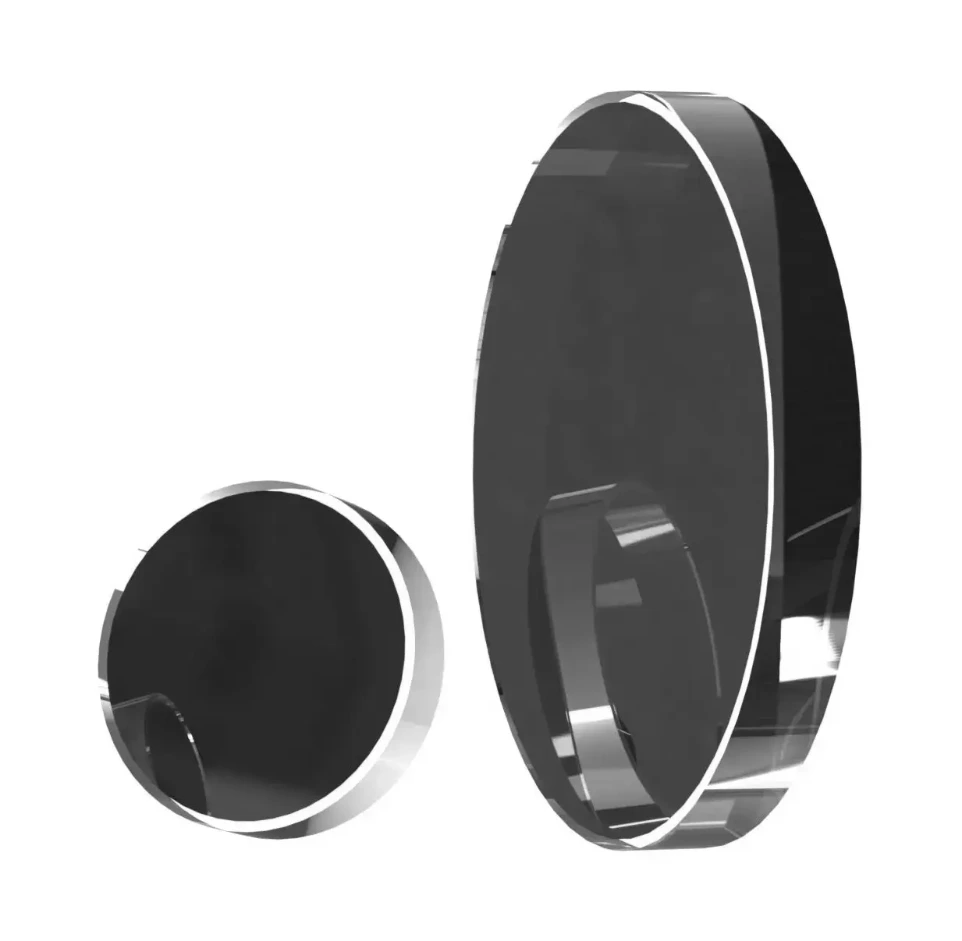
A window mounted at Brewster's angle — the specific angle of incidence at which p-polarized light is transmitted with zero surface reflection. The classic laser tube window design, achieving lossless transmission for one polarization state without requiring any anti-reflection coating at all.
Mounting angle
Brewster's angle (material-specific)
p-pol reflection
0% (theoretical)
Coating required
None
Output polarization
Linear (p-polarized)
Overview
- A flat window deliberately tilted to Brewster's angle — the specific angle of incidence (θ_B = arctan(n)) at which reflected and refracted rays are perpendicular, causing p-polarized light reflectance to drop to exactly zero
- At this angle, p-polarized (parallel to the plane of incidence) light passes through with theoretically 100% transmission and zero surface reflection — eliminating the need for any anti-reflection coating
- s-polarized light, by contrast, experiences substantial reflection loss at Brewster's angle — meaning Brewster windows function as inherent polarizers, favoring the transmission of one polarization state over the other
- The historic and still-common end-window design for gas laser tubes (HeNe, CO₂, Argon-ion) — enforcing linear polarization of the laser output as a natural consequence of differential loss between polarizations within the laser cavity
- Eliminates coating-related laser damage and degradation concerns since the lossless transmission is achieved through geometry and physics rather than a thin-film coating that could be damaged at high power or degrade over time
- Brewster's angle depends on the refractive index of the window material — different substrates require different mounting angles to achieve the zero-reflection condition
Key Features
Coating-free zero reflection
By exploiting the physics of polarized reflection rather than thin-film interference, a Brewster window achieves zero reflection for p-polarized light using only the bare, uncoated substrate surface — eliminating any risk of coating damage, degradation, or absorption loss that a dielectric AR coating could introduce at high power.
Intrinsic polarization selection
Because s-polarized light suffers substantial reflection loss at Brewster's angle while p-polarized light passes essentially undiminished, a pair of Brewster windows in a laser cavity (one at each end) forces the laser to oscillate in a single linear polarization state — the basis of polarized output in many gas laser designs.
High laser damage threshold
Without a coating layer to damage, Brewster windows handle extremely high intracavity laser power densities — a key reason they remain the preferred window design for high-power gas lasers and intracavity elements in laser resonators where coating damage thresholds would otherwise limit achievable power.
Material-dependent angle
Brewster's angle is calculated from θ_B = arctan(n) — for N-BK7 (n=1.517) this is approximately 56.6°; for fused silica (n=1.46) approximately 55.5°; for ZnSe (n=2.4) approximately 67.4°. Each substrate material requires precise angular mounting to achieve the zero-reflection condition for its specific refractive index.
Design and Construction
Geometry & mounting
Angular precision
- Window must be tilted to within a fraction of a degree of the true Brewster angle for the substrate material to achieve near-zero p-polarization reflectance
- Mounting fixtures typically allow fine angular adjustment to optimize the angle for the specific laser wavelength and gas mixture
Surface specifications
- Surface flatness: λ/4 to λ/10 — important for maintaining laser mode quality and minimizing intracavity loss
- Surface quality: 20-10 to 10-5 — minimizes scatter loss, critical inside a resonant laser cavity
- No coating applied — bare polished substrate surface is the functional element
Brewster angle by material
Common substrate angles
- N-BK7 (n=1.517): θ_B ≈ 56.6°
- Fused Silica (n=1.46): θ_B ≈ 55.5°
- CaF₂ (n=1.43): θ_B ≈ 55.0°
- ZnSe (n=2.4): θ_B ≈ 67.4°
- Germanium (n=4.0): θ_B ≈ 76.0°
Design considerations
- Higher-index materials require steeper mounting angles, increasing the physical footprint of the window in the optical path
- The large angle of incidence elongates the effective optical path through the substrate compared to normal-incidence mounting
Optical Materials
Standard glass
Gas laser tube windows
- N-BK7 — standard HeNe and visible gas laser Brewster windows
- Fused Silica — broader transmission range and higher damage threshold for UV-extended or high-power applications
UV-grade
- CaF₂ — UV gas laser (excimer-adjacent) Brewster windows
- UV Fused Silica — argon-ion and UV laser Brewster windows
Infrared materials
CO₂ & IR laser windows
- ZnSe — standard CO₂ laser (10.6 µm) Brewster window material; low absorption
- Germanium — alternative LWIR Brewster window substrate for specific laser designs
Wavelength Options
UV
- 250–400 nm
- UVFS / CaF₂
- Uncoated (Brewster)
Visible (HeNe)
- 633 nm
- N-BK7
- Uncoated (Brewster)
NIR
- 700–2000 nm
- BK7 / Fused Silica
- Uncoated (Brewster)
CO₂ LWIR
- 10.6 µm
- ZnSe
- Uncoated (Brewster)
Applications
Laser Systems
Gas laser tube end windows
The classic application — HeNe, Argon-ion, and CO₂ gas laser tubes use Brewster windows at each end to seal the gas discharge tube while enforcing linearly polarized laser output as a natural byproduct of the differential polarization loss.
Research
Intracavity polarization control
Used as intracavity elements in research laser systems to force single-polarization oscillation without introducing coating-related intracavity loss — preserving the highest possible laser efficiency and beam quality.
Industrial
High-power CO₂ laser windows
ZnSe Brewster windows handle the high intracavity power densities of industrial CO₂ lasers used in cutting and welding — avoiding the coating damage risk that would limit power handling in a coated normal-incidence window.
Optics Education
Polarization demonstration
Used in optics education and laboratory demonstrations to illustrate Brewster's angle, polarization by reflection, and the relationship between refractive index and the zero-reflection condition.
Spectroscopy
Polarization-sensitive instrumentation
Used in spectroscopic and ellipsometric instruments where a coating-free, high-purity polarization-selective window is needed to avoid introducing coating-induced polarization artifacts into precision measurements.
Defense
High-power laser resonator windows
Used in high-energy laser resonator designs where coating damage threshold would otherwise be the limiting factor for intracavity power handling — the coating-free Brewster geometry removes this limitation entirely.
Why choose Brewster Windows
Zero reflection without coating
Achieves lossless p-polarization transmission through geometry alone — no AR coating required, eliminating coating damage and degradation concerns entirely.
Built-in polarization selection
Naturally favors transmission of one polarization state over the other — the standard mechanism for enforcing linear polarization output in gas laser cavities.
Highest laser damage threshold
The absence of any coating layer makes Brewster windows the most damage-resistant window design for extreme intracavity laser power densities.
Proven gas laser standard
The time-tested window design for HeNe, Argon-ion, and CO₂ gas lasers — decades of reliable performance in laser tube sealing applications.
Frequently asked questions
Here are some common questions about achromatic lens.
At Brewster's angle, the reflected ray and the refracted (transmitted) ray are exactly perpendicular to each other. For p-polarized light (electric field oscillating in the plane of incidence), the oscillating dipoles in the material that would generate the reflected wave are aligned along the direction the reflected ray would need to travel — but a dipole cannot radiate along its own axis of oscillation, so no reflected p-polarized wave is generated, resulting in zero reflectance. This geometric coincidence does not apply to s-polarized light (oscillating perpendicular to the plane of incidence), which continues to reflect partially at Brewster's angle according to the standard Fresnel equations.
A single Brewster-angle surface transmits p-polarized light with extremely high efficiency (theoretically 100%, practically very close given a high-quality polished surface) while still transmitting a substantial fraction of s-polarized light too — a single pass does not produce high-extinction polarization purity. The strong polarization selection effect in lasers comes from the cumulative effect of many round trips through the gain medium and Brewster windows inside the resonant cavity, where the small per-pass loss difference between polarizations compounds over thousands of round trips until only the low-loss (p-polarized) mode survives to oscillate.
Yes — Brewster windows are also used as simple polarization-selective elements outside laser cavities, such as in spectroscopic and ellipsometric instrumentation, or as low-loss windows for already-polarized laser beams aligned to the p-polarization direction. They are less commonly used for general-purpose unpolarized light transmission, since a substantial fraction of the s-polarized component would be lost to reflection, and the steep mounting angle requires more physical space than a normal-incidence AR-coated window.