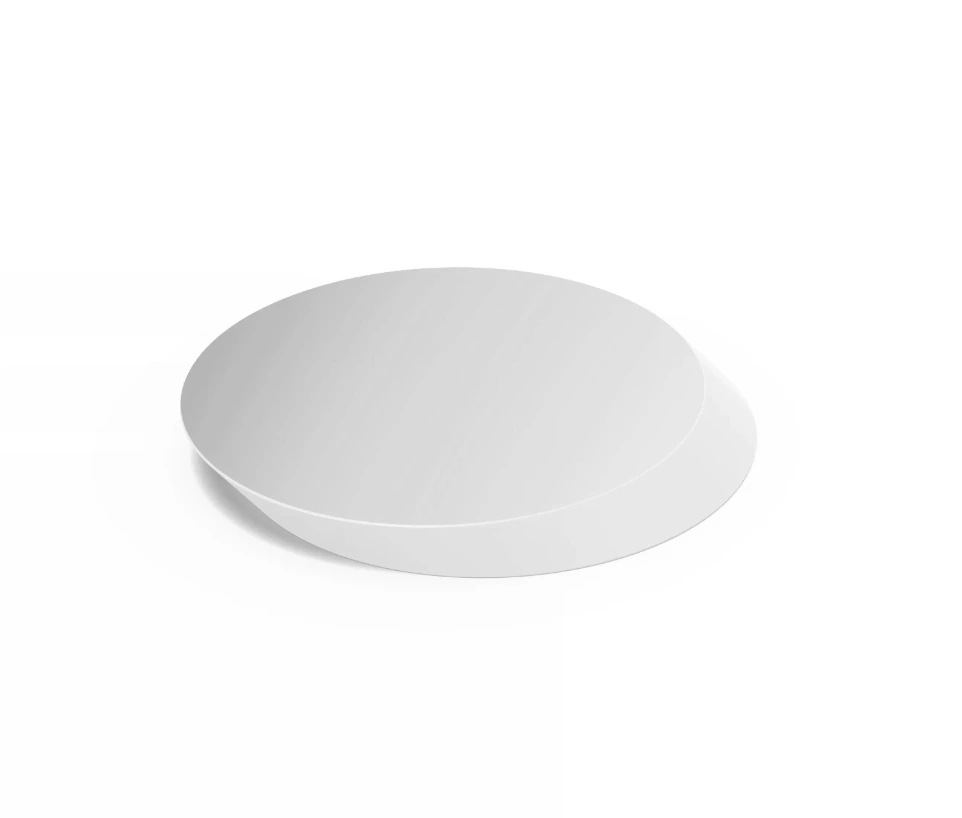
Wedge Window
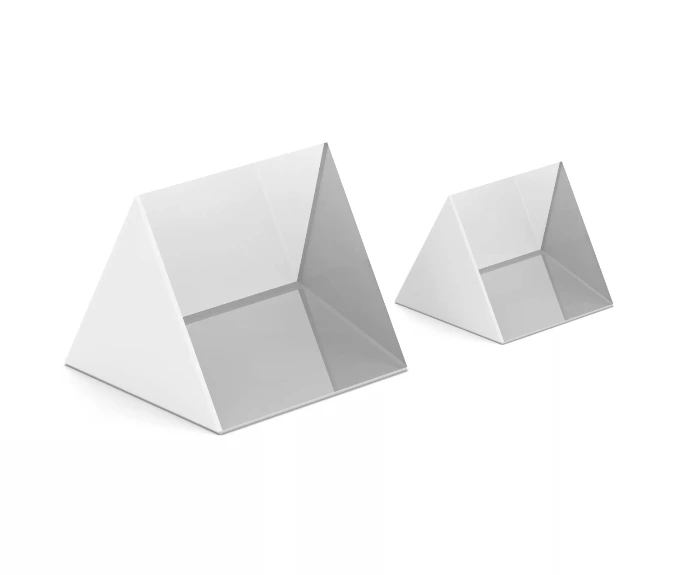
A window with a small, precisely controlled angle between its two surfaces — deflecting unwanted back-reflections away from the optical axis to eliminate interference fringes and laser feedback. The standard solution wherever a flat window's parallel-surface back-reflection would destabilize a laser or corrupt a measurement.
Wedge angle
Typically 0.5°–5°
Function
Back-reflection elimination
Beam deviation
Small, calculable
Etalon fringes
Eliminated
Overview
- A flat window manufactured with a small, deliberate angle (the "wedge angle") between its front and back surfaces, rather than true parallelism
- The wedge angle separates the reflections from the front and back surfaces angularly — preventing them from recombining and interfering, and directing both away from the original beam path
- Eliminates the etalon effect: in a perfectly parallel window, multiple internal reflections between the two surfaces interfere constructively and destructively as wavelength or angle varies, producing periodic transmission ripples (fringes) that corrupt spectroscopic measurements and destabilize laser cavities
- Used universally in laser systems as output windows, isolator windows, and beam sampling elements where any back-reflection toward the laser source must be avoided
- The transmitted beam is deviated by a small, predictable angle δ ≈ (n−1)·α for small wedge angle α — a deviation that must be accounted for in system alignment, unlike a parallel window
- Available in a wide range of wedge angles depending on the application — from a few arcminutes (subtle back-reflection control with minimal beam deviation) to several degrees (strong back-reflection separation, used as beam samplers)
Key Features
Back-reflection suppression
By angling the two surfaces relative to each other, a wedge window deflects the front-surface and back-surface reflections in different directions, both away from the original beam axis — preventing reflected light from coupling back into a laser cavity or interfering with the primary measurement beam.
Etalon fringe elimination
A parallel window acts as a weak Fabry-Pérot etalon — internal multiple reflections interfere to produce periodic transmission variations with wavelength. The wedge angle de-tunes this resonance across the aperture, washing out the fringe pattern and producing smooth, fringe-free transmission essential for accurate spectroscopic and interferometric measurements.
Laser cavity stability
In laser systems, even a tiny fraction of light reflected back into the gain medium can destabilize single-frequency operation, induce mode-hopping, or damage sensitive laser diodes. Wedge windows used as output couplers, isolator windows, and protective covers reliably prevent this feedback path.
Dual-surface beam sampling
Because the front and back surface reflections of a wedge window emerge at distinctly different angles, a single wedge window can serve as a simple beam sampler — picking off a small, well-separated fraction of an incident beam from one surface for power monitoring while the main beam continues largely undisturbed.
Design and Construction
Wedge angle selection
Typical angle ranges
- Light wedge (2–10 arcmin): minimal beam deviation; subtle back-reflection control for sensitive laser cavities
- Standard wedge (0.5°–2°): general-purpose back-reflection elimination for laser windows and gas cell optics
- Steep wedge (3°–10°): strong separation; used for beam sampling and high-isolation applications
Tolerances
- Wedge angle tolerance: ±5 arcsec to ±2 arcmin depending on grade
- Surface flatness: λ/4 standard; λ/10 for laser-grade wedge windows
- Surface quality: 60-40 standard; 20-10 to 10-5 for high-power laser applications
Design parameters
Beam deviation calculation
- For small wedge angle α: deviation δ ≈ (n−1)·α
- Higher-index materials produce more deviation for the same wedge angle — a consideration when selecting substrate
- Orientation marking (wedge direction indicator) is typically provided for correct mounting alignment
Coating options
- BBAR on both surfaces — minimizes residual reflection in laser beam paths
- V-coat — single-wavelength laser applications
- One surface AR-coated, other uncoated — used when a defined sampling reflection is desired
Optical Materials
Standard glass
Visible & NIR
- N-BK7 — standard laser window and gas cell wedge material; excellent transmission and availability
- Fused Silica — higher laser damage threshold; lower thermal expansion for high-power applications
UV-grade
- UV Fused Silica — excimer and UV laser wedge windows
- CaF₂ — deep UV and broadband UV-IR wedge windows
Infrared materials
IR wedge substrates
- Germanium — LWIR laser and thermal imaging wedge windows
- ZnSe — CO₂ laser wedge windows; low absorption at 10.6 µm
- Silicon — MWIR wedge windows; lightweight
Wavelength Options
UV
- 193–400 nm
- UVFS / CaF₂
- LIDT-rated AR
Visible
- 400–700 nm
- N-BK7
- BBAR or V-coat
NIR
- 700–2000 nm
- BK7 / Fused Silica
- NIR BBAR
LWIR
- 8–12 µm (CO₂)
- ZnSe / Ge
- BBAR 8–12 µm
Applications
Laser Systems
Laser output & isolator windows
Output coupling windows and isolator windows in laser systems — preventing back-reflections from destabilizing the laser cavity or inducing mode-hopping, especially critical in single-frequency and narrow-linewidth laser sources.
Spectroscopy
Fringe-free gas cell windows
Sealing windows for spectroscopic gas cells and sample compartments where parallel-window etalon fringes would corrupt the wavelength-dependent transmission measurement — the wedge eliminates this artifact entirely.
Telecommunications
Fiber-optic component windows
Used in fiber-optic isolators, circulators, and laser diode packages to prevent back-reflections from coupling into the fiber or laser source — critical for maintaining signal integrity in optical communication systems.
Industrial
High-power laser beam sampling
Steep-wedge windows pick off a small, well-defined fraction of a high-power industrial laser beam for real-time power monitoring while the main beam continues to the workpiece largely undisturbed.
Research
Interferometer & cavity optics
Used in precision interferometer and optical cavity setups where unwanted internal reflections from auxiliary windows could introduce spurious fringes or noise into the primary measurement signal.
Defense
Laser rangefinder & designator windows
Output windows for laser rangefinders and target designators — eliminating retroreflected energy that could otherwise be detected by adversary laser warning receivers or interfere with the instrument's own detection electronics.
Why choose Wedge Windows
Eliminates etalon fringes
The only window geometry that fully removes the periodic transmission ripple caused by internal multiple reflections — essential for clean spectroscopic and interferometric measurements.
Protects sensitive laser sources
Prevents back-reflected light from destabilizing laser cavities or damaging laser diodes — a standard requirement in virtually every precision laser system.
Built-in beam sampling
A single wedge surface can serve as both a sealing window and a beam-sampling pick-off — reducing component count in power-monitoring optical paths.
Wide angle selection
Available across a broad range of wedge angles — from subtle arcminute wedges to steep multi-degree wedges — matching the specific isolation requirement of each application.
Frequently asked questions
Here are some common questions about achromatic lens.
The required wedge angle depends on the beam divergence and the distance to sensitive components. For most laser applications, a wedge angle of 0.5° to 1° provides sufficient angular separation between the front and back surface reflections to steer them well clear of the input beam and any downstream apertures over typical propagation distances. Highly divergent or tightly focused beams may require steeper wedges; well-collimated beams over short distances can use lighter wedges (a few arcminutes) to minimize beam deviation while still achieving adequate isolation.
Yes — because a wedge window deviates the transmitted beam by a wavelength-dependent angle (due to material dispersion), it introduces a small amount of chromatic dispersion across the field, similar to a very weak prism. For imaging applications where a wedge window must be used (for instance, an anti-reflection sealing window with back-reflection control), the wedge angle should be kept as small as practical, and downstream optics may need to compensate for the resulting beam deviation and slight color fringing.
Wedge windows are typically marked with an orientation indicator (such as a small flat, notch, or printed arrow) showing the direction of the thick edge of the wedge. Correct rotational alignment ensures the reflected beams are deflected in the intended direction — for example, away from a return path toward a laser source, or toward a designated beam-sampling detector. Incorrect orientation can result in reflections being steered toward, rather than away from, sensitive components.