Convex Mirror
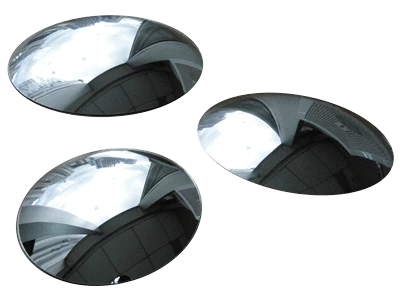
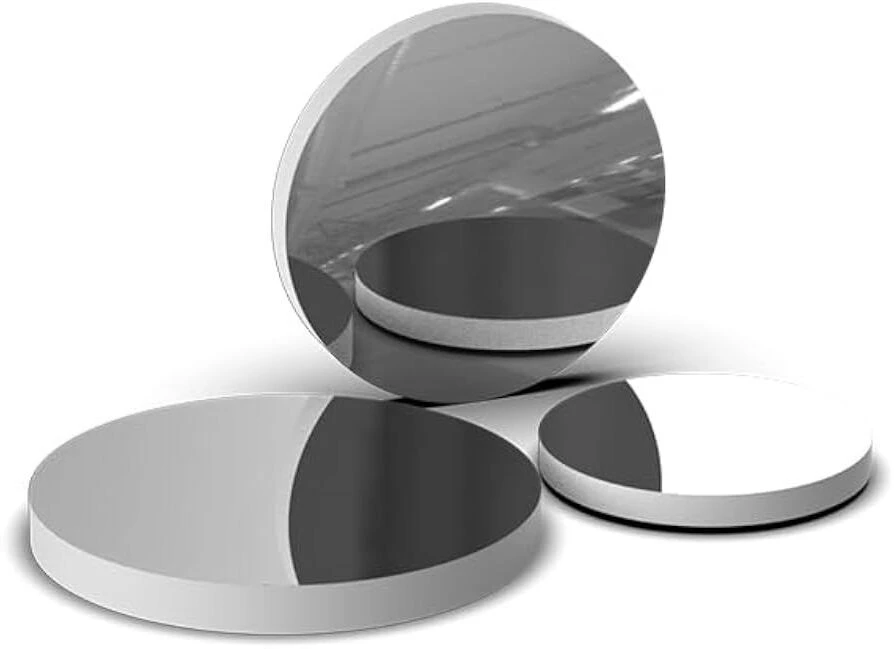
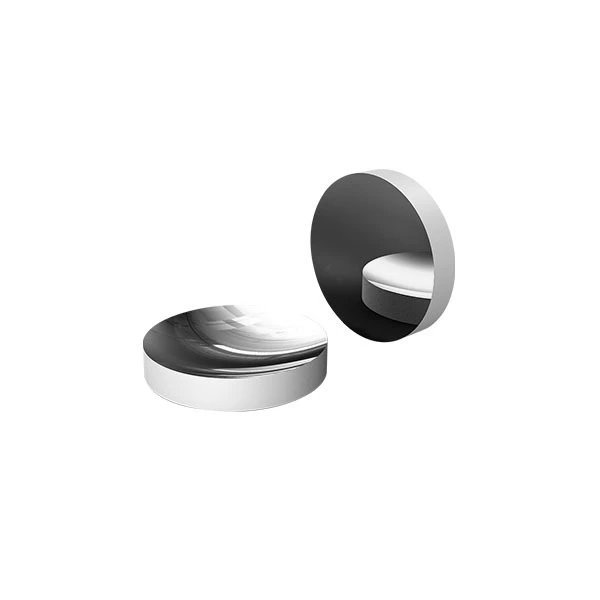
A spherical mirror curving outward away from the light source — diverging reflected light and producing a wide field of view from a compact element. Used wherever a wide viewing angle, beam expansion, or negative optical power is required, from automotive safety mirrors to Cassegrain telescope secondaries.
Surface form
Spherical, convex
Focal length
Negative (virtual focus)
Image type
Virtual, upright, demagnified
Field of view
Wider than equivalent flat
Overview
- A mirror with a spherical convex (outward-curving) reflective surface that diverges reflected light — producing a virtual, upright, demagnified image behind the mirror
- Has negative optical power by convention — the virtual focal point lies behind the mirror surface, at f = −R/2 for normal incidence
- Always produces a virtual image regardless of object distance — unlike a concave mirror, a convex mirror cannot produce a real, projectable image of a real object
- Provides a wider field of view than a flat mirror of the same physical size — the diverging surface captures and reflects a larger solid angle of the surrounding scene
- The demagnified image makes objects appear smaller and farther away than they actually are — the well-known basis for the universal automotive mirror warning "objects in mirror are closer than they appear"
- Used as the secondary mirror in Cassegrain-type telescope designs to fold and extend the effective focal length within a compact tube
Key Features
Wide field of view
A convex mirror reflects a wider angular field than a flat mirror of equal size — because the diverging surface captures light from a broader range of incident angles. This makes convex mirrors the standard solution for wide-area surveillance, security observation, and safety applications where maximum coverage from a compact mirror is the priority.
Beam expansion
In laser and telescope optics, convex mirrors serve as the diverging element in reflective beam expanders and Cassegrain-type telescope secondaries — expanding a converging beam from the primary mirror, or expanding a small collimated beam to a larger diameter, without introducing chromatic aberration.
Effective focal length extension
In Cassegrain and related telescope designs, a convex secondary mirror placed before the primary mirror's focus reflects the converging beam back through a hole in the primary — multiplying the effective focal length several-fold while keeping the physical telescope tube short, the defining advantage of folded telescope optics.
Compact safety & surveillance optics
The combination of wide field of view and demagnified (smaller, fits-more-in-frame) image makes convex mirrors the standard solution for blind-spot mirrors, traffic safety mirrors at intersections, security observation mirrors, and machine safety guarding — providing maximum situational awareness from a small, low-cost reflective element.
Design and Construction
Geometry & specifications
Optical parameters
- Focal length: f = −R/2 (negative by sign convention for diverging mirrors)
- Image magnification: always less than 1 (demagnified) and always positive (upright) for any object distance
- Field of view scales with the ratio of mirror diameter to radius of curvature — smaller R produces wider field of view for a given mirror size
Tolerances
- Radius of curvature: ±0.5% standard; ±0.1% precision (Cassegrain secondary mirrors)
- Surface figure: λ/4 standard; λ/10 to λ/20 for telescope secondary mirrors
- Surface quality: 60-40 commercial; 10-5 for precision astronomical optics
Common design variants
Telescope secondary types
- Cassegrain: convex hyperbolic secondary; compact tube, flat field at focus
- Gregorian: concave secondary (not convex) — different optical path, used less commonly
- Ritchey-Chrétien: convex hyperbolic secondary; corrected for coma; standard for professional observatories
Safety/surveillance mirror forms
- Hemispherical (dome) mirrors — full 360° or hemispherical field of view for security applications
- Cylindrical convex strips — wide horizontal field of view for blind-spot mirrors
Optical Materials
Precision optical substrates
Glass & glass-ceramic
- BK7 / float glass — standard precision optics convex mirrors
- Fused Silica — low thermal expansion; laser and scientific instrument mirrors
- Zerodur / ULE — astronomical telescope secondary mirrors requiring thermal stability
Safety mirror materials
- Acrylic (PMMA) with vacuum-metalized coating — lightweight, shatter-resistant traffic and security mirrors
- Polished stainless steel — extreme durability for industrial and outdoor security mirror applications
Coating types
Precision optical coatings
- Protected aluminum — broadband; standard secondary mirror coating
- Protected silver — higher reflectance for visible/NIR astronomical applications
- Enhanced dielectric — premium telescope secondaries requiring >99% reflectance
Wavelength Options
Visible
- 400–700 nm
- Protected Al/Ag
- 85–99% reflectance
NIR
- 700–2000 nm
- Protected Ag
- >97% reflectance
Broadband (Vis)
- 400–700 nm
- Aluminized acrylic
- Safety mirror grade
Applications
Astronomy
Cassegrain telescope secondaries
The secondary mirror in Cassegrain, Ritchey-Chrétien, and related folded telescope designs — extending the effective focal length several-fold within a short tube while reflecting the converging beam back through the primary mirror to the focal plane.
Safety
Traffic & blind-spot mirrors
Convex traffic safety mirrors installed at intersections, parking garage corners, and warehouse aisles provide drivers and pedestrians with a wide field of view around obstructions — the same principle used in vehicle blind-spot mirrors.
Security
Surveillance mirrors
Hemispherical convex mirrors mounted in retail stores, warehouses, and public spaces provide wide-area visual surveillance coverage from a single compact mirror — allowing security personnel to monitor large areas without multiple camera positions.
Laser Systems
Beam expanders
Used as the diverging element in reflective (mirror-based) beam expanders — expanding a small collimated laser beam to a larger diameter for applications requiring reduced beam divergence or compatibility with a larger downstream aperture, with zero chromatic aberration unlike lens-based expanders.
Automotive
Wide-angle vehicle mirrors
Convex side-view and rear-view mirror sections provide drivers with a wider field of view than a flat mirror of the same size — reducing blind spots at the cost of some depth perception accuracy, a well-understood and accepted safety tradeoff.
Industrial
Machine safety guarding
Convex mirrors mounted on industrial machinery and robotic work cells allow operators to observe areas of the machine or workspace that would otherwise be obscured — a low-cost passive safety measure required by many industrial safety standards.
Why choose Convex Mirrors
Widest field of view per size
Provides a wider angular field of view than any flat mirror of the same physical dimensions — the most space-efficient way to achieve wide-area observation coverage.
Compact telescope folding
Enables Cassegrain-type telescope designs to achieve very long effective focal lengths within short physical tube lengths — the key enabler of compact, portable astronomical telescopes.
Zero chromatic aberration
Like all mirrors, achromatic by nature — making convex mirrors ideal for broadband beam expansion applications where a lens would introduce wavelength-dependent divergence.
Low-cost safety solution
Inexpensive acrylic and metal convex safety mirrors provide an extremely cost-effective passive safety improvement for traffic, security, and industrial applications.
Frequently asked questions
Here are some common questions about achromatic lens.
A convex mirror has negative optical power — reflected rays diverge as if coming from a virtual focal point behind the mirror. For any object position (no matter how far or close), the diverging reflected rays never actually converge in front of the mirror — they only appear to converge to a virtual point behind it. This means a convex mirror can never form a real, projectable image; it always produces a virtual, upright, demagnified image, regardless of object distance — unlike a concave mirror, which produces different image types depending on whether the object is inside or outside the focal length.
A convex mirror demagnifies the image — objects appear smaller than they would in a flat mirror at the same distance. Human depth perception partly relies on apparent angular size to judge distance — a smaller apparent size is subconsciously interpreted as "farther away." Because the convex mirror makes objects look smaller (and therefore seem farther) than they actually are, the well-known warning is required on vehicle convex mirrors to correct for this perceptual effect.
A Cassegrain telescope uses a convex secondary mirror placed before the primary mirror's focal point — the diverging convex surface reflects the still-converging beam back through a hole in the primary mirror, producing a compact instrument. A Gregorian telescope uses a concave secondary mirror placed after the primary's focal point — the beam crosses focus once before reaching the secondary, requiring a physically longer tube for the same effective focal length. Cassegrain (and the coma-corrected Ritchey-Chrétien variant) designs are far more common in modern telescopes due to their more compact form factor.