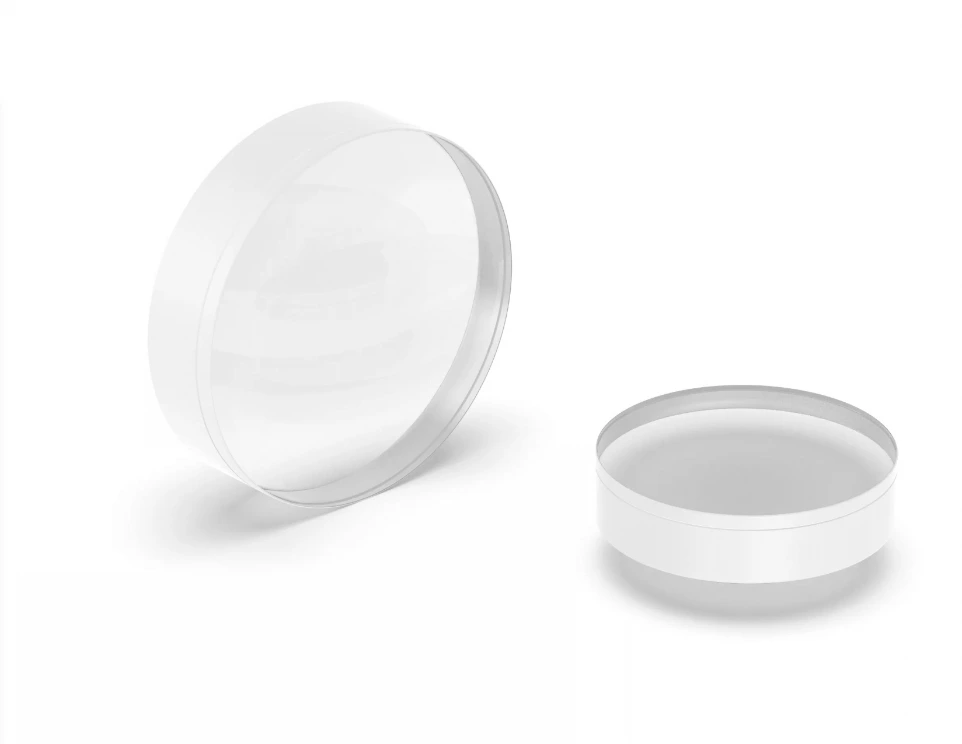
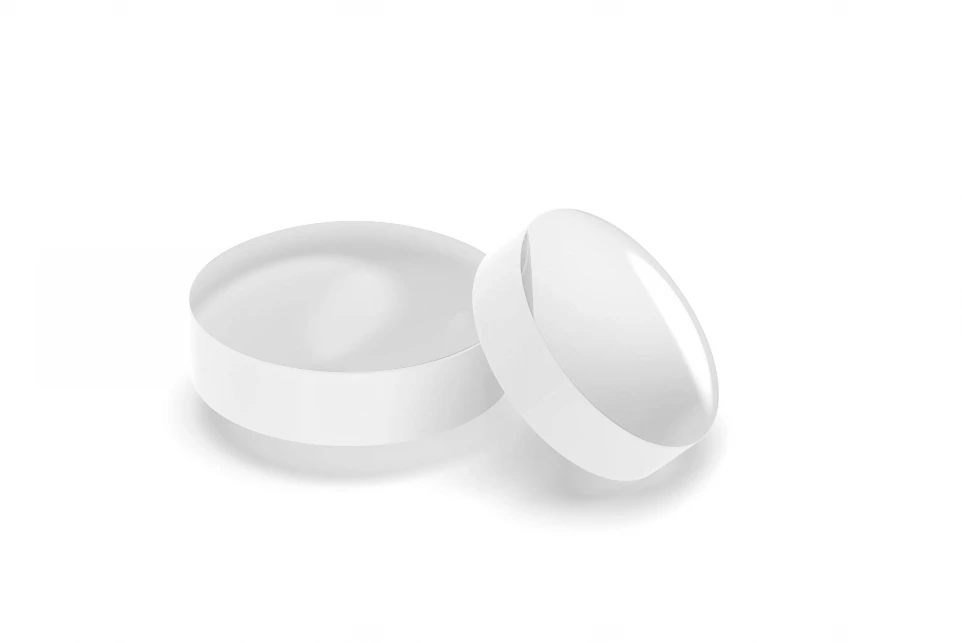
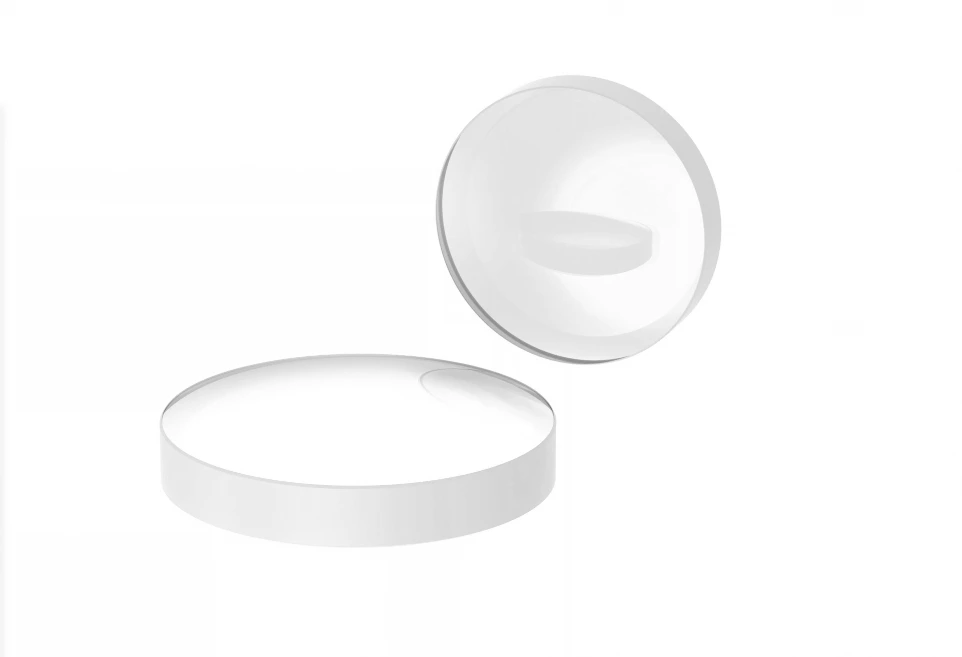
Plano-Convex Lens
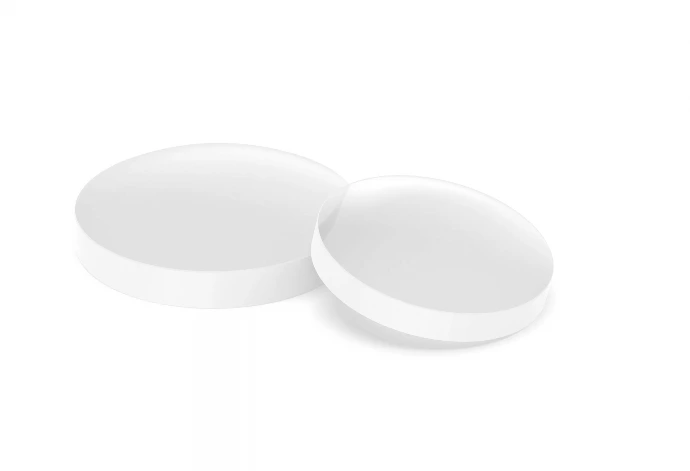
The most widely used converging singlet lens in optics — one flat surface paired with one outward-curving convex surface. A simple, cost-effective solution for focusing, collimating, and beam-shaping tasks across UV, visible, NIR, and infrared wavelength ranges.
Overview
- Positive focal length singlet — brings parallel light to a focal point beyond the lens
- Flat (plano) surface on one side; spherical convex surface on the other — asymmetric form by design
- Best performance when the convex surface faces the longer conjugate (collimated beam or distant object)
- Minimizes spherical aberration in infinite conjugate configurations when correctly oriented
- Widest material selection of any lens type — from standard BK7 through infrared germanium
- The industry's standard first-choice lens for monochromatic light-focusing and beam-collimation tasks
Key Features
Light collimation & focusing
When a point source is placed at the focal point, the plano-convex lens converts diverging light into a collimated parallel beam — essential in laser systems, projectors, and illumination optics. In reverse, a collimated beam is focused to a tight spot.
Orientation-dependent performance
The asymmetric surface profile means orientation matters. The convex surface should face the source for infinite conjugate setups, while the flat surface faces the image plane. Reversed orientation dramatically increases spherical aberration and reduces performance.
Low wavefront distortion
In correct orientation, the plano-convex design provides near-best-form performance for infinite conjugate applications — minimizing wavefront error and delivering clean, low-aberration output suitable for interferometry, laser optics, and precision imaging.
Cost-effective & versatile
Single-element construction, simple polishing geometry, and wide material availability make plano-convex lenses the most economical converging lens — stocked in hundreds of size-and-material combinations for fast off-the-shelf sourcing.
Design and Construction
Surface & form specifications
Surface quality
- Standard: 60-40 scratch-dig surface quality
- Precision: 20-10 or 10-5 for laser-grade optics
- Surface figure: λ/4 standard, λ/8 available for precision use
Key tolerances
- Focal length tolerance: typically ±1–2%
- Center thickness tolerance: ±0.1–0.05 mm
- Diameter tolerance: ±0.0/−0.1 mm standard
- Centration: ≤3 arcmin standard, ≤1 arcmin precision
Design parameters
Optical parameters
- Radius of curvature defines focal length per lensmaker's equation: f = R / (n−1)
- Abbe number of substrate governs chromatic dispersion — BK7 has V≈64 (low dispersion)
- Index of refraction ranges from ~1.4 (fused silica) to ~4.0 (germanium)
Coating options
- Uncoated — for low-power or broadband applications
- MgF₂ single-layer — cost-effective, visible range
- Broadband AR (BBAR) — <0.5% reflection per surface across a waveband
- V-coat — minimal reflection at a single laser wavelength
Optical Materials
Standard optical glass
Visible & NIR range
- N-BK7 — industry standard borosilicate crown; excellent transmission 350–2000 nm
- N-SF11 — higher refractive index (n=1.784); useful for compact short-focal-length designs
- Sapphire (Al₂O₃) — extremely hard, high-temperature stable, 150 nm–5.5 µm range
UV-grade materials
- UV-grade Fused Silica — high transmission from 185 nm; low thermal expansion; ideal for excimer laser use
- Calcium Fluoride (CaF₂) — excellent UV and IR transmission; minimal chromatic dispersion
Infrared materials
Mid-wave IR (MWIR)
- Silicon (Si) — 1.2–8 µm range; lightweight, hard, excellent for imaging
- Calcium Fluoride — extends to 8 µm; lower index than Ge
Long-wave IR (LWIR)
- Germanium (Ge) — 2–12 µm; high index (n≈4.0); premium thermal imaging substrate
- Zinc Selenide (ZnSe) — 0.5–20 µm; low absorption; preferred for CO₂ laser optics
- Zinc Sulfide (ZnS) — 0.4–12 µm; harder than ZnSe; used in rugged FLIR systems
Wavelength Options
Deep UV
- 185–350 nm
- CaF₂ or UVFS
- UV-optimized AR
Visible
- 400–700 nm
- N-BK7 standard
- MgF₂ or BBAR
NIR
- 700–2000 nm
- BK7 / Fused Silica
- VIS-NIR BBAR
MWIR
- 2–5 µm
- Silicon or CaF₂
- BBAR 3–5 µm
LWIR
- 8–12 µm
- Germanium or ZnSe
- BBAR 8–12 µm
Applications
Laser Systems
Beam focusing & collimation
Used extensively in laser setups to collimate diverging diode output or focus a collimated beam to a tight spot. The flat surface toward the image plane minimizes spherical aberration at high power densities.
Imaging
Cameras & instruments
Serves as an objective or field element in scientific cameras, machine vision systems, and simple imaging instruments where monochromatic or narrowband illumination makes chromatic correction unnecessary.
Fiber Optics
Coupling & collimation
Pairs with optical fiber to collimate diverging output or focus collimated light into fiber cores. Precision-grade fused silica versions handle UV and high-power applications without degradation.
Thermal Imaging
IR camera lenses
Germanium and ZnSe plano-convex lenses are the building blocks of thermal camera objectives for defense, industrial inspection, and medical thermography applications.
Illumination
Projectors & condensers
Used in projector systems and condenser optics to collect and direct light from a source into a controlled beam — from stage lighting to scientific illuminators and exposure systems.
Sensing
Barcode & sensor optics
The compact, simple form of a plano-convex lens makes it ideal for miniaturized scanning and sensing systems — including barcode readers, LiDAR receivers, and optical proximity sensors.
Why choose Plano-Convex Lenses
Widest material range
Available in more substrate materials than any other lens type — from deep-UV fused silica to long-wave IR germanium — covering virtually every wavelength from 185 nm to 12 µm.
Best-form for infinite conjugates
The plano-convex profile is the theoretical near-best-form lens for infinite conjugate applications — minimizing spherical aberration with the simplest possible single-element construction.
Lowest cost entry point
Standard N-BK7 plano-convex lenses are among the most affordable precision optical components available — ideal for prototyping and building multi-element systems before upgrading to achromats.
Off-the-shelf availability
Available from major suppliers (Edmund Optics, Thorlabs, Newport) in hundreds of standard sizes — allowing fast iteration and system assembly without custom manufacturing lead times.
Frequently asked questions
Here are some common questions about achromatic lens.
Orient the convex surface toward the longer conjugate — the collimated beam input or the more distant object. For a collimating application (diverging source to parallel output), the convex side faces the source. For focusing (parallel beam to spot), the convex side faces the incoming collimated beam. Reversing the lens significantly increases spherical aberration.
A plano-convex lens is preferred when one conjugate is at or near infinity — such as collimating a point source or focusing a collimated beam. Biconvex lenses are better suited for equal conjugate ratios (object and image at similar distances). For unequal ratios beyond 5:1, the plano-convex is the preferred form.
Yes. All single-element lenses including plano-convex suffer from chromatic aberration — different wavelengths focus at different distances. For monochromatic sources (single-wavelength lasers) this is not a concern. For broadband or white-light applications, an achromatic doublet should be used instead.
Standard options include: uncoated (for broadband or low-power use), MgF₂ single-layer AR (cost-effective visible range), broadband AR (BBAR) coatings reducing reflection below 0.5% per surface over a defined waveband, and V-coatings for minimal reflection at a single wavelength — especially for laser applications at 532 nm, 1064 nm, or 1550 nm.
Yes. Custom specifications including diameter, focal length, substrate material, surface quality, centration tolerance, and coating can all be specified. Custom lenses are particularly common for infrared systems using germanium or ZnSe where standard sizes may not match system requirements.