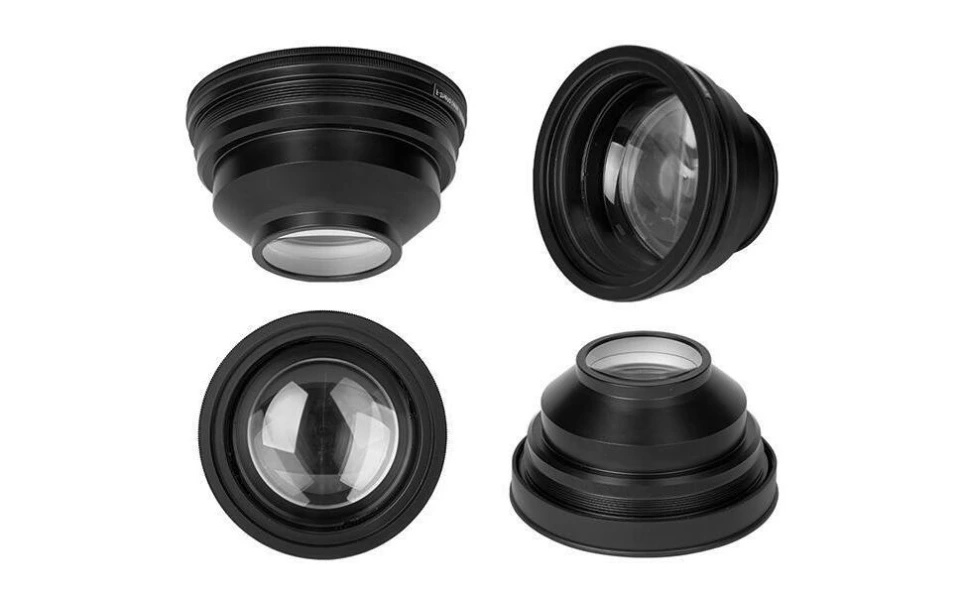
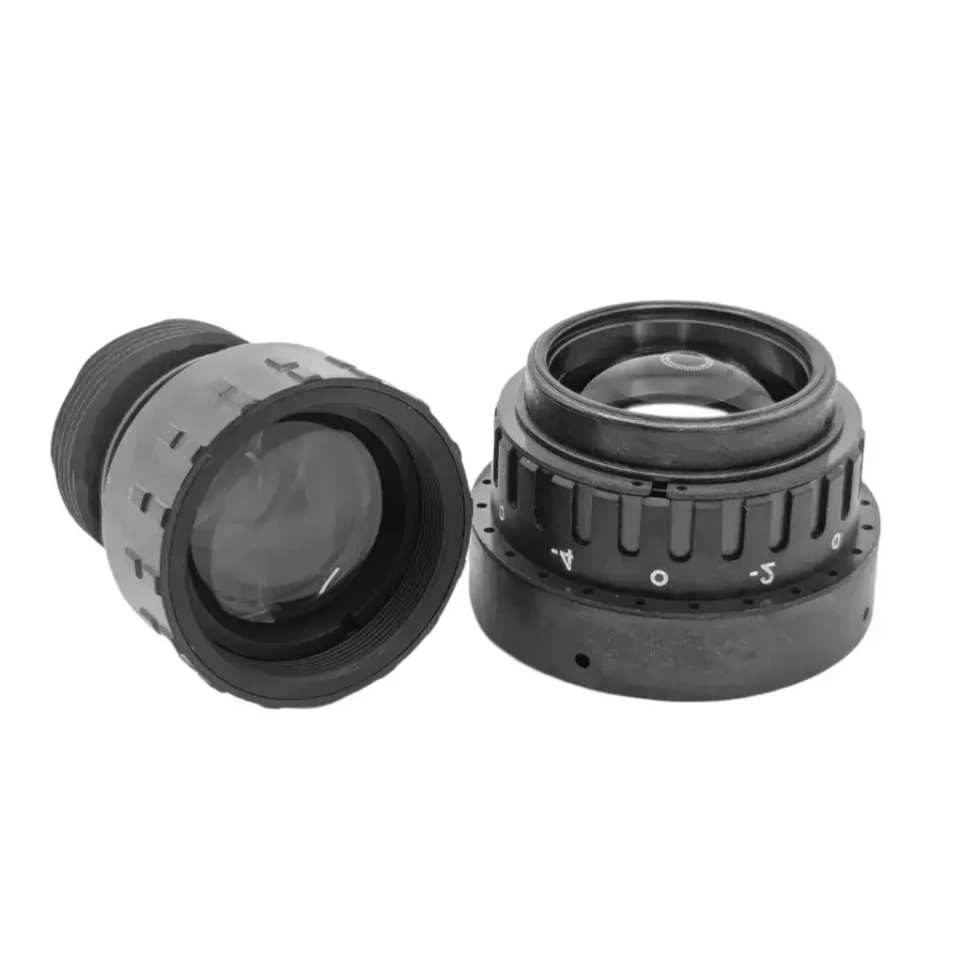
Athermalized IR Lens Assembly
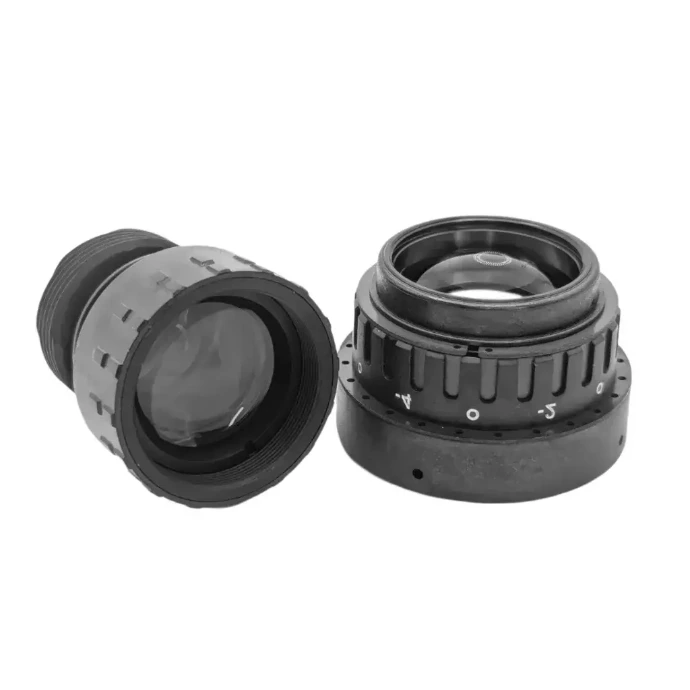
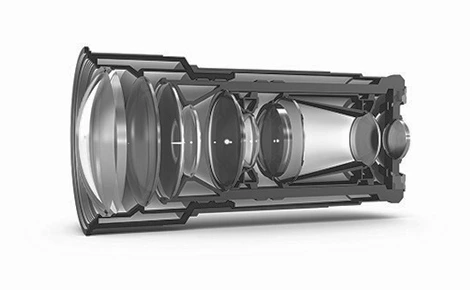
A multi-element infrared lens system specifically engineered to maintain focus across extreme temperature ranges without mechanical or electronic refocusing — exploiting the unusual thermal and dispersive properties of IR-transmitting crystalline materials to passively cancel temperature-induced focus shift. The essential optic for thermal imaging systems deployed in uncontrolled outdoor and field environments.
Function
Passive thermal focus stabilization
Operating range
Often −40°C to +70°C or wider
Method
Optical, mechanical, or hybrid athermalization
Spectral band
MWIR (3–5 µm) or LWIR (8–12 µm
Overview
- A multi-element infrared lens assembly specifically designed to maintain acceptable focus across a wide operating temperature range without requiring active mechanical refocusing — addressing the pronounced thermal sensitivity of standard IR optical materials, whose refractive index and physical dimensions change substantially more with temperature than typical visible-range glass
- Infrared materials such as germanium exhibit a thermo-optic coefficient (dn/dT) far larger than visible glass — meaning even modest ambient temperature swings can shift an uncorrected IR lens's focal point enough to noticeably degrade image sharpness, a problem visible-range lens designers rarely need to address to the same degree
- Optical athermalization achieves temperature stability purely through lens design — selecting and combining IR materials with complementary, partially canceling thermo-optic properties so the overall system focal length remains nearly constant across temperature, without any moving parts
- Mechanical (active or passive-mechanical) athermalization instead uses temperature-compensating mechanical structures — such as differential-expansion metal spacers, or motorized focus mechanisms driven by a temperature sensor — to physically reposition lens elements as ambient temperature changes, compensating for the optical thermal drift through controlled mechanical motion
- Critical for thermal imaging cameras deployed in uncontrolled outdoor environments — military and security surveillance systems, automotive night vision, firefighting thermal cameras, and industrial process monitoring — where ambient temperature can swing dramatically between operating conditions and any focus drift would compromise image usability exactly when reliable performance matters most
- Athermalization is evaluated alongside the lens's other standard IR optical specifications (spectral band, f-number, field of view, MTF performance) as an additional, often mission-critical design requirement specifically for field-deployed and uncontrolled-environment thermal imaging applications
Key Features
Passive temperature-stable focus
Maintains acceptable focus across the design temperature range without any moving parts or active control system — optical athermalization achieves this purely through the careful selection and combination of IR materials whose thermo-optic properties partially cancel each other across the operating temperature range.
Mechanical compensation alternatives
Where purely optical athermalization cannot achieve the required performance across an extreme temperature range, mechanical compensation mechanisms — differential-expansion metal structures or active motorized focus driven by temperature sensing — physically reposition lens elements to maintain focus, trading some mechanical complexity for broader achievable temperature compensation.
Wide operational temperature range
Well-athermalized IR lens assemblies maintain useful imaging performance across temperature ranges spanning −40°C to +70°C or wider — essential for systems deployed in environments ranging from arctic surveillance to desert security applications, where ambient conditions vary far more dramatically than typical consumer optics ever encounter.
Reliable field-deployment performance
Eliminates the focus drift failure mode that would otherwise compromise image quality precisely when ambient temperature is changing — a critical reliability property for security, defense, and industrial monitoring systems where consistent thermal imaging performance must be guaranteed regardless of time of day or season.
Design and Construction
Athermalization approaches
Optical (passive material) athermalization
- Combines IR materials with complementary thermo-optic coefficients (dn/dT) so their temperature-induced focus shifts substantially cancel
- No moving parts; lowest mechanical complexity and highest reliability once correctly designed
- Material selection constrained by available IR-transmitting materials, limiting design flexibility compared to visible-range achromatic correction
Mechanical athermalization
- Passive mechanical — differential thermal expansion of metal spacer materials repositions elements automatically with temperature, no power required
- Active mechanical — temperature sensor drives a motorized focus mechanism to compensate; most flexible but adds complexity, power consumption, and a potential failure point
Specifications
Key parameters
- Athermalization range: the specified temperature range over which focus/MTF performance remains within tolerance
- Residual focus shift: quantifies any remaining defocus across the athermalized range, even after compensation
- Spectral band: MWIR (3–5 µm) or LWIR (8–12 µm), determining material selection and detector pairing
Trade-offs
- Purely optical athermalization sometimes constrains achievable f-number or field of view compared to a non-athermalized design of similar element count, due to the limited palette of suitable IR materials
- Mechanical solutions can achieve broader compensation range at the cost of added moving parts and potential reliability concerns in extreme environments
Optical Materials
Primary IR materials
High-index crystalline elements
- Germanium — high index, strong refractive power, but the largest thermo-optic coefficient among common IR materials, requiring careful compensation
- Silicon — used in some MWIR athermalized designs; different thermal behavior than germanium, useful for compensation pairing
Compensating materials
- Zinc Selenide and Zinc Sulfide — different thermo-optic characteristics than germanium, used in combination to help cancel net system thermal focus drift
- Chalcogenide glass — moldable IR glass with thermo-optic properties useful for cost-effective athermalized lens designs in moderate-performance applications
Mechanical compensation materials
Differential-expansion structures
- Aluminum and other high-thermal-expansion metals — used in passive mechanical athermalization structures, paired against lower-expansion housing materials to drive compensating element motion
- Invar and other low-expansion alloys — used for the stable reference structure against which compensating motion is measured
Wavelength Options
MWIR
- 3–5 µm
- Silicon / Ge / ZnSe combinations
- BBAR 3–5 µm
LWIR
- 8–12 µm
- Ge / ZnS / Chalcogenide
- BBAR + DLC 8–12 µm
Applications
Defense
Military & border surveillance thermal cameras
Provides reliable, focus-stable thermal imaging across the extreme outdoor temperature ranges encountered in military surveillance, perimeter security, and border monitoring deployments around the world.
Automotive
Thermal night-vision driver assistance
Maintains consistent thermal imaging focus across the wide temperature range automotive night-vision systems experience, from cold winter mornings to hot summer engine-bay-adjacent mounting conditions.
Public Safety
Firefighting thermal imaging cameras
Used in handheld and helmet-mounted firefighting thermal cameras that must reliably maintain focus across the dramatic temperature swings encountered moving between outdoor staging areas and active fire environments.
Industrial
Outdoor process & equipment monitoring
Used in fixed industrial thermal monitoring installations for equipment condition monitoring and process control, where consistent focus performance is required regardless of seasonal or daily temperature variation.
Aerospace
UAV & aircraft thermal imaging payloads
Provides stable thermal imaging performance across the altitude-driven temperature extremes experienced by drone and aircraft-mounted thermal imaging payloads during flight operations.
Energy
Solar & power infrastructure inspection
Used in thermal inspection systems for solar panel and power infrastructure monitoring, deployed outdoors and requiring consistent focus across full seasonal and diurnal temperature ranges for reliable defect detection.
Why choose Athermalized IR Lens Assemblies
Reliable focus without active control
Optically athermalized designs maintain focus across wide temperature ranges with no moving parts — the most reliable solution for field-deployed thermal imaging systems.
Engineered for extreme environments
Specifically designed to handle the temperature extremes of real-world outdoor deployment — far beyond what standard, non-athermalized IR optics can reliably tolerate.
Flexible compensation architectures
Available in purely optical, passive mechanical, and active mechanical athermalization approaches — matched to the specific temperature range, performance, and reliability requirements of the application.
Mission-critical imaging consistency
Eliminates the focus-drift failure mode in defense, security, and safety applications where reliable thermal imaging performance must be guaranteed regardless of ambient conditions.
Frequently asked questions
Here are some common questions about athermalized Lens Assembly.
Common IR-transmitting materials, particularly germanium, have a thermo-optic coefficient (the rate of change of refractive index with temperature, dn/dT) that is roughly an order of magnitude larger than typical visible-range optical glass. This means the same ambient temperature change causes a much larger shift in an IR lens's effective focal length than it would in an equivalent visible-light lens design. Combined with the fact that many thermal imaging systems are deployed outdoors and exposed to far wider temperature swings than typical visible-light camera applications, this large thermo-optic sensitivity makes focus drift a much more significant practical problem for IR lens designers than it typically is for visible-range optics.
Optical (passive material) athermalization is generally preferred when it can achieve the required performance, since it has no moving parts — meaning no mechanical wear, no power consumption, and no potential failure point from a stuck or malfunctioning mechanism, making it the most reliable option for harsh, unattended field deployments. However, the limited palette of available IR materials with suitable complementary thermal properties sometimes constrains what optical athermalization alone can achieve, particularly for very wide temperature ranges or demanding f-number/field-of-view combinations. In these cases, mechanical athermalization (passive differential-expansion structures, or active motorized focus) provides the additional compensation range needed, at the cost of added mechanical complexity and, for active systems, power consumption and an additional potential failure mode.
The required athermalization range should be based on the actual environmental extremes the deployed system will realistically encounter — not just typical ambient air temperature, but also factors like solar loading on an exposed housing, proximity to heat-generating equipment, or cold-soak conditions during overnight outdoor storage. Military and defense specifications often require −40°C to +70°C or wider as a baseline standard for field-deployable equipment. For less extreme applications such as indoor industrial monitoring, a narrower specified range may be entirely adequate and more cost-effective, since athermalization performance and design complexity both generally increase with the required compensation range.