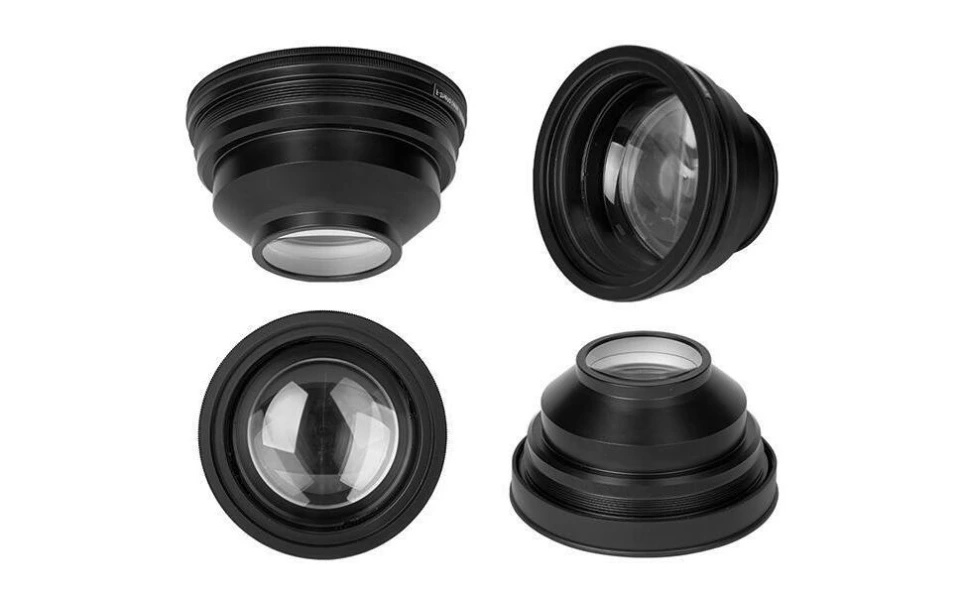
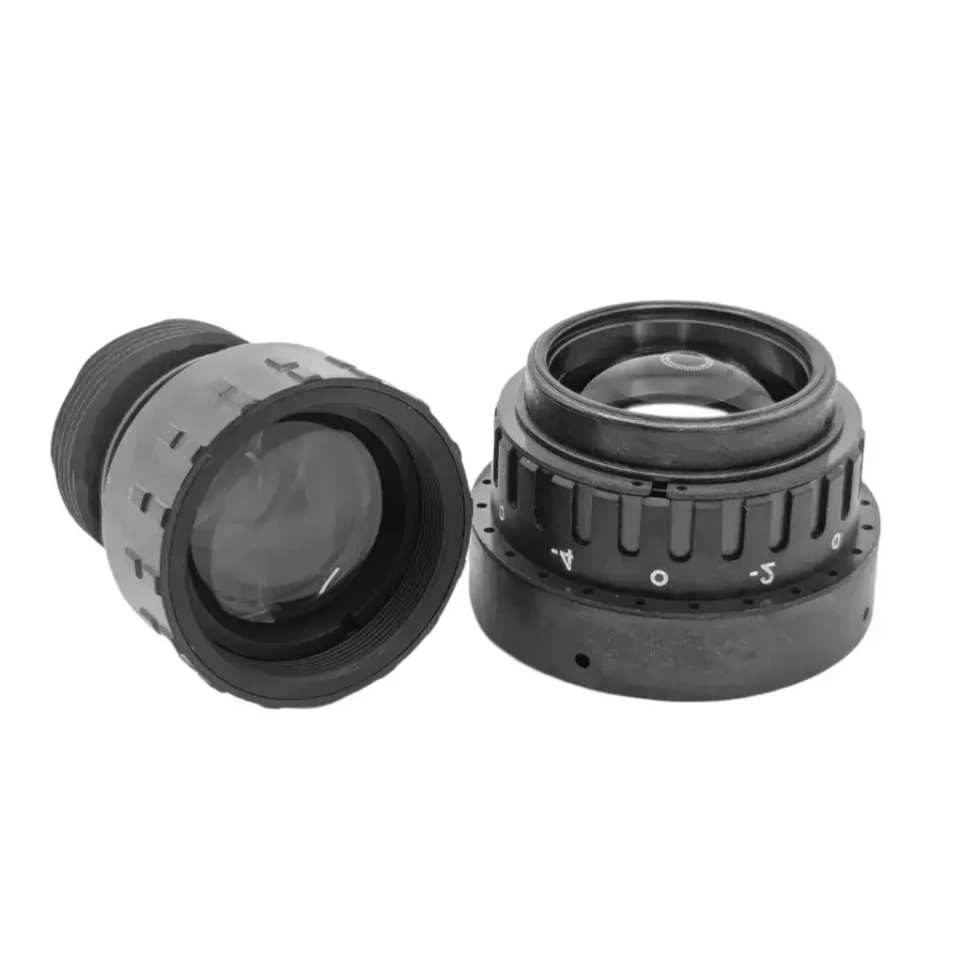
Projection Lens
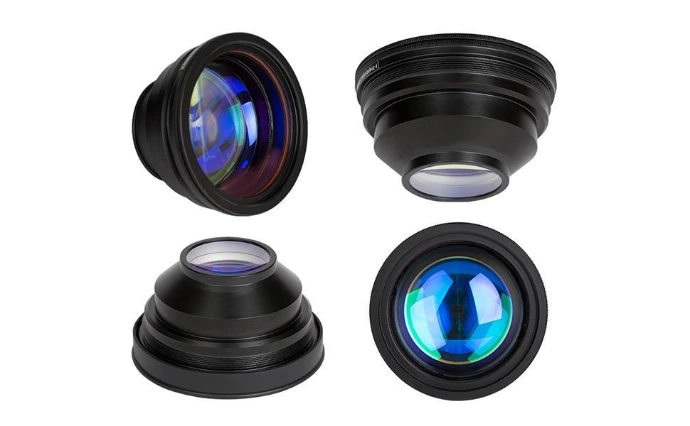
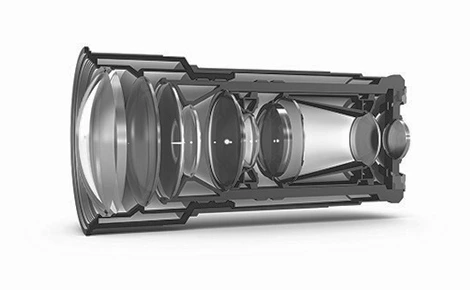
A multi-element lens assembly that projects a magnified, focused image of a small source — a microdisplay panel, photographic transparency, or DMD chip — onto a large distant screen with high brightness uniformity and minimal distortion. The optical engine behind cinema, business, and home theater projectors, photolithography steppers, and large-format display systems.
Function
Small source to large-screen magnification
Conjugate ratio
Highly asymmetric (large magnification)
Key requirement
Uniform brightness, low distortion
Throw ratio
Standard, short, or ultra-short thro
Overview
- A multi-element lens assembly designed to form a large, magnified, sharply focused real image of a small source — typically a microdisplay imaging panel (DLP, LCD, LCoS) — onto a distant projection screen, operating at a highly asymmetric conjugate ratio very different from a standard photographic or machine vision lens
- Must simultaneously control multiple aberrations across the full projected field — distortion (critical since projected straight lines on a screen are highly visible to viewers), field curvature (the panel and screen are both flat, requiring genuinely flat-field correction rather than the curved-field tolerance acceptable in some other applications), and chromatic aberration (especially in single-panel designs combining red, green, and blue information through a single lens path)
- Throw ratio — the relationship between projection distance and image width — defines a major design category: standard-throw lenses for typical conference room and theater installations, short-throw lenses for space-constrained settings, and ultra-short-throw lenses (sometimes incorporating an aspheric mirror) for projectors mounted very close to or even below the screen
- Brightness uniformity across the projected field is a critical specification — natural optical illumination falloff toward the edges of any wide-angle projection must be actively controlled through lens design, since uneven brightness is highly noticeable and objectionable to viewers in a large projected image
- Used in cinema and home theater projection, business and education presentation projectors, large-venue event projection, and specialized industrial and scientific projection applications including photolithography (projecting a mask pattern onto a photoresist-coated wafer) where the "projection" function operates in reverse — demagnifying rather than magnifying — but uses closely related optical correction principles
- Modern laser-phosphor and LED-illuminated projectors place additional demands on projection lens design for color uniformity and thermal stability compared to older lamp-based systems, given the different illumination source characteristics
Key Features
High-ratio magnification with flat-field correction
Projects a small imaging panel (often under 1 inch diagonal) onto a screen that may be tens of feet across — a magnification ratio of 100× or more — while maintaining flat-field focus across the entire projected image, since both the source panel and the destination screen are flat surfaces requiring genuine field-flatness correction rather than curved-field tolerance.
Low geometric distortion
Distortion that would be imperceptible in many other optical applications becomes highly visible when projected onto a large screen — straight lines in presentation content, architectural content, or cinema imagery must remain visually straight, driving projection lens designs toward very low distortion specifications, particularly for wide-throw-angle short-throw designs.
Uniform brightness delivery
Actively engineered to minimize the natural cosine-fourth-power illumination falloff toward the edges of the projected field — uneven brightness across a large projected image is immediately noticeable to viewers, making uniform light delivery a critical, actively managed specification rather than an incidental property.
Throw-ratio specialization
Available across standard, short-throw, and ultra-short-throw categories, each requiring substantially different optical architectures — ultra-short-throw designs often incorporate a strongly curved final mirror or highly asymmetric lens element to achieve large image projection from extremely close mounting distances.
Design and Construction
Throw-ratio architectures
Standard & long throw
- Conventional multi-element refractive design; projector positioned a substantial distance from the screen
- Often available as a zoom lens to accommodate a range of installation distances and screen sizes
Short & ultra-short throw
- Requires extreme wide-angle optical design, often incorporating a large strongly-curved aspheric mirror as the final imaging element
- Significantly more complex distortion and field-flatness correction given the very wide projection angle from a close mounting position
Specifications
Key parameters
- Throw ratio: projection distance divided by image width; standard ~1.5–2.5:1, short-throw <1:1, ultra-short-throw as low as 0.25:1 or less
- Distortion: typically specified as <1–2% for premium projection lenses, tighter for professional cinema applications
- Brightness uniformity: typically specified as a minimum percentage of center brightness maintained at the field edges/corners
Color & light engine matching
- Must be matched to the projector's specific light engine (lamp, LED, or laser-phosphor) and imaging panel technology (DLP single or three-chip, 3LCD, LCoS) for correct color and brightness performance
Optical Materials
Standard correction glass
Aberration-correcting elements
- Extra-low dispersion (ED) glass — controls lateral chromatic aberration across the wide projected field
- High-index glass — manages curvature requirements in compact, high-magnification projection lens designs
Ultra-short-throw elements
- Large aspheric glass or precision-molded aspheric elements — essential for the extreme wide-angle correction ultra-short-throw designs require
- Aspheric reflective mirror elements — used as the final imaging surface in many ultra-short-throw lens systems
Coatings & thermal management
Coating considerations
- Multi-layer broadband AR coatings across all surfaces — important given the high element count and brightness requirements of projection lens designs
- High-temperature-tolerant coatings and mounts — particularly important for lamp-based projector light engines generating substantial heat near the lens
Wavelength Options
Visible (RGB)
- 400–700 nm
- ED glass groups
- VIS BBAR
Laser-phosphor
- 450 nm + phosphor band
- Thermally stable glass
- Laser-matched coatings
Applications
Cinema
Digital cinema projection
Premium, highly corrected projection lenses deliver the large-format, low-distortion, uniform-brightness images required for commercial digital cinema exhibition, where image quality directly affects audience experience across the full theater screen.
Business
Conference & education projectors
Standard and short-throw projection lenses are the core optic of business and education presentation projectors, balancing image quality, brightness, and installation flexibility for conference rooms and classrooms.
Consumer
Home theater projection
Used in consumer home theater projectors, with zoom and lens-shift capable designs providing the installation flexibility needed for varied home viewing room configurations and screen sizes.
Semiconductor
Photolithography projection optics
Highly specialized, extreme-precision projection lens systems form the core imaging optics of semiconductor photolithography steppers, projecting (in demagnified form) the photomask pattern onto photoresist-coated wafers with nanometer-level accuracy.
Events
Large-venue & staging projection
High-brightness projection lenses support large-venue event projection, concert staging, and architectural projection mapping, often requiring specialized throw ratios and extreme brightness output for very large display surfaces.
Simulation
Flight & training simulator displays
Used in flight simulators and training systems requiring wide-field-of-view, geometrically accurate projected imagery for realistic visual simulation across curved or multi-screen display configurations.
Why choose Projection Lenses
Engineered for visible-screen quality
Distortion and brightness uniformity specifications are tuned for the highly visible large-screen viewing condition — far more stringent than would be needed for many other imaging applications.
Throw-ratio flexibility
Available across standard, short, and ultra-short-throw architectures — matching the lens to the specific installation distance and space constraints of the venue.
Light-engine matched performance
Designed and optimized in coordination with the specific projector light engine and imaging panel technology for correct color, brightness, and thermal performance.
Scales from consumer to cinema
Available across the full performance and cost spectrum — from consumer home theater projectors to the extreme-precision optics of digital cinema and photolithography systems.
Frequently asked questions
Here are some common questions about Projection lens.
Throw ratio is the ratio of the projector's distance from the screen to the width of the resulting projected image (distance ÷ image width). A standard-throw lens with a 2:1 ratio needs to be positioned 2 meters from the screen to produce a 1-meter-wide image. Short-throw and ultra-short-throw lenses achieve the same image size from much closer mounting distances — useful in rooms with limited depth or where a projector must be mounted very close to or below the screen to avoid casting shadows from presenters or audience members. Throw ratio is one of the most important specifications when matching a projector to a specific room and screen configuration.
A small amount of geometric distortion that might be barely noticeable or easily tolerated in a photograph becomes highly visible and objectionable when the same content is projected onto a large screen for direct viewing — straight lines in presentation slides, spreadsheet grids, architectural content, and cinema imagery are immediately recognizable reference features, and any curvature introduced by lens distortion is readily apparent to viewers at typical viewing distances. This is why projection lens designs, especially for professional and cinema applications, target very low distortion specifications, often tighter than would be required for an equivalent-focal-length lens in many other imaging applications.
No — projection lenses must be matched to the specific projector's optical system, including the imaging panel size and format, the light engine type and color characteristics, and the lens mount mechanical interface. Many professional and cinema projectors support interchangeable lenses within a manufacturer's compatible lens family (allowing throw-ratio selection for different installations), but lenses are generally not interchangeable across different projector brands or imaging technologies without significant compatibility issues, including incorrect image circle coverage, color shading, or complete mechanical incompatibility. Always select lenses specifically designed or certified for your particular projector model or family.