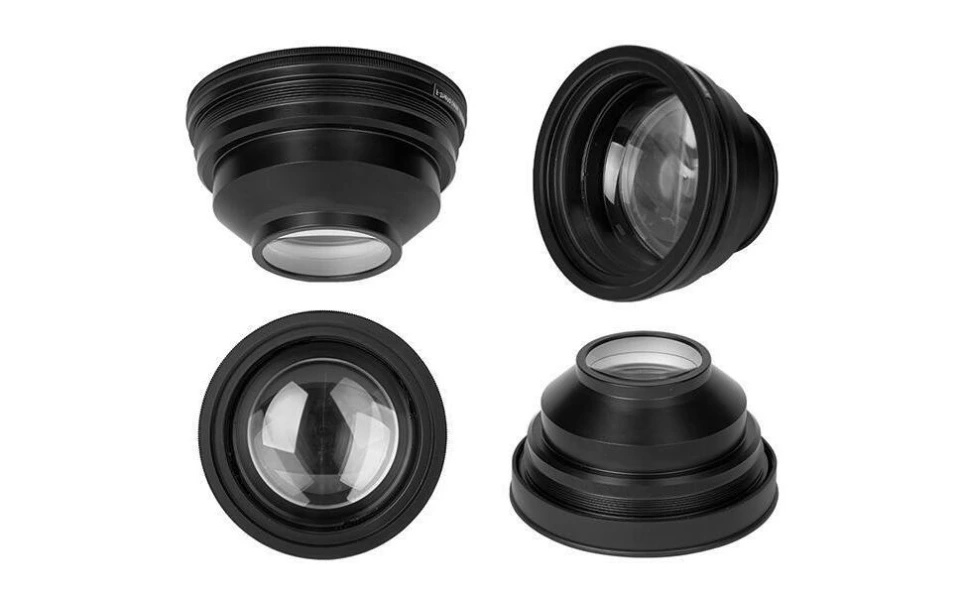
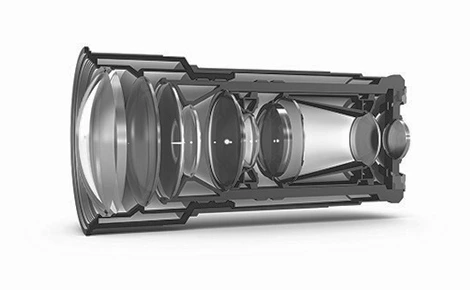
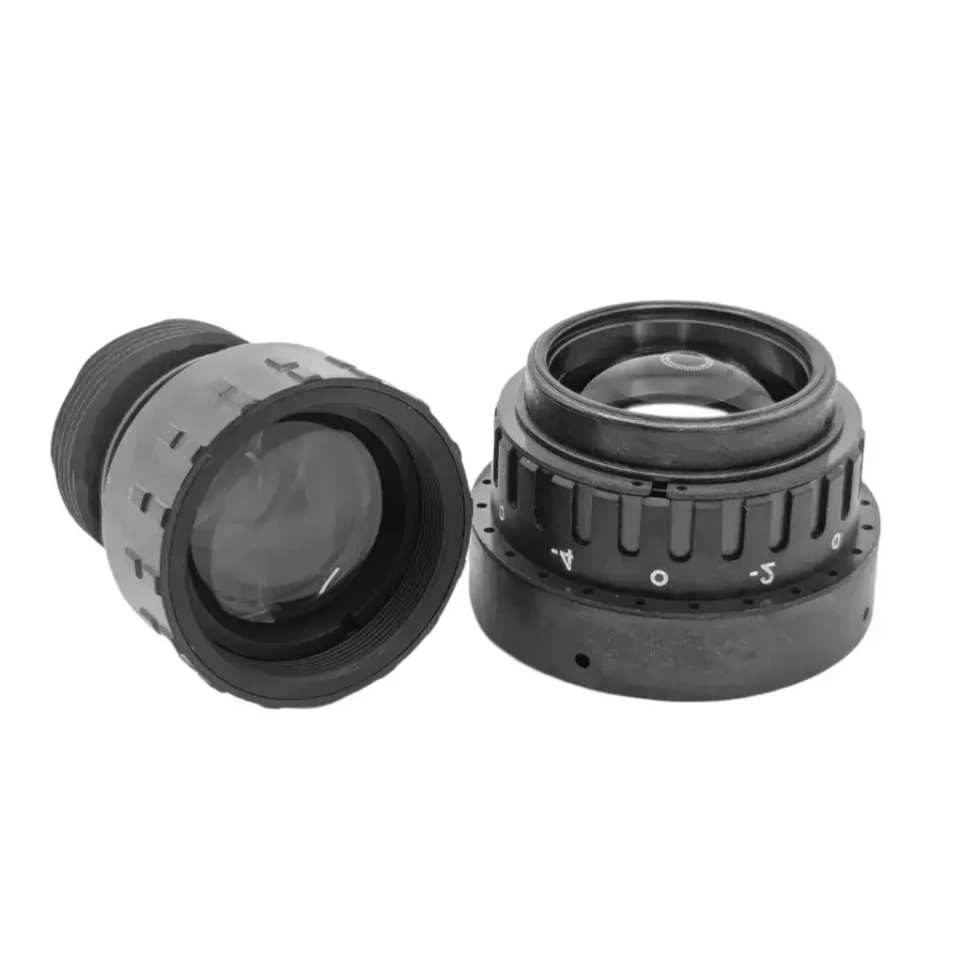
Tube Lens
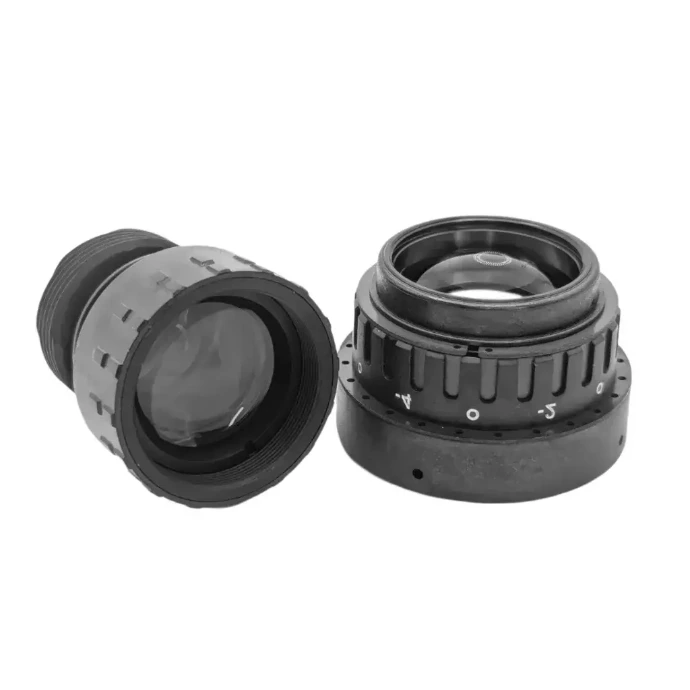
The companion lens assembly to an infinity-corrected microscope objective — converting the objective's collimated output back into a real, focused intermediate image at the camera sensor or eyepiece. Its focal length directly sets system magnification in concert with the objective, making correct tube lens matching essential to accurate, well-corrected microscope imaging.
Function
Collimated-to-real-image conversion
Focal length
160–200 mm typical (system-specific)
Pairs with
Infinity-corrected objectives
Magnification role
M = f_tube / f_objective
Overview
- A multi-element lens assembly positioned in the collimated "infinity space" beyond an infinity-corrected microscope objective, whose function is to focus that collimated light into a real, sharp intermediate image at the camera sensor plane or eyepiece field stop
- System magnification in an infinity-corrected microscope is the ratio of the tube lens focal length to the objective focal length (M = f_tube / f_objective) — meaning the tube lens's focal length is not an arbitrary choice but a calibrated system parameter that, combined with the objective's stated magnification, determines the actual total magnification delivered to the camera or eyepiece
- Different microscope manufacturers historically standardized on different tube lens focal lengths (commonly 160 mm, 165 mm, 180 mm, or 200 mm) — meaning an objective's printed magnification value is only accurate when paired with the tube lens focal length the objective was originally designed and corrected for, a critical compatibility consideration when mixing components from different manufacturers or systems
- Like the objective itself, tube lenses are optically corrected — contributing their own share of the overall system's chromatic and spherical aberration correction in coordination with the objective's correction, particularly significant in premium plan-apochromat systems where both objective and tube lens are co-designed for optimal combined performance
- Used in every infinity-corrected compound microscope, confocal microscope, and related research imaging instrument — an essential but often overlooked component, since casual users may focus exclusively on objective selection without recognizing the tube lens's equally important role in final image quality and accurate magnification
- In camera-coupled microscope systems, the tube lens (sometimes integrated into a camera adapter) must be matched not only to the objective's design tube length but also to the camera sensor format to ensure appropriate field coverage without vignetting
Key Features
Collimated-to-real-image conversion
Converts the collimated output beam from an infinity-corrected objective into a real, focused intermediate image — without this conversion step, the objective's collimated light would never form a viewable or capturable image, making the tube lens an essential, non-optional partner to every infinity-corrected objective.
System magnification determination
The tube lens's focal length directly sets overall system magnification in combination with the objective (M = f_tube / f_objective) — selecting or substituting a tube lens with a different focal length than the system was designed for changes the actual magnification delivered, even though the objective's printed magnification value remains unchanged.
Coordinated aberration correction
In premium microscope systems, the tube lens is co-designed with the objective series to share aberration correction responsibility — particularly chromatic correction — meaning objective and tube lens from the same manufacturer's matched system typically deliver better combined image quality than mixing components across different manufacturers' incompatible tube lens standards.
Sensor format field coverage
The single-prism image erection allows binoculars and spotting scopes to be designed with objectives and eyepieces on the same axis — producing a streamlined, pocket-friendly form factor that Porro-prism instruments cannot achieve. Roof prism designs dominate the compact and ultrac-compact binocular market.
Design and Construction
Manufacturer standards
Common tube lens focal lengths
- 160 mm — historical standard for several legacy manufacturer systems
- 165 mm, 180 mm — used by specific manufacturer platforms; not interchangeable with other standards without magnification recalibration
- 200 mm — common modern standard across several current major microscope platforms, simplifying some cross-compatibility
Compatibility implications
- Mixing an objective designed for one tube length standard with a tube lens of a different focal length changes actual magnification from the objective's printed value
- Can also introduce uncorrected aberration if the objective's correction assumed a specific tube lens design that differs from the one actually used
Optical design considerations
Correction complexity
- Simple achromatic doublet tube lenses — adequate for basic, lower-NA objective systems
- Multi-element, highly corrected tube lenses — required to complement plan-apochromat objectives without introducing residual aberration that would compromise the objective's high-grade correction
Field & format matching
- Tube lens field number (maximum supported field diameter) must meet or exceed the objective's field number and the camera sensor's diagonal dimension
- Camera adapter optics (relay lenses between tube lens image and the actual sensor) may introduce additional magnification factors requiring system calibration
Optical Materials
Standard correction glass
Achromatic & apochromatic groups
- Standard crown-flint achromatic doublets — basic tube lens correction for routine, lower-grade objective systems
- ED glass and fluorite-equivalent elements — used in premium tube lenses paired with plan-apochromat objective series for matched, high-grade combined correction
Coatings
Coating considerations
- Multi-layer broadband AR coatings across all surfaces — important for maintaining transmission and contrast through the full microscope optical train
- Wavelength-matched coatings for systems dedicated to specific fluorescence excitation/emission bands
Wavelength Options
UV
- 250–400 nm
- UV-transmissive glass
- UV-AR coatings
Visible
- 400–700 nm
- Achromatic / apochromatic
- VIS BBAR
NIR fluorescence
- 700–900 nm
- NIR-optimized correction
- NIR BBAR
Applications
Life Sciences
Research compound microscopes
Every infinity-corrected research microscope relies on a matched tube lens to convert the objective's collimated output into the final intermediate image viewed through the eyepieces or captured by the camera.
Imaging
Scientific camera coupling
Tube lenses (often integrated into camera adapter assemblies) couple the microscope's optical train to scientific CCD and CMOS cameras, determining both magnification and field coverage on the sensor.
Research
Confocal & multiphoton microscopy
Used in confocal and multiphoton laser scanning microscope systems where the tube lens focuses the scanned, infinity-corrected beam path into the final detector or scan-relay optical path.
Industrial
Semiconductor inspection microscopy
Used in industrial inspection microscope systems for semiconductor and electronics manufacturing, where accurate, calibrated magnification (set by the matched objective-tube lens pair) is essential for dimensional verification.
OEM
Custom microscope system integration
Used by OEM instrument developers building custom microscope-based systems, where tube lens focal length is a key design parameter selected to achieve the desired system magnification with specific objective series.
Metrology
Optical measurement systems
Used in optical comparators and measurement microscopes where precise, traceable magnification calibration depends on the known, matched relationship between objective and tube lens focal lengths.
Why choose Matched Tube Lenses
Accurate, calibrated magnification
Ensures the objective's printed magnification value is actually delivered — critical for any application relying on accurate, traceable magnification for measurement or documentation.
Preserves objective correction quality
A properly matched tube lens completes the aberration correction the objective was designed assuming — using a mismatched tube lens can introduce uncorrected aberration even with a premium objective.
Full sensor field coverage
Correctly sized tube lenses provide even illumination across the full camera sensor format — avoiding the vignetting a mismatched or undersized tube lens would introduce.
Essential infinity-system component
An infinity-corrected objective cannot form a usable image without a tube lens — making correct tube lens selection a non-optional, foundational part of microscope system design.
Frequently asked questions
Here are some common questions about Tube Lens.
Tube lens focal length standards (160 mm, 165 mm, 180 mm, 200 mm, etc.) emerged historically as each major microscope manufacturer developed their own infinity-corrected optical systems independently, optimizing the objective-tube lens combination as a cohesive design rather than adhering to a single industry-wide standard. While this lack of universal standardization can complicate cross-manufacturer component mixing, manufacturers generally maintain consistency within their own product lines, so objectives and tube lenses from the same manufacturer's matched system are designed to work correctly together.
Two effects occur. First, the actual system magnification changes from the objective's printed value, since magnification equals the tube lens focal length divided by the objective's design focal length — using a tube lens with a different focal length than the objective was designed for proportionally changes the delivered magnification away from the printed number. Second, image quality may degrade, since premium objectives (particularly plan-apochromats) are often optically corrected assuming a specific tube lens design completes part of the aberration correction — using a mismatched tube lens can leave some chromatic or spherical aberration uncorrected that the original matched system would have eliminated.
Total magnification at the camera sensor is calculated as: (objective magnification) × (tube lens focal length / objective's design tube lens focal length) × (any additional camera adapter relay magnification factor). For a properly matched system where the tube lens matches the objective's design focal length, this simplifies to simply the objective's printed magnification times any camera adapter factor. When mixing components across different tube lens standards, the actual delivered magnification must be explicitly recalculated rather than assumed from the objective's printed value alone — important for any application requiring accurate, traceable magnification calibration.