Microscope Objective
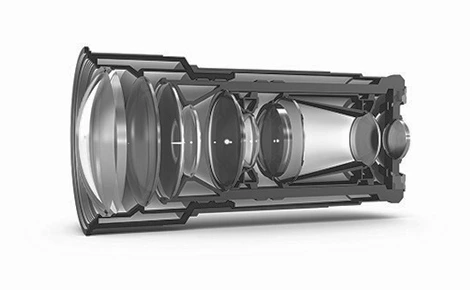
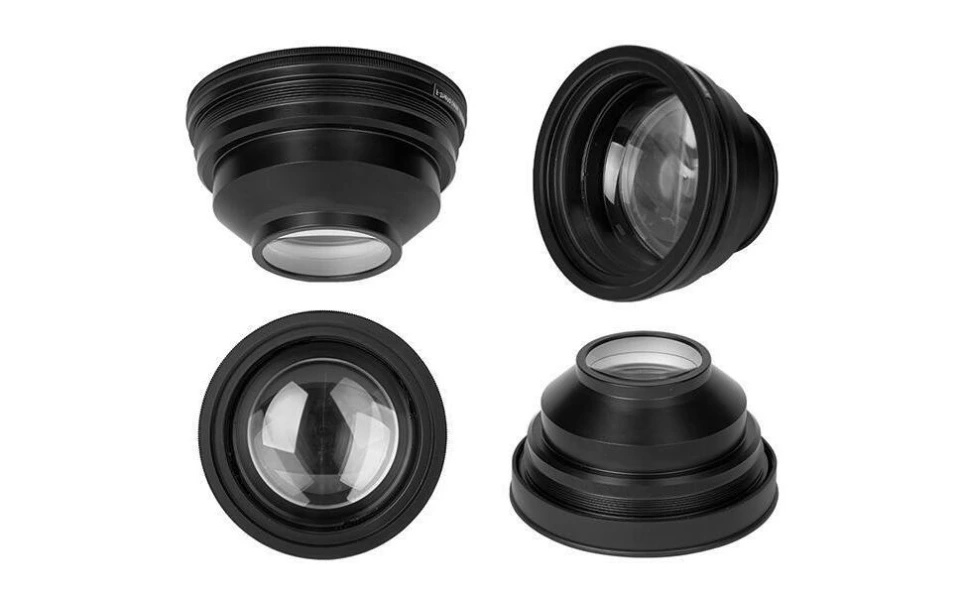
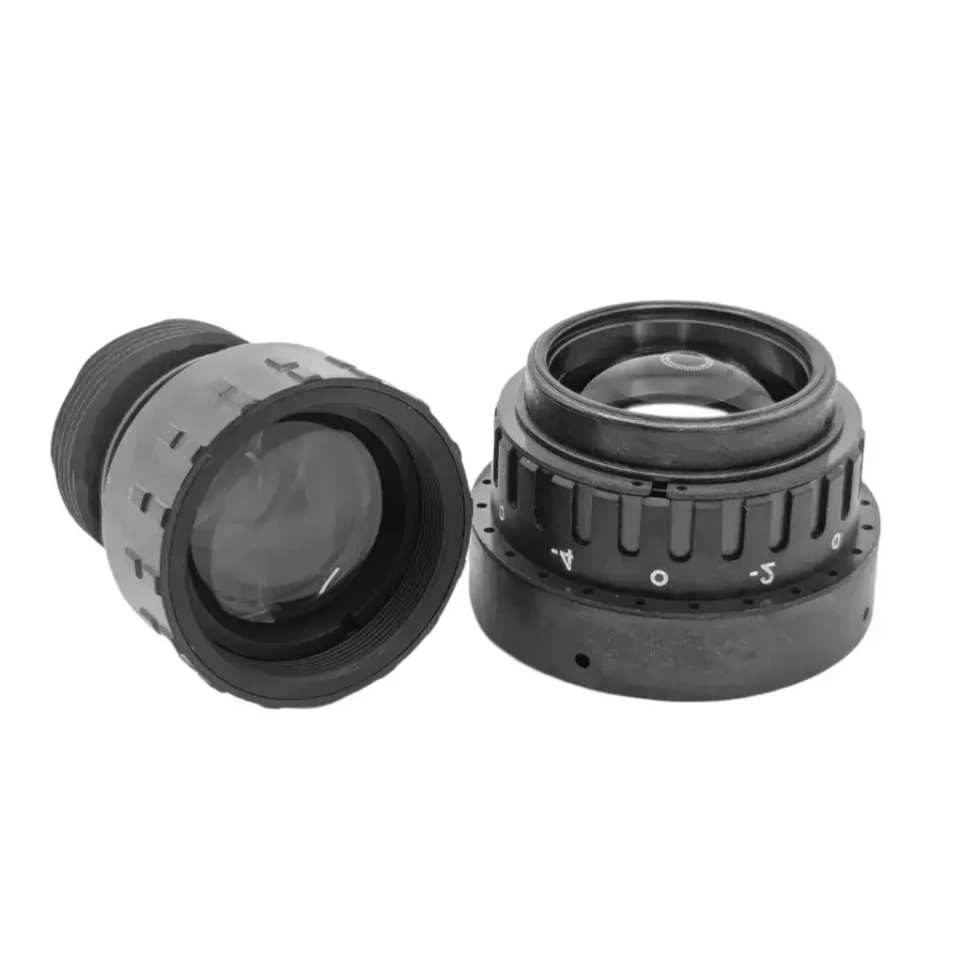
The defining multi-element lens assembly of every microscope — collecting light from a microscopic specimen at extremely high numerical aperture and forming a magnified intermediate image, in concert with a tube lens, with the resolution, flatness, and color correction the scientific application demands. Available across a hierarchy of correction grades from basic achromats to apochromats.
Numerical aperture
0.1 to 1.4+ (oil immersion)
Magnification
2× to 100×
Correction grades
Achromat, Fluorite, Plan-Apo
Standard
Infinity-corrected (modern)
Overview
- The primary collecting and magnifying lens assembly closest to the specimen in a compound microscope — a multi-element design optimized to collect light over a very high numerical aperture (NA) and form a well-corrected image at the specified magnification
- Modern microscope objectives are almost universally infinity-corrected — the objective alone produces a collimated (parallel) beam from each object point rather than a direct real image, with a separate tube lens elsewhere in the optical path forming the final intermediate image; this design allows accessories (filters, beamsplitters, polarizers) to be inserted in the collimated space between objective and tube lens without introducing aberration
- Correction grade hierarchy reflects increasing chromatic and spherical aberration correction complexity and cost: achromats (corrected at two wavelengths), fluorites/semi-apochromats (corrected closer to three wavelengths using fluorite or ED glass), and plan-apochromats (full three-wavelength correction plus flat-field correction) — the premium standard for quantitative, multi-color, high-resolution imaging
- Numerical aperture is the single most important specification — determining both resolution (via the diffraction limit) and light-gathering power; higher-NA objectives (especially oil and water immersion designs exceeding NA 1.0) require immersion media to achieve their full theoretical NA, since this exceeds what is physically possible imaging through air alone
- Working distance — the physical clearance between the objective's front lens and the specimen at focus — generally decreases as magnification and NA increase, a fundamental tradeoff that becomes a critical practical constraint in high-magnification, high-NA objective use, particularly for live-cell and thick-specimen imaging
- Standardized parfocal distance and thread mounting (RMS, M25, M32 depending on manufacturer and class) allow objectives of different magnification to be interchanged on a rotating nosepiece while remaining approximately in focus, a major practical convenience in routine microscopy
Key Features
Infinity-corrected collimated output
Modern objectives project light from each object point as a collimated beam rather than directly forming a real image — this infinity space accommodates filters, beamsplitters, and polarizing accessories without introducing the aberration a finite-conjugate objective would suffer from inserted optical elements, a defining architectural advantage of the infinity-corrected design.
High numerical aperture light collection
Numerical aperture directly determines both resolving power (via the diffraction limit, resolution ≈ 0.61λ/NA) and light-gathering efficiency — premium oil-immersion objectives reaching NA 1.4 collect dramatically more light and resolve finer detail than a dry objective of the same magnification, at the cost of requiring immersion oil and very short working distance.
Tiered chromatic correction
Achromat, fluorite, and plan-apochromat correction grades provide progressively tighter color correction — achromats are adequate for routine brightfield observation, while plan-apochromats eliminate the secondary spectrum chromatic error essential for accurate multi-color fluorescence channel co-registration in quantitative research microscopy.
Flat-field (plan) correction
The single-prism image erection allows binoculars and spotting scopes to be designed with objectives and eyepieces on the same axis — producing a streamlined, pocket-friendly form factor that Porro-prism instruments cannot achieve. Roof prism designs dominate the compact and ultrac-compact binocular market.
Design and Construction
Correction grade hierarchy
Standard grades
- Achromat — corrected at two wavelengths (typically red and blue); routine brightfield and educational use; most economical
- Fluorite / semi-apochromat — uses fluorite or ED glass; improved correction approaching three-wavelength performance; higher NA available
- Plan-Apochromat — full three-wavelength chromatic correction plus flat-field correction; the premium standard for quantitative and multi-color fluorescence imaging
Immersion types
- Dry (air) — NA limited to below 1.0 by the air-glass interface; most convenient, no immersion medium required
- Water immersion — NA up to ~1.2; matches refractive index of aqueous live-cell samples, reducing spherical aberration
- Oil immersion — NA up to ~1.4–1.5; highest resolution; requires immersion oil matched to the coverslip and objective design
Specifications & standards
Key specifications
- Magnification: 2× to 100× standard range; printed/marked on the objective barrel
- Numerical aperture (NA): printed alongside magnification; the primary resolution and light-gathering specification
- Working distance: ranges from several millimeters (low NA/magnification) to a few hundred microns (high-NA oil immersion)
- Coverslip correction: many objectives are corrected for a specific coverslip thickness (standard 0.17 mm); mismatch introduces spherical aberration
Mechanical standards
- Parfocal distance: standardized so objectives of different power remain approximately in focus when rotated into position on a nosepiece
- Thread mount: RMS (0.8" x 36 TPI) is the traditional standard; M25 and M32 are increasingly common on modern high-end systems
Optical Materials
Standard correction glass
Achromat & fluorite materials
- Standard crown-flint glass pairs — achromat-grade two-wavelength chromatic correction
- Fluorite (CaF₂) or fluorite-equivalent ED glass — anomalous dispersion enabling near-apochromatic correction at lower cost than full apochromats
Plan-apochromat materials
- True fluorite/CaF₂ elements combined with multiple high-index and low-dispersion glass types — full three-wavelength secondary spectrum correction
- Often 8–14+ individual lens elements in cemented and air-spaced groups within a single objective barrel
Immersion media & coatings
Immersion media
- Immersion oil (n≈1.515, matched to glass) — for oil-immersion objectives; eliminates the refractive index mismatch at the specimen-objective interface
- Water/glycerol (n≈1.33–1.47) — for water and glycerol immersion objectives used with live aqueous specimens
Coatings
- Multi-layer broadband AR coatings — critical given the high element count of premium objectives
- Phase rings (phase-contrast objectives) — specialized internal coating ring for phase-contrast microscopy technique
Wavelength Options
UV
- 250–400 nm
- UV-transmissive glass
- UV-AR coatings
Visible
- 400–700 nm
- Standard / fluorite / plan-apo
- VIS BBAR
NIR fluorescence
- 700–900 nm
- NIR-optimized correction
- NIR BBAR
Applications
Life Sciences
Fluorescence & confocal microscopy
Plan-apochromat objectives are the standard for multi-channel fluorescence and confocal microscopy, providing the chromatic co-registration and flat-field correction essential for accurate, quantitative biological imaging.
Medical
Clinical pathology & diagnostics
Used in clinical pathology, hematology, and microbiology laboratories for routine specimen examination, with achromat and plan-fluorite objectives covering the magnification range needed for diagnostic workflows.
Materials Science
Semiconductor & materials inspection
Used in industrial and research microscopy for semiconductor wafer inspection, metallurgical analysis, and materials characterization where high resolution and accurate imaging of surface structure are required.
Research
Live-cell & super-resolution imaging
Water-immersion and specialized high-NA objectives are essential for live-cell imaging (minimizing spherical aberration in aqueous samples) and super-resolution microscopy techniques requiring the highest available numerical aperture.
Forensics
Trace evidence microscopy
Used in forensic laboratories for detailed microscopic examination of trace evidence, fibers, and particulate matter requiring high-magnification, well-corrected imaging for accurate analysis and documentation.
Education
Teaching & educational microscopy
Achromat objectives provide cost-effective, reliable imaging for educational microscope systems used in classroom and teaching laboratory settings across all levels of science education.
Why choose Microscope Objectives
Tiered performance to match budget
Available across achromat, fluorite, and plan-apochromat grades — allowing precise matching of optical correction level and cost to the specific imaging application's requirements.
Infinity-corrected accessory compatibility
The infinity space between objective and tube lens accommodates filters, beamsplitters, and polarizers without introducing aberration — essential for flexible, modular microscope system configuration.
Highest available numerical aperture
Oil and water immersion designs reach NA values unattainable by any dry objective — delivering the maximum possible resolution and light-gathering power for the most demanding imaging applications.
Interchangeable on standardized nosepieces
Parfocal distance and thread standardization allow rapid switching between magnifications on a rotating nosepiece while remaining approximately in focus.
Frequently asked questions
Here are some common questions about Microscope Objective.
An infinity-corrected objective does not form a real image by itself — instead, it converts light diverging from each point of the specimen into a collimated (parallel) beam. A separate lens, the tube lens, located elsewhere in the optical path then focuses this collimated light to form the actual intermediate image. The key advantage of this architecture is that the space between the objective and tube lens contains collimated light — optical accessories like filters, dichroic beamsplitters, and polarizers can be inserted into this collimated space without introducing the focus shift or aberration they would cause if placed in a converging beam, as would be the case with older finite-conjugate objective designs. This makes infinity-corrected systems far more flexible for adding fluorescence filter cubes, polarization optics, and other accessories.
Numerical aperture is defined as NA = n·sin(θ), where θ is the half-angle of the cone of light the objective can collect from the specimen and n is the refractive index of the medium between specimen and objective. To collect light over a wider angle (higher NA), the objective's front lens element must be positioned very close to the specimen — physically, a wide collection angle from a more distant point requires a much larger front lens diameter than is practical. This is why high-NA objectives, particularly oil-immersion designs reaching NA 1.4, necessarily have very short working distances — often a few hundred microns — making them sensitive to specimen and coverslip thickness variations.
For routine brightfield observation, basic specimen screening, and educational use, an achromat objective is generally sufficient and most cost-effective. For applications requiring accurate color rendition across the visible spectrum, flat-field photomicrography, or any multi-channel fluorescence imaging where precise spatial co-registration between color channels matters (since different objectives correction grades have different residual chromatic focus shift between wavelengths), a plan-apochromat is strongly recommended — using a lower-correction-grade objective for multi-color fluorescence work can introduce visible registration errors between channels that compromise quantitative image analysis.