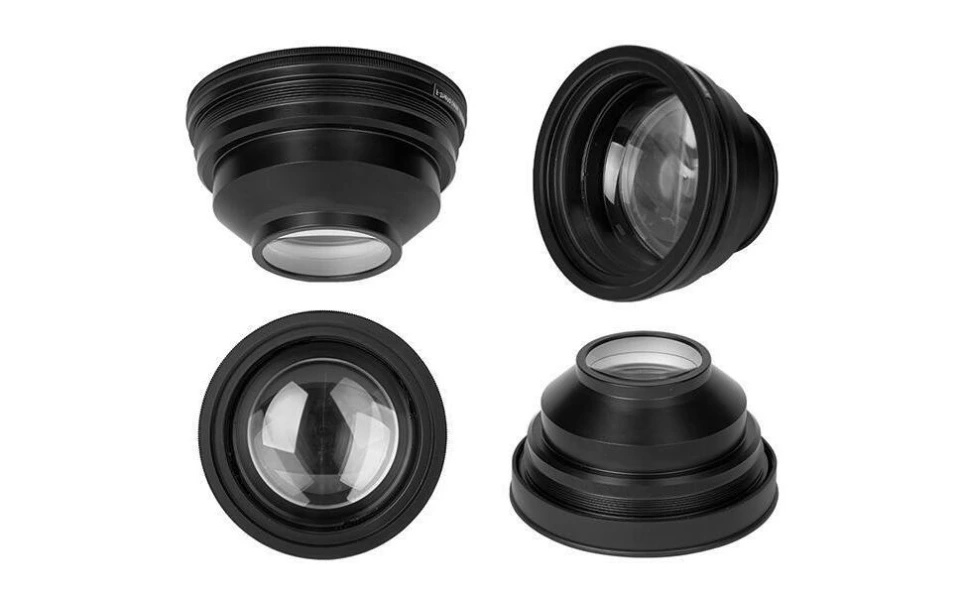
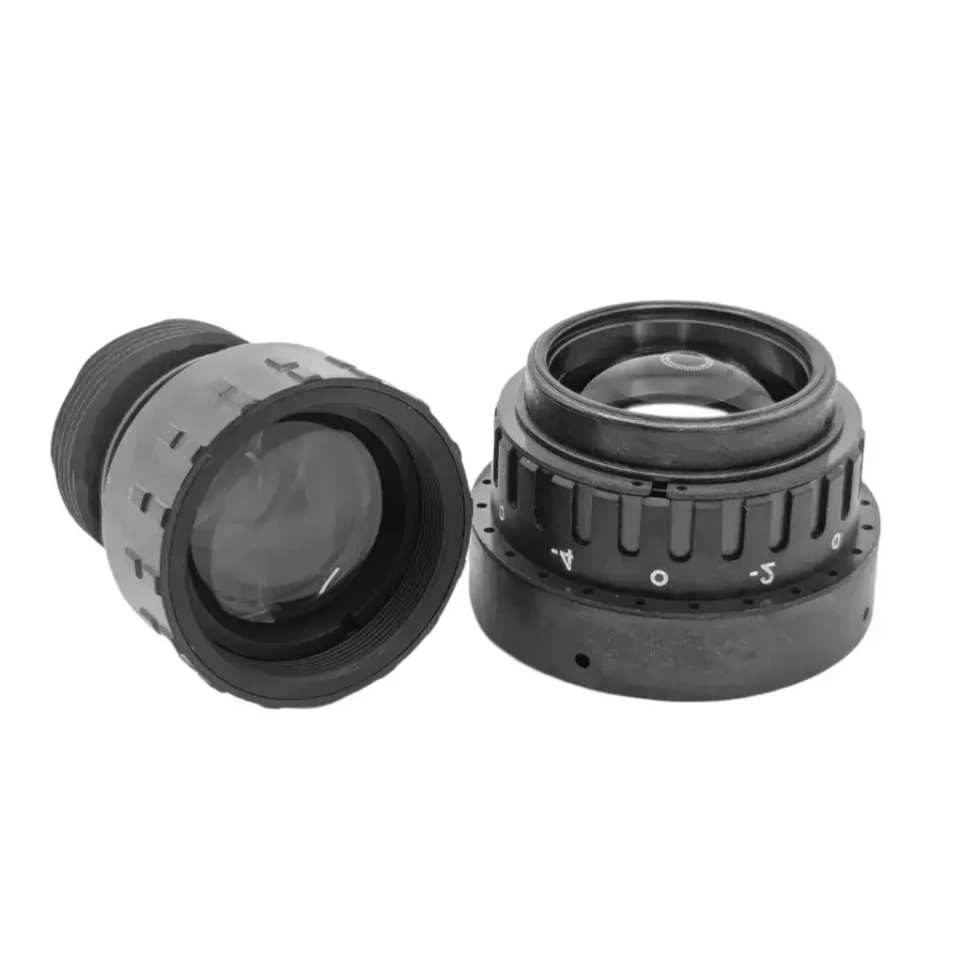
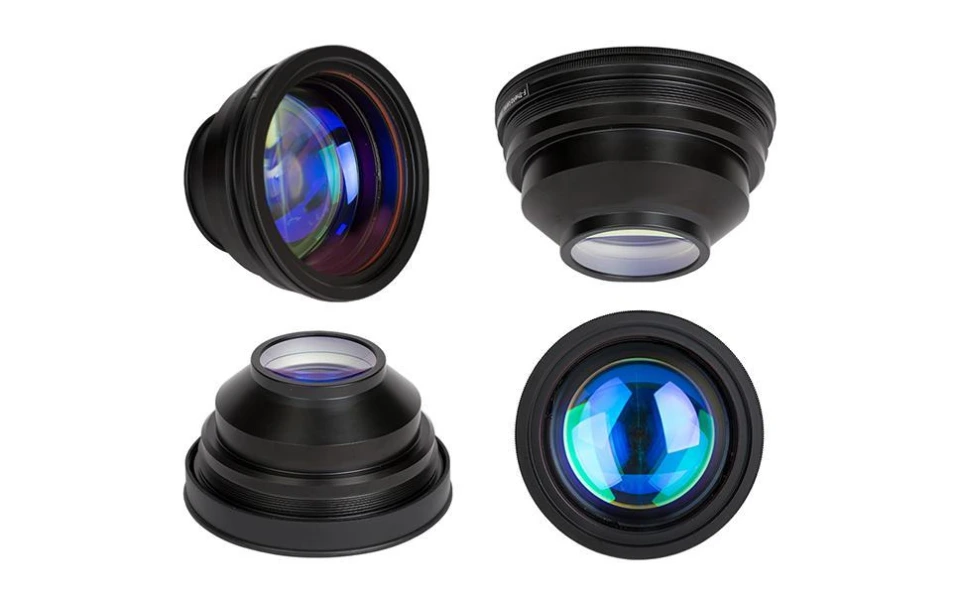
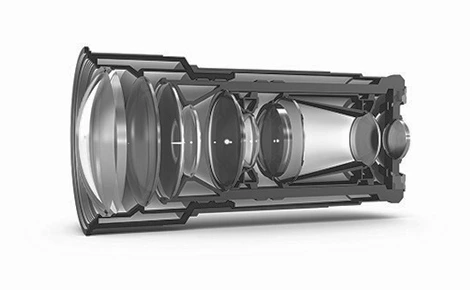
Telecentric Lenses
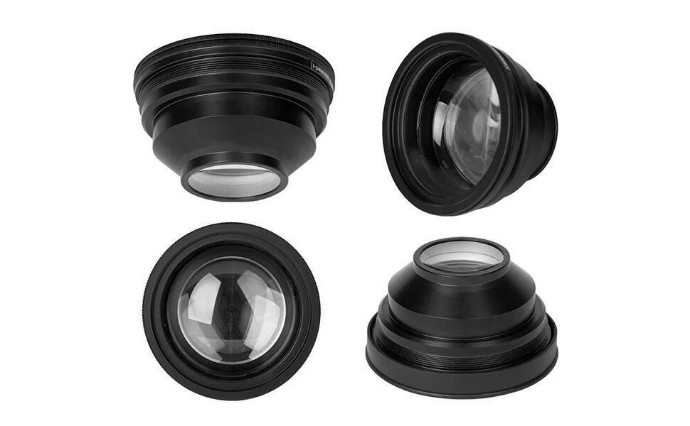
A multi-element lens assembly engineered so its chief rays travel parallel to the optical axis in object space, image space, or both — eliminating the magnification-versus-distance error of conventional perspective optics. The standard imaging solution for precision dimensional measurement, where apparent object size must remain constant regardless of its exact distance from the lens.
Function
Constant magnification vs. distance
Chief ray angle
Parallel to optical axis
Configurations
Object-space, image-space, double
Working distance
Fixed, lens-determined
Overview
- A specialized multi-element lens whose internal aperture stop is positioned at a specific optical location so that chief rays (rays passing through the center of the aperture stop) emerge parallel to the optical axis rather than converging toward a perspective point
- This parallel chief-ray geometry means that the apparent size of an object in the image does not change as the object moves slightly closer to or farther from the lens within its depth of field — eliminating the perspective magnification error inherent to conventional lenses
- Object-space telecentric lenses have parallel chief rays on the object side — used for precision dimensional measurement where the part may not sit at an exact fixed distance
- Image-space telecentric lenses have parallel chief rays on the sensor side — ensuring uniform illumination and consistent response across the sensor regardless of pixel position, valuable for photometric and color-critical imaging
- Bi-telecentric (double telecentric) lenses are telecentric in both object and image space simultaneously — combining constant magnification with uniform image-side illumination, the premium configuration for the most demanding metrology applications
- Requires a front (or rear) lens element with a clear aperture at least as large as the object field being measured — a key practical constraint distinguishing telecentric lenses from compact conventional optics of similar focal length
Key Features
Distance-independent magnification
The defining property of a telecentric lens — an object's apparent size in the captured image stays constant even as its distance from the lens varies within the depth of field, eliminating the perspective error that would otherwise introduce measurement uncertainty as parts shift slightly in position on an inspection line.
Reduced perspective distortion on 3D features
Because chief rays travel parallel to the optical axis, a telecentric lens images the side walls and varying depths of a three-dimensional object without the parallax-induced foreshortening a conventional lens introduces — critical for accurately measuring hole diameters, edge positions, and feature dimensions on parts with non-trivial depth.
Uniform illumination response (image-space)
Image-space telecentric designs deliver light to the sensor at a consistent angle across the entire field — avoiding the cosine-fourth-power falloff and angle-dependent pixel response variation that conventional lenses can introduce, particularly valuable for quantitative photometric and color measurement applications.
Forgiving focus tolerance for measurement
Within the lens's specified depth of field, an object can be slightly out of best focus and still be measured accurately, since the magnification (not just the sharpness) remains constant — a critical practical advantage on production lines where exact part positioning cannot always be guaranteed.
Design and Construction
Telecentric configurations
Object-space telecentric
- Aperture stop placed at the back focal point of the front lens group
- Eliminates magnification error from object distance variation; image-side rays may still be non-telecentric
- Standard configuration for dimensional measurement and gauging applications
Bi-telecentric (double telecentric)
- Telecentric in both object and image space simultaneously
- Requires more lens elements and a more complex symmetric-around-stop design
- Premium configuration for the highest-accuracy metrology and photometric measurement systems
Specifications & constraints
Key specifications
- Telecentricity error: typically <0.01° to 0.1° depending on grade — quantifies residual chief-ray angle deviation from true parallel
- Magnification accuracy / distortion: <0.1% typical for precision metrology-grade telecentric lenses
- Working distance: fixed by design; cannot be adjusted like a conventional lens's focus without affecting magnification
Practical constraints
- Front element diameter must be at least as large as the object field of view — large-field telecentric lenses
- require correspondingly large, heavy front optics
- Generally higher cost than conventional lenses of similar focal length due to larger elements and tighter design tolerances
Optical Materials
Standard visible-range glass
Achromatic element materials
- N-BK7 / crown-flint glass pairs — standard achromatic doublet and triplet elements for visible-range machine vision telecentric lenses
- Low-dispersion glass — used in premium telecentric designs to minimize residual chromatic aberration across the field
Extended-range & coatings
UV and NIR telecentric lenses
- UV-transmitting glass and fused silica elements — for UV-enhanced machine vision and semiconductor inspection telecentric lenses
- NIR-optimized AR coatings — for telecentric lenses used with NIR illumination in low-contrast or non-visible inspection applications
Coatings
- Broadband AR (BBAR) coatings — standard across the visible or extended spectral range used
- Anti-reflective coatings tuned to the specific machine vision illumination wavelength for maximum contrast
Wavelength Options
UV-enhanced
- 365–400 nm
- UV glass / Fused Silica
- UV-AR coatings
Visible
- 400–700 nm
- Achromatic glass groups
- VIS BBAR
NIR
- 700–1000 nm
- NIR-optimized glass
- NIR BBAR
Applications
Machine Vision
Precision dimensional gauging
The standard lens for automated optical measurement of part dimensions, hole diameters, and edge positions on production lines, where constant magnification regardless of small part-position variation directly determines measurement repeatability and accuracy.
Semiconductor
Wafer & die inspection
Used in semiconductor metrology and inspection systems to measure die dimensions, bump heights, and pattern critical dimensions without the perspective error a conventional lens would introduce across the wafer's slight height variations.
Electronics
PCB & component inspection
Provides accurate, distance-independent measurement of component placement, solder joint geometry, and PCB feature dimensions in automated optical inspection (AOI) systems used throughout electronics manufacturing.
Medical Devices
Precision component verification
Used to verify critical dimensions of medical device components — needles, catheters, implantable parts — where regulatory and functional requirements demand the highest dimensional measurement accuracy and repeatability.
Automotive
Manufacturing quality control
Used in automotive parts inspection for gauging machined component dimensions, weld bead geometry, and assembly verification where consistent measurement accuracy across a moving production line is required.
3D Metrology
Multi-depth feature measurement
Bi-telecentric lenses enable accurate measurement of features at varying depths within a single part — such as stepped bores, counterbores, and multi-level machined surfaces — without the magnification shift a conventional lens would introduce between depth planes.
Why choose Telecentric Lenses
Eliminates perspective error
The only lens type that maintains constant magnification regardless of object distance within the depth of field — the foundational requirement for accurate automated dimensional measurement.
Forgiving of part positioning
Measurement accuracy is preserved even when parts are not positioned at the exact nominal distance — reducing the precision required of upstream part-handling fixtures and conveyors.
Accurate 3D feature imaging
Parallel chief rays image depth-varying features without the parallax distortion that would corrupt measurements of holes, edges, and stepped surfaces under conventional optics.
Bi-telecentric for ultimate accuracy
Double telecentric designs combine constant magnification with uniform image-side response — the premium choice for the most demanding metrology and photometric applications.
Frequently asked questions
Here are some common questions about Telecentric Lens.
Because chief rays in object-space telecentric design must travel parallel to the optical axis, every point across the object field is imaged by rays that enter the lens through roughly the same region of the front element, traveling parallel to each other — rather than converging toward a single small entrance pupil as in conventional perspective optics. This means the front lens element's clear aperture must be at least as large as the full object field of view to capture light from every point in that field. This is why telecentric lenses for larger fields of view become correspondingly larger, heavier, and more expensive than a conventional lens of similar focal length.
Telecentric lenses are generally designed with a fixed working distance — the specific object distance at which the telecentric (parallel chief ray) property is achieved. Some telecentric lenses do offer limited focus adjustment, but moving significantly away from the design working distance can degrade or eliminate the telecentric property, reintroducing perspective-related magnification error. For applications requiring different working distances, a telecentric lens specifically designed for that working distance should be selected rather than relying on focus adjustment of a fixed-working-distance design.
Object-space telecentric: use when constant magnification regardless of object distance is the priority — the most common requirement for dimensional gauging applications, and the most cost-effective telecentric configuration. Image-space telecentric: use when uniform sensor illumination and consistent pixel response across the field matters more than object-distance magnification stability — common in photometric and color-critical imaging. Bi-telecentric (double telecentric): use when both properties are simultaneously required — the highest-accuracy metrology applications where both magnification stability and uniform image-side response are critical, justifying the additional cost and complexity.