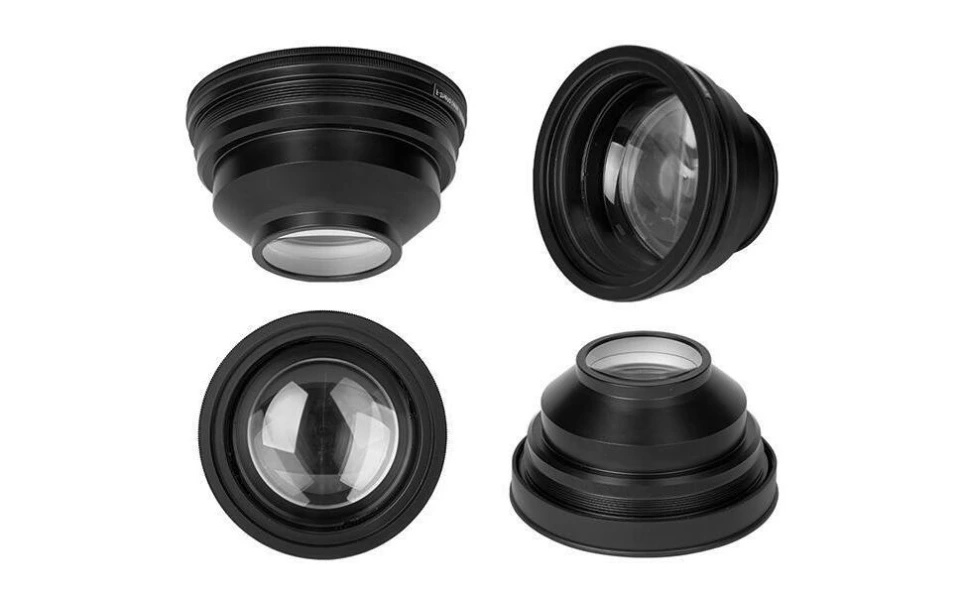
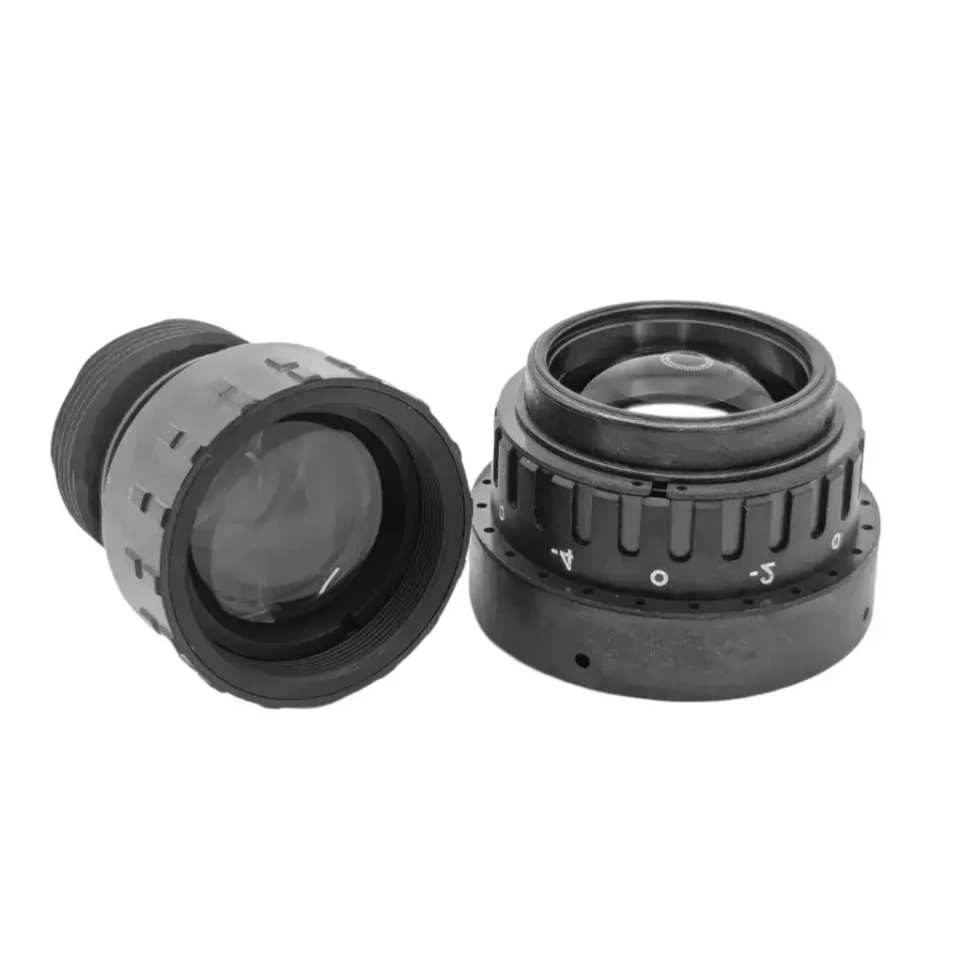
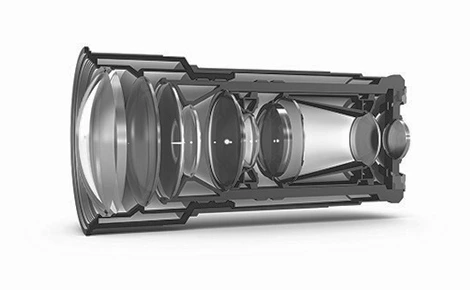
Wide- Angle Lens
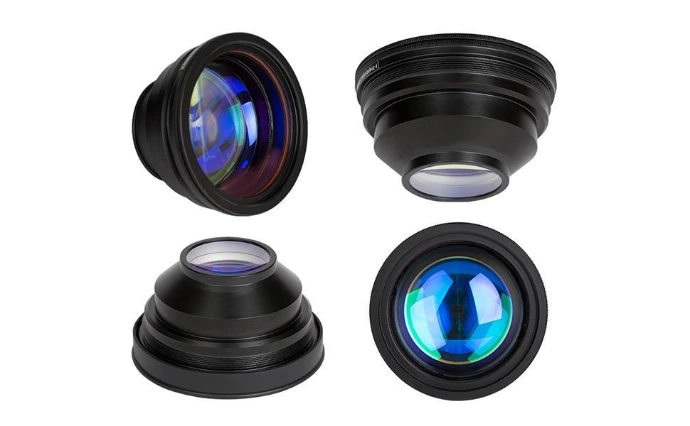
A multi-element lens assembly delivering an angular field of view substantially wider than a standard lens while preserving rectilinear projection — straight lines in the scene remain straight in the image. The balanced choice for architectural, landscape, and machine vision applications that need broad scene coverage without the curvilinear distortion of a fisheye design.
Field of view
~60°–120° (rectilinear)
Projection
Rectilinear (straight lines preserved)
Key challenge
Edge distortion & illumination falloff
Design type
Retrofocus (for SLR/DSLR compatibility)
Overview
- A multi-element lens assembly engineered to capture a substantially wider angular field of view than a standard (normal) lens — typically 60° to 120° — while maintaining rectilinear projection so that straight lines in the scene render as straight lines in the image
- Preserving rectilinear projection at wide field angles is optically demanding — as the field angle increases, controlling barrel distortion, lateral chromatic aberration, and illumination falloff toward the edges becomes progressively more difficult, requiring more lens elements and more complex correction groups than a normal-angle lens
- Retrofocus (inverted telephoto) optical architecture is standard for wide-angle lenses used on cameras with mechanical components (mirrors, shutters) behind the lens mount — the design pushes the rear nodal point and exit pupil farther from the sensor than the focal length alone would suggest, providing the back focal clearance these mechanisms require
- Used wherever capturing a broad scene or wide field within a limited working distance is required — architectural and interior photography, landscape photography, vehicle-mounted cameras, and machine vision applications inspecting large or close-range objects
- Wide-angle lenses exaggerate the apparent perspective relationship between near and far objects in a scene — foreground elements appear disproportionately large relative to background elements compared to a normal-angle lens, an effect that can be used creatively or that must be managed carefully in documentary and measurement applications
- Distinguished from a fisheye lens primarily by this insistence on rectilinear (straight-line-preserving) projection — a wide-angle lens trades some of the fisheye's extreme angular coverage for the geometric fidelity rectilinear projection provides
Key Features
Rectilinear straight-line preservation
Unlike a fisheye lens, a wide-angle lens maintains rectilinear projection — straight architectural lines, horizons, and grid patterns in the scene remain straight in the captured image, a property essential for architectural photography, measurement applications, and any use case where geometric accuracy of straight features matters.
Broad scene coverage at short working distance
Captures a wide field of view from a relatively close working distance — valuable in confined spaces (small rooms, vehicle interiors, tight machine vision installations) where physically moving the camera farther back to fit more scene into a normal-angle lens's field of view is not practical.
Retrofocus mechanical clearance
The retrofocus (inverted telephoto) design pushes the lens's effective exit pupil and rear nodal point back from the sensor, providing the physical clearance needed for a reflex mirror, focal-plane shutter, or other mechanism positioned between the lens mount and the image sensor — without this design approach, true wide-angle focal lengths would be mechanically incompatible with SLR/DSLR camera bodies.
Engineered illumination & distortion control
Multiple correcting lens groups and increasingly aspheric elements actively control the natural cosine-fourth-power illumination falloff toward the field edges and minimize barrel distortion — without this active correction, wide-angle images would show pronounced dark corners and curved straight lines.
Design and Construction
Optical architecture
Retrofocus design
- Front negative (diverging) lens group precedes a rear positive (converging) group
- Pushes the effective entrance and exit pupils away from the sensor, enabling short focal lengths with adequate back focal distance
- Standard architecture for SLR, DSLR, and any camera system requiring back focal clearance for internal mechanisms
Mirrorless & machine vision variants
- Symmetric or near-symmetric designs possible without mirror clearance constraints — often more compact and with fewer elements
- Machine vision wide-angle lenses prioritize low distortion and edge resolution over the mechanical constraints of consumer camera mounts
Performance specifications
Key specifications
- Distortion: typically <2–5% for general-purpose wide-angle lenses; <0.5–1% for low-distortion machine vision and architectural-grade designs
- Field of view: 60°–120° diagonal typical for rectilinear wide-angle designs
- Relative illumination (corner brightness vs center): a key specification, often improved with dedicated vignetting-control coatings or graduated filters in critical applications
Element count
- Typically 8–15+ elements in multiple groups for high-quality wide-angle designs — substantially more than a normal-angle lens of similar aperture, reflecting the increased correction complexity
Optical Materials
Standard correction glass
Aberration-correcting elements
- Extra-low dispersion (ED) glass — controls lateral chromatic aberration at wide field angles, a particularly challenging aberration in wide-angle designs
- High-index glass — enables stronger curvatures with thinner elements, helping manage the bulk and weight of multi-element wide-angle designs
Aspheric elements
- Precision-molded or ground aspheric elements — reduce distortion and field curvature with fewer total elements than an all-spherical design would require
Coatings & specialty options
Coating considerations
- Multi-layer broadband AR coatings across all air-glass surfaces — critical given the high element count typical of wide-angle designs
- Specialized coatings to manage flare and ghosting from the wide range of off-axis stray light angles a wide-angle lens must accept
Wavelength Options
Visible
- 400–700 nm
- ED glass groups
- VIS BBAR
Machine vision NIR
- 700–900 nm
- NIR-corrected glass
- NIR BBAR
Applications
Photography
Architectural & interior photography
Captures full building facades and interior spaces while preserving straight architectural lines — the rectilinear projection ensures vertical and horizontal building elements remain geometrically accurate in the final image.
Photography
Landscape & travel photography
The standard lens choice for capturing expansive landscape scenes and travel photography, providing broad scene coverage while maintaining natural-looking geometry compared to a fisheye lens.
Machine Vision
Close-range large-object inspection
Used in machine vision systems inspecting large parts or wide work areas where physical space constraints prevent positioning a standard lens far enough back to capture the full field of view.
Automotive
Backup & side-view cameras
Provides the wide rear and side coverage needed in automotive backup and blind-spot monitoring cameras, balancing broad field of view with manageable, controlled distortion for driver interpretation.
Robotics
Wide-area scene capture
Used in mobile robot and drone-mounted cameras to capture broad situational scene context for navigation and obstacle avoidance without the extreme distortion of a fisheye lens complicating downstream image processing.
Surveillance
Wide-coverage security cameras
Used in fixed security camera installations to cover a broad monitored area from a single camera position while maintaining straight-line geometry useful for accurate scene interpretation by security personnel.
Why choose Wide-Angle Lenses
Geometric accuracy at wide field
Preserves rectilinear projection across a substantially wider field of view than a normal lens — straight lines stay straight, unlike a fisheye design.
Broad coverage in confined spaces
Captures wide scenes from short working distances — essential wherever physical space prevents backing the camera away to achieve equivalent coverage with a normal lens.
Mechanically compatible design options
Retrofocus architecture provides the back focal clearance needed for SLR/DSLR mirror and shutter mechanisms — enabling true wide-angle focal lengths on reflex camera systems.
Balanced distortion-coverage tradeoff
Delivers substantially more field of view than a normal lens while keeping distortion within levels manageable for architectural, measurement, and documentary applications.
Frequently asked questions
Here are some common questions about Wide -Angle Lens.
A retrofocus (or "inverted telephoto") design places a negative (diverging) lens group in front of a positive (converging) group — the opposite arrangement to a telephoto lens. This pushes the lens's effective rear nodal point and exit pupil farther back from the sensor than the nominal focal length alone would place it, providing the mechanical clearance needed behind the lens for a reflex mirror, focal-plane shutter, or other internal camera mechanism. Without retrofocus design, a true short-focal-length wide-angle lens would need to sit so close to the sensor that it would physically collide with these mechanisms — which is why retrofocus design became standard for wide-angle lenses on SLR and DSLR camera systems.
Choose a wide-angle lens when geometric accuracy matters — architectural photography, measurement applications, or any scenario where straight lines in the scene must remain straight in the image. Choose a fisheye lens when maximum angular coverage is the priority and some curvilinear distortion is acceptable or will be corrected digitally — panoramic capture, 360° surveillance, or VR content where extreme field of view outweighs the need for natural-looking geometry. As a general guideline, rectilinear wide-angle lenses top out around 100–120° of field of view before distortion and edge illumination become impractical to control, while fisheye designs extend to 180° and beyond by abandoning rectilinear projection.
Even a perfectly rectilinear (geometrically correct, straight-lines-preserved) wide-angle lens introduces a perceptual effect at the edges of a wide field of view: objects near the edge of the frame, especially spherical or rounded objects like faces, can appear stretched or elongated. This is not a lens flaw — it's an inherent geometric consequence of projecting a wide field of view onto a flat image plane (rectilinear projection necessarily stretches off-axis objects to keep straight lines straight). This effect, sometimes called "wide-angle distortion" in casual usage, is different from barrel or pincushion distortion (which curves straight lines) and is a fundamental property of any rectilinear projection at wide field angles, not a correctable lens aberration.